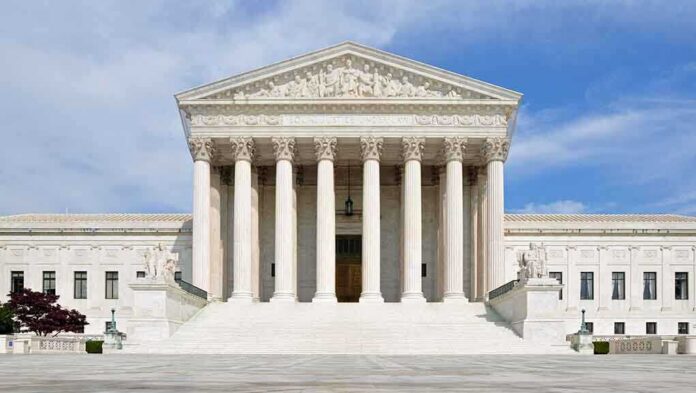
When a congressional leader says “dramatic Supreme Court reform is necessary,” the conversation is no longer about mood or messaging; it is about live options to reengineer the Court’s structure and authority, and the political calculus required to move any of them from slogan to statute.
The Short Version
- House Democratic Leader Hakeem Jeffries has explicitly called for “dramatic Supreme Court reform,” keeping major structural options on the table while declining to endorse court expansion outright.
- The reform menu spans a binding ethics code, 18-year term limits, docket and process changes, and—most controversially—changing the Court’s size.
- Republican leadership is united against these moves; House leaders have said any reform package is “dead on arrival,” and a GOP panel advanced an amendment to lock the Court at nine justices.
- Term limits command the broadest policy development and cross-ideological interest, though their constitutional pathway is contested.
What Jeffries actually said—and why it matters
Jeffries has moved past generic critiques of the Court and into structural territory. On stage at the National Association of Black Journalists and in subsequent interviews, he argued “dramatic Supreme Court reform is necessary,” pairing that claim with an assertion that multiple options should remain open. He has pointed to an enforceable judicial ethics code as a plausible starting point and has signaled support, across reporting, for 18-year term limits—while stopping short of endorsing expansion of the Court’s size. That distinction matters. “Court packing” is a political accelerant; ethics rules and tenure reform, by contrast, have longer institutional pedigrees and clearer pathways to partial bipartisan engagement. The center of gravity in his remarks is a structural reset, not a single maximalist tactic.
This is consistent with a durable American pattern: when the Court’s jurisprudence is perceived as out of step with electoral majorities or institutional expectations, reformers move from rhetoric to design—altering tenure, clarifying ethics constraints, and, occasionally, weighing expansion. The Jeffries posture slots squarely into that cycle.
The reform menu: mechanisms and feasibility
Ethics code. A binding code of conduct for justices—mirroring rules long applied to lower federal judges—aims to cabin conflicts of interest, enhance disclosure, and standardize recusal. Because Congress has historically legislated around the Court’s operations and financial disclosures, a well-crafted ethics statute is the lowest-friction reform technically and politically. Jeffries has framed this as an early step rather than an endpoint.
18-year term limits. This is the most developed structural proposal in contemporary scholarship and policy shops: a single, nonrenewable 18-year active term, with appointments scheduled at two-year intervals to regularize turnover and reduce vacancy lotteries. Leading analyses argue a statute could implement active-service limits while preserving Article III life tenure via senior status, keeping Justices on the federal bench but rotating them off the apex docket after 18 years. The model promises calmer confirmations, more predictable appointments, and fewer gerontocratic stakes. Its critics counter that any limit—statutory or otherwise—abridges the Constitution’s “good Behaviour” tenure guarantee and risks litigation and institutional crisis on day one.
Court size. Congress has changed the number of Justices multiple times in the Republic’s first century, and mainstream legal analysis recognizes congressional power to do so; the modern taboo is political, not textual. Even so, Jeffries has notably not endorsed expansion, only “keeping options on the table”. That rhetorical posture allows leverage in negotiations but avoids committing to the most polarizing lever in the toolkit.
The politics: immovable objects meet irresistible talk
Democrats face a stark arithmetic problem. House Republican leadership has already cast reform as retaliatory and promised to block it; Speaker-level opposition has framed any package as “dead on arrival”. In parallel, a Republican-led House panel advanced a constitutional amendment to cap the Court at nine Justices, a prophylactic against expansion that communicates resolve even if it never secures ratification. The immediate implication is clear: unless Democrats secure aligned control of the elected branches and are prepared to navigate Senate rules, sweeping reform will stall. That does not make the current push performative; it defines it as groundwork—agenda setting, coalition building, and policy maturation ahead of a possible window.
On the right, the counter-argument clusters around judicial independence and constitutional fidelity. Senator Mike Lee’s line is representative: term limits are framed as an abuse of power that would undercut Article III’s tenure protections and invite partisan cycling of the Court. A prominent libertarian critique goes further, casting term limits as disguised packing that violates the “good Behaviour” clause and risks a separation-of-powers rupture. Those objections will animate litigation and messaging against any statutory approach and ensure that, if enacted, term limits immediately meet a constitutional test.
Term limits: where the real debate lives
Set aside the heat around expansion and you find the workhorses of reform—18-year terms—where the legal engineering and empirical claims are thickest. Proponents argue a staggered, predictable appointment cadence lowers the stakes of any single vacancy, reduces incentives for strategic retirement, and aligns Court turnover more closely with democratic cycles, all while preserving life tenure via reassignment to senior service after 18 years. Skeptics reply that the “senior status” workaround is a distinction without a constitutional difference and that only a constitutional amendment can legitimately cabin active service on the Supreme Court.
Two consequences flow from this standoff. First, any statutory term-limits bill must be drafted to respect salary protection and continued judicial office, to maximize its chances in court. Second, durability requires public legitimacy: if the reform is seen as a partisan response to recent cases rather than a neutral modernization of 18th-century design, it will bleed support and invite reversal the next time power flips. That is why Jeffries’ coupling of ethics, tenure, and broader democratic-process reforms is strategic—bundling changes that can be defended as rule-of-law hygiene rather than case-law revenge.
Jeffries Signals Openness to Supreme Court Expansion, Citing 'Dramatic Reform'https://t.co/du7sX7hw3C
— The Liberty Tribune (@LibertyTribune_) August 18, 2026
What to watch: from signal to structure
The most telling indicator is not rhetoric about “packing” but the appearance of legislative text and coalition discipline. If Democrats introduce a comprehensive package—ethics enforcement with inspection authority, senior-status term limits with a clear transition plan, and process rules for emergency stays—you can treat the project as live. If, instead, activity concentrates around hearings and white papers while House resistance remains unified, expect incremental movement on disclosure and recusals alone. Jeffries has moved the party’s stance from ambient grievance to structural design; the next phase is whether he can translate that posture into a draft that survives scrutiny from constitutional scholars and the Senate’s rulekeepers.
The bottom line is not ambiguous. A top Democratic leader has declared the status quo untenable and invited a debate over the Court’s operating system. The most plausible near-term reforms are a binding ethics code and, if power aligns, a statutory term-limits regime crafted to withstand an inevitable constitutional challenge. Expansion sits in reserve—lawful under prevailing readings of congressional authority but politically volatile. Republicans, for their part, are preparing the institutional antibodies: categorical opposition now, and structural locks, if they can muster them, to foreclose change later. That is the shape of the fight.
Sources:
zerohedge.com, washingtonpost.com, redstate.com, constitutioncenter.org, breitbart.com, youtube.com, c-span.org