Presidential orders to lower the American flag to half-staff are not mere ceremony; they are one of the clearest ways a president signals who, and what, the nation is asked to collectively honor.
At a Glance
- President Donald Trump ordered American flags across federal properties to be flown at half-staff in honor of Senator Lindsey Graham after his death.
- The directive was announced by Trump himself on social media and echoed by multiple local and national news outlets.
- Flags at the White House and surrounding federal buildings were promptly lowered, visually reinforcing the national scope of the order.
- This action fits a broader pattern in Trump’s presidency of using flag-lowering proclamations to honor political allies and respond to high-profile deaths.
Trump’s Order and How It Was Communicated
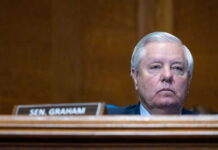
In the immediate aftermath of Senator Lindsey Graham’s death at age 71, President Donald Trump publicly directed that American flags be lowered to half-staff in Graham’s honor. The order was communicated in the way Trump increasingly favored for official and semi-official pronouncements: through his own social media accounts. Local reporting in Alabama, for instance, notes that “President Donald Trump took to social media Sunday to announce he is ordering all American flags lowered to half mast to honor Sen. Lindsey Graham.” That formulation—“all American flags”—tracks the language typically used when a president is invoking the full authority of his office to cover federal buildings, military installations, and U.S. missions abroad.
Trump’s Instagram reel reinforces that this was framed as a national tribute, not a symbolic gesture limited to the White House grounds. In that post, he speaks “in honor of the remarkable life and achievements of Senator Lindsey Graham,” and pairs personal praise with the announcement of the flag order. The pattern is familiar from other episodes in his presidency: an initial social media statement that blends eulogy and directive, followed by more formal documentation or confirmation through press channels.
Regional media across the country picked up the story quickly. An explainer from a Pennsylvania outlet opens with the straightforward line: “President Donald Trump ordered flags be lowered to half-staff nationwide to honor the late Sen. Lindsey Graham.” That “nationwide” language is significant; it reflects the understanding among news organizations that Trump’s directive applied to the usual scope of a presidential half-staff order—federal facilities and, by extension, state and local entities that choose to follow suit.
What the Order Looks Like on the Ground
One way to distinguish rhetoric from actual practice is to look at federal sites, especially the White House. Here, the visual evidence is unambiguous. Multiple video reports and wire services documented U.S. flags at the White House and its adjacent buildings being lowered to half-staff following Graham’s death. Reuters video, for example, shows the flags dropping to half-staff “to honor U.S. Republican Senator Lindsey Graham,” confirming that the symbolic center of federal power carried out the president’s directive.
Local television footage and social posts from outlets in South Carolina, Texas, and elsewhere show the same thing: flags at federal and many state facilities at half-staff, explicitly linked in captions and anchors’ narration to Trump’s order honoring Graham. In practice, when the White House and other federal sites make this change, state governors and local officials often follow with their own synchronizing proclamations, even if the legal obligation is limited to federal property. Coverage from Alabama notes this phenomenon explicitly in the context of explaining “why the American flag is at half-staff this week.” The effect, within a day of Trump’s announcement, is a country where, at least on public buildings, the lowered flag becomes widely visible.
This national visibility matters because Graham was not merely a home-state senator; he was, by longstanding reputation, a Republican stalwart and one of Trump’s closest political allies. The gesture therefore functions both as institutional homage to a senior senator and as a personal tribute from a president to a confidant.
The Legal and Traditional Framework Behind Half-Staff Orders
To understand the significance of Trump’s order for Lindsey Graham, it helps to situate it within the broader rules governing the flag. The U.S. Flag Code, as interpreted by agencies like the General Services Administration (GSA), lays out when and how the flag may be flown at half-staff. A broadcast segment that draws on GSA and congressional guidance explains that, as a general rule, the president may order the flag to half-staff upon the death of principal figures of the United States government and other notable individuals. Those orders typically specify duration and scope: White House, public buildings and grounds, military posts, naval stations, and U.S. missions abroad.
Trump has exercised this authority in other prominent cases. After the fatal shooting of conservative activist Charlie Kirk at a Turning Point USA event, Trump issued a formal presidential proclamation titled “Honoring the Memory of Charlie Kirk,” ordering that “the flag of the United States shall be flown at half-staff at the White House and upon all public buildings and grounds, at all military posts and naval stations…in the District of Columbia and throughout the United States and its Territories and possessions until sunset, September 14, 2025.” That proclamation further directed embassies and consular offices abroad to comply, illustrating the standard legal formula for such a nationwide observance.
In that earlier case, governors such as Gretchen Whitmer explicitly aligned their own state orders “in accordance with an order issued by President Donald Trump,” extending half-staff requirements to U.S. and state flags on Michigan property. The Graham order follows this established pattern, even if, at the time of initial reporting, the formal proclamation was less immediately prominent than Trump’s social media announcement.
Symbolic Politics: Whom the Nation Is Asked to Mourn
Presidential decisions about half-staff honors are not neutral; they are saturated with symbolic politics. Trump’s record illustrates this. In 2018, after the Capital Gazette newsroom shooting, he initially faced criticism for declining a request to lower flags, only later mandating that U.S. flags on federal grounds be displayed at half-staff in tribute to five slain journalists. The timing and manner of that reversal drew scrutiny and highlighted how quickly decisions about the flag become proxies for judgments about whose suffering merits national recognition.
By contrast, Trump moved swiftly in cases involving political allies and ideological fellow travelers. For Kirk, a conservative figure closely associated with Trumpist politics, the White House not only lowered its flags but promoted the proclamation with video content styled as a tribute. The Graham order sits squarely within this pattern. Graham had, over the course of Trump’s political rise, journeyed from vocal critic to ardent supporter, ultimately becoming one of the president’s most reliable defenders in the Senate. Lowering flags for Graham under the presidential imprimatur therefore communicates more than respect for a senator’s long tenure; it reinforces a narrative in which loyalty to Trump and alignment with his agenda are part of what earns the highest symbolic honors.
This does not mean the action was unusual in a procedural sense. Flags have been lowered for senators before; the practice is longstanding. But the combination of timing, the personalization of Trump’s social media announcement, and the broader context of his selective use of half-staff proclamations makes the Graham order a useful case study in how modern presidents intertwine institutional rituals with personal and partisan messaging.
Nationwide Scope and the Role of Media Amplification
One recurrent feature of Trump-era flag orders is the interplay between official text and media amplification. In the Kirk case, the proclamation is archived on the White House site, complete with legal language and the president’s signature. Media coverage then translated that formal document into plain-language headlines about Trump ordering flags nationwide to half-staff. For Graham, the early reporting leaned more heavily on Trump’s social media posts and on observable changes at federal sites; nevertheless, the language used—“Trump orders all American flags to be lowered to half mast” and “ordered flags be lowered to half-staff nationwide”—had the same effect of framing the order as comprehensive.
These structural incentives matter. As neutral-context analysis has pointed out, the side that controls the initial framing—often through rapid social media posting and friendly local coverage—shapes public understanding before formal documentation is widely scrutinized. For Trump and his supporters, confirming and amplifying the Graham order bolsters an image of a president who honors Republican figures and observes tradition. For critics, the move may be read against earlier episodes in which he was slower to honor journalists or other victims, but the basic factual claim—that he ordered flags lowered in Graham’s honor—is not contested in the reporting.
The consequence is a public narrative that solidifies quickly: Graham dies after a brief and sudden illness; Trump, as president, orders the flag lowered; the White House complies; local outlets explain to residents why they see half-staff flags. Whether or not citizens encounter the formal proclamation, the meaning of the gesture is clear.
How This Fits Into the Broader History of Flag Honors
Looking across episodes—from the Capital Gazette shooting to the Kirk and Graham tributes—a broader pattern emerges in how modern presidents navigate flag honors. The Flag Code and related guidance give them wide discretion; within that discretion, each administration builds its own unwritten hierarchy of whose deaths warrant nationwide observance. For Trump, the record shows strong responsiveness when the deceased is a prominent ally or conservative figure and more complex, sometimes delayed decisions when confronted with tragedies involving institutions or communities historically critical of him.
Senator Lindsey Graham occupies a distinctive place in that story. His long Senate career, hawkish foreign policy stance, and eventual full-throated support for Trump made him both a conventional subject for institutional mourning and a personal symbol of loyalty. Lowering the flag for him is entirely consistent with past practice for senior senators; pairing that act with a direct social media announcement and framing it as “all American flags” is characteristic of Trump’s broader effort to claim and personalize national rituals.
For readers trying to interpret such gestures, the key is to see them as operating on two levels at once. At the surface, they are respectful observances governed by established rules. Underneath, they are signals about who is counted among the nation’s honored dead, which tragedies and figures a president chooses to elevate, and how partisan narratives are woven into the fabric of shared symbols like the flag. The order for Lindsey Graham is, in that sense, both routine and revealing.
Sources:
facebook.com, youtube.com, fox43.com, instagram.com, wyff4.com, wsmv.com, foxcarolina.com, x.com, whitehouse.gov, apnews.com, pbs.org, foxnews.com, thehill.com, abc10.com