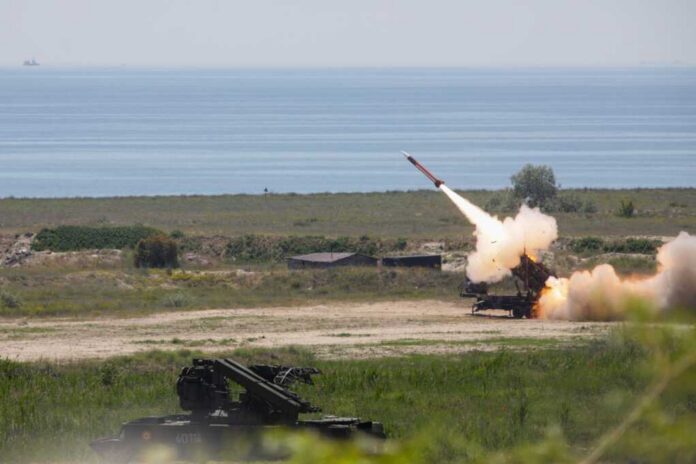
Iran’s missile barrage over Israel has become the latest reminder that the Middle East is still one miscalculated strike away from a wider war.
Quick Take
- Multiple live reports describe Iran firing missiles toward Israel, with Israeli officials saying interceptors responded in the sky.[1][3]
- Broadcast transcripts say the attack followed Israeli strikes in Beirut and southern Lebanon, which Iran framed as retaliation.[1][2][3]
- Several video descriptions mention both Iranian missiles and Israeli interceptors, making the night footage visually dramatic but not technically self-explanatory.[1][3]
- The available record supports the broader event, but it does not provide forensic authentication of each object visible in the clip.[1][2][3]
Iran’s Strike and Israel’s Response
Reuters-style live coverage and broadcast summaries in the record say Iran fired multiple waves of missiles toward Israel, and Israeli military spokesmen said their air defenses intercepted incoming fire.[1][3] The same reports place the launch inside a larger exchange that already included Israeli strikes on Iranian-linked targets in Lebanon and elsewhere, making the missile barrage part of an escalating regional confrontation rather than an isolated event.[1][2][3]
That broader context matters because the footage is being circulated as proof of a direct Iranian attack, but the transcripts show a more complicated visual picture. Descriptions repeatedly mention “missiles” and “interceptors” streaking through the night sky, which means the scene can include both the incoming projectiles and Israel’s defensive response at the same time.[1][3] For viewers, that distinction is critical: a bright trail in the sky is not always the weapon people think it is.
What the Footage Does and Does Not Prove
The supplied material supports the claim that Iranian missiles were aimed at Israel, but it stops short of proving every object in the clip through independent forensic means.[1][2][3] There is no frame-by-frame geolocation study, radar correlation, or raw-file chain of custody in the research package, so the circulating video remains a journalistic record of the event rather than a technical authentication of the imagery itself.[1][2][3]
That limitation matters in fast-moving conflict coverage, where live reporting often moves faster than verification. The transcripts and summaries are consistent with an Iranian missile attack, but they also show how quickly official statements, broadcaster narration, and social video can harden a narrative before the public can separate incoming missiles from defensive interceptors or debris.[1][3] In a region where information warfare moves alongside real warfare, that is a built-in weakness.
The Bigger Pattern in the Israel-Iran Conflict
The reporting fits a familiar pattern: attack, interception claim, retaliatory strike, then a race to define the story first.[1][2][3] Iranian state messaging in the supplied transcripts framed the launch as a response to Israeli operations in Beirut and southern Lebanon, while Israeli coverage presented the same event as hostile missile fire that had to be met with air defense and follow-on strikes.[1][2][3] Both sides had incentives to shape the narrative quickly.
#BREAKING Footage emerges showing a barrage of Iranian missiles cutting through the sky over Iran en route to Israel. The massive escalation is now visibly underway.#IranWar #IsraelUnderAttack #MiddleEastCrisis pic.twitter.com/XfN5BwDlY2
— Ayesha Ufaq (@Ufaq_RM) June 8, 2026
For readers, the key takeaway is not that the event is uncertain, but that the visual evidence needs to be handled with care. The available reporting is strong enough to support the conclusion that Iran launched missiles toward Israel, yet it is not strong enough to prove the exact identity of every streak shown in the footage.[1][3] In a conflict this dangerous, precision matters as much as intensity.
Sources:
[1] YouTube – Iranian missiles aimed at Israel seen over Middle Eastern sky
[2] Web – IRGC says Israel used air-launched ballistic missiles on targets in …
[3] Web – Trump tells Axios he will ask Netanyahu not to strike back at Iran