

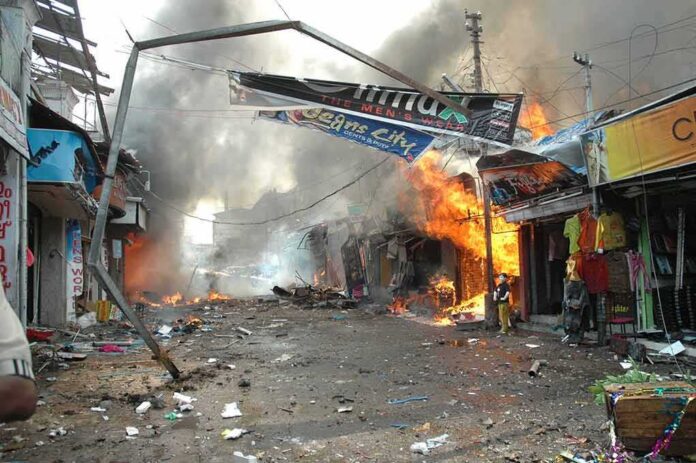
When mass protest erupts in France, a small but determined fringe often turns grievance into destruction; the latest wave followed that pattern with unmistakable clarity, as peaceful marches gave way in multiple cities to looting, arson, and assaults on public buildings, culminating in a historic town hall largely lost to fire.
At a Glance
- Nationwide demonstrations were accompanied by organized vandalism, looting, and arson in multiple cities.
- Authorities made more than a thousand arrests in a single day; total arrests across the unrest climbed into the thousands, underscoring the scale of disorder.
- Limoges’s 143-year-old town hall suffered catastrophic fire damage; officials described a premeditated attempt to burn it down.
- The violence was geographically broad, not confined to Paris; reports catalogued damage in provincial cities as well.
What happened: protest and riot, side by side
Across France, large demonstrations over living costs, schools, and public services were punctuated by hours of street combat: masked groups clashed with police, shops were ransacked, and government buildings were attacked. The Interior Ministry’s public descriptions were blunt—confrontations with law enforcement, looting or attempted looting, and damage to public institutions—while independent reporting detailed buildings set alight and widespread vandalism across several cities. This was not a single flashpoint contained to the capital. Coverage from national and international outlets tracked similar patterns in provincial centers, where public buildings and storefronts became targets during the evening hours when peaceful crowds thinned and more aggressive factions took over.
Arrest figures help sketch the scale of the breakdown. On an estimated 550,000-person protest day, authorities made at least 1,200 arrests—an extraordinary tally for a single democratic country on a single day of mobilization. Subsequent counts compiled by German public media placed total arrests across the broader wave near 2,400, explicitly linked by officials to rioting, looting, and arson. Arrest is not conviction, but these numbers are consistent with police facing sustained, organized property crime and violence at the margins of mass protest.
A symbolic loss: Limoges’s town hall in flames
Among the most striking incidents was the destruction of Limoges’s 143-year-old town hall, a civic landmark whose roof collapsed after a fire that officials called deliberate. The city’s mayor described a premeditated attempt to burn the building down; people inside feared for their lives as the blaze spread. A regional prefect later said the structure was “largely lost,” with two-thirds of its exterior gone—language rarely used for municipal properties outside of wartime. The image is familiar in French political memory: a seat of local democracy blackened and hollowed out, not by abstract forces but by fire set in the midst of a protest that began on unrelated economic and social grievances.
Limoges was not an outlier in a Paris-centric story. Reports catalogued damage, clashes, and opportunistic looting in multiple cities; the through-line was the same choreography France has seen before, where late-day “cortèges de tête”—the hard front of a march—peel off into black bloc tactics while calmer demonstrators disperse. When a prefecture, city hall, or school becomes a target, the political symbolism is direct: a statement against institutions themselves rather than a mere outburst against policing.
France’s protest repertoire: why violence recurs at the margins
To understand why this keeps happening, set the episode alongside France’s modern repertoire of contention. The Yellow Vests of 2018–19 were among the most violent protest cycles since 1968, despite lacking centralized leadership and drawing in many participants who never broke a window. That combination—broad, decentralized mobilization with a militant edge—is a recurring French pattern. Scholars analyzing the Yellow Vests stress two simultaneous truths: crowds were vast and heterogeneous, and a minority embraced tactics—arson, property destruction, assault—designed to force salience through disruption. A policing researcher has even compared the present wave’s reported damage to the opening weekends of December 2018, an apt benchmark for severity.
The mechanism is painfully familiar. Large marches, often well-permitted and orderly in daylight, mix students, unions, local residents, and political factions. As evening approaches, smaller, masked groups bend the agenda toward confrontation. Urban terrain—with narrow streets, dense retail corridors, and symbolic targets within walking distance—offers opportunities for rapid property damage. Police tactics oscillate between containment and dispersal; each has tradeoffs, and both can leave blocks unprotected long enough for opportunistic looting to cascade. When a historic building burns, the nation sees in it not only a crime scene but a metaphor for frayed civic bonds.
Competing claims versus established facts
Officials and pundits will argue over who exactly instigated the worst violence—far-left factions, criminal opportunists, or unaffiliated militants. Those political attributions are predictable, and prosecutions may eventually establish specific actors. What is already established is narrower and more important for understanding the episode: violence and property destruction occurred widely alongside otherwise peaceful demonstrations; police documented thousands of arrests; and at least one historic municipal building was devastated by an apparently deliberate fire. That is the factual spine. Broader claims about foreign direction or movement-wide culpability are assertions awaiting courtroom-grade proof, not the basis of present judgment.
Scale also matters for interpretation. The BBC’s estimate of 550,000 protesters on a single day coexisted with at least 1,200 arrests that same day, a numerical contrast that can mislead in either direction if used simplistically: it is wrong to portray the entire movement as violent, and equally wrong to minimize the severity of hundreds of distinct crimes folded into a protest calendar. Responsible analysis keeps both truths in view.
Implications for policing, politics, and civic trust
Episodes like this shift the center of gravity in three domains. First, policing: law enforcement faces the hard problem of protecting the right to protest while preventing targeted arson and looting. Tactically, that means better intelligence on black bloc formations, quicker hardening of symbolic sites, and post-event investigative depth capable of turning arrests into successful prosecutions where evidence supports it. The arrest totals suggest operational success at the point of contact; the ultimate test is case outcomes and deterrence.
Second, politics: attacks on town halls and prefectures tend to strengthen demands for order across the political spectrum, even among citizens sympathetic to the underlying grievances. Leaders who condemn violence clearly and pursue accountability usually gain room to negotiate policy reforms with nonviolent organizers. Those who blur the line—or minimize the damage—find public patience evaporates quickly when storefronts are boarded up and municipal landmarks smolder.
What to watch next
Two follow-ons determine whether this wave becomes a contained spasm or a protracted crisis. One is judicial: the distribution of charges—arson, aggravated theft, assault on officials—along with conviction rates, will show whether the state built prosecutable cases or merely cleared streets. The other is administrative: a credible accounting of public and private damages, from municipal repair contracts to insurer payouts, will anchor the financial and political costs in something firmer than anecdote. France has seen this movie before; the country’s institutions know the work required to close the loop between protest, riot, and restoration.
Sources:
reason.com, dw.com, bbc.co.uk, cnbc.com, france24.com