Sick baby ants emit a chemical “kill me” signal to sacrifice themselves, mirroring the selfless patriotism conservatives champion to protect family and nation from invasive threats.
Story Highlights
- Infected worker pupae of invasive ant species Lasius neglectus proactively signal for destruction only when adult workers are present, preventing colony-wide fungal outbreaks.
- Adult ants perform “destructive disinfection” by ripping open cocoons, puncturing pupae, and spraying formic acid to eliminate both the sick pupae and pathogen Metarhizium brunneum.
- This first-of-its-kind altruistic disease signaling protects the queen and colony reproduction, akin to cellular sacrifice in multicellular organisms.
- Queen pupae emit no such signals due to superior immunity, prioritizing reproductive success much like strong family leadership preserves future generations.
- Study from Institute of Science and Technology Austria reveals colonies as superorganisms where individual sacrifice upholds the greater good.
Breakthrough Discovery in Ant Social Immunity
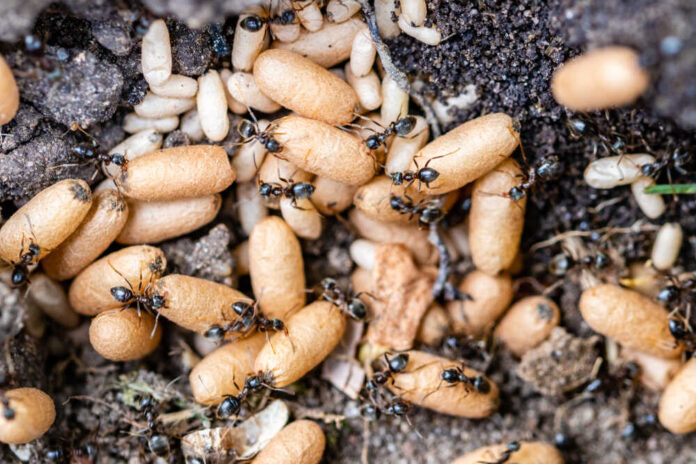
Researchers at the Institute of Science and Technology Austria published findings on December 2, 2025, in Nature Communications. Infected worker pupae of Lasius neglectus, an invasive black garden ant, release modified cuticular hydrocarbons (CHCs) as a distress signal. This emission occurs conditionally, only when adult worker ants approach. Pupae isolated alone produce no signal, demonstrating deliberate, context-aware altruism. Workers respond by prying open silk cocoons, puncturing the pupae’s cuticle, and dousing them with formic acid. This kills the pupae and the fungal pathogen Metarhizium brunneum, halting infection spread in high-density nests.
Mechanism of Altruistic Sacrifice
Experiments confirmed the signal’s proactivity. Healthy pupae coated with extracts from infected ones triggered identical worker destruction, proving the chemical cue drives the response. Infected pupae upregulate immune genes and alter CHCs on their surface only in workers’ presence. These non-volatile compounds avoid alerting distant ants, ensuring targeted action. Unlike mobile adults who self-isolate or exit nests, immobile pupae trapped in cocoons rely on this ultimate sacrifice. The behavior prevents pathogen proliferation, safeguarding the colony’s sterile workforce and vital reproductive core.
Superorganism Dynamics and Queen Protection
Ant colonies function as superorganisms, with individuals acting like cells in a body. Sterile worker pupae forfeit their lives to protect the queen, whose reproduction sustains the colony—echoing how families prioritize children’s future over individual comfort. Queen pupae, possessing stronger immunity, emit no signals and escape destruction. Sylvia Cremer, lead researcher heading ISTA’s Social Immunity group, states colonies coordinate immunity like multicellular organisms. This parallels cellular apoptosis, where doomed cells signal for removal to preserve the whole.
Erika Dawson, first author and former ISTA postdoc now at Sorbonne University, notes the signals boost inclusive fitness by enabling gene propagation through siblings. Thomas Schmitt from University of Würzburg analyzed the precise, surface-bound CHCs. Experts like Mark Bulmer of Towson University affirm pupae proactively signal their end, not as a byproduct. Erik Frank highlights workers as sterile cells sacrificing for the queen’s lineage, contrasting human individualism with eusocial unity.
Sick baby Lasius neglectus ants emit chemical distress signals only when workers are nearby and able to eliminate them.https://t.co/wrun9ayVfy
— Science News (@ScienceNews) January 5, 2026
Implications for Science and Nature’s Lessons
Prior studies by Cremer’s team identified CHC detection and formic acid disinfection, but this 2025 work unveils conditional signaling as the first in social insects. Lasius neglectus forms dense, invasive nests prone to rapid disease spread, amplifying the need for such defenses. Findings validate social immunity models and suggest applications in human disease signaling or agriculture, potentially cutting pesticide use through bio-inspired controls. Open questions remain on signaling at low infection levels, with Cremer planning further tests. Limited direct economic impacts emerge, though biotech parallels advance antimicrobial research.
Sources:
Sick baby ants sacrifice themselves to save their colony (Popular Science)
These sick baby ants sacrifice themselves to protect their colony (Science News)
Sick, Immobile Young Ants Send ‘Kill Me’ Signal to Colony Workers (The Scientist)
Sick ants invite self-sacrifice to save colony (ScienceDaily)
Baby Ants Beg For Death When They’re Sick, Study Finds (VICE)