

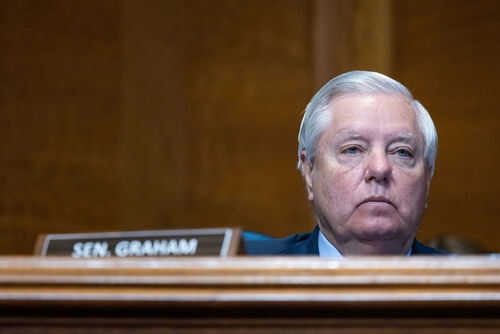
When a high-profile politician dies suddenly, the real story is rarely in the pathology alone; it is in how a vacuum of detail invites speculation, and how evidence closes that space back down.
Key Points
- Senator Lindsey Graham died at 71 after what his office called a “brief and sudden illness,” later identified by the D.C. medical examiner as an aortic dissection caused by longstanding cardiovascular disease.
- Despite Graham’s adversarial stance toward Iran and Russia and openly hostile reactions from Iranian media, there is no credible evidence tying foreign actors to his death.
- FBI or federal assassination investigations have not been announced; emergency responders and medical findings instead describe a rapid cardiac emergency consistent with natural causes.
- The poisoning narrative rests entirely on circumstantial timing and partisan outlets, illustrating a broader pattern in U.S. conspiracy culture around sudden political deaths.
- Understanding how such theories arise—and how official evidence is eventually communicated—is now part of reading any major political death in the United States.
What We Actually Know About Graham’s Death
The evidentiary baseline is straightforward. Graham’s office announced that the senator died on the evening of July 11, 2026, at age 71, from a “brief and sudden illness,” and requested privacy for his family. Multiple major outlets echoed this language in early coverage, noting the lack of detail but not suggesting foul play. At that point, the public record contained a sharp fact—he was dead—and a large gray zone about why.
Within days, that gray zone narrowed. Emergency medical radio traffic and subsequent reporting described responders being dispatched to Graham’s Capitol Hill residence for chest pain, followed by cardiac arrest and attempts at resuscitation before transport to George Washington University Hospital. Preliminary findings from the D.C. medical examiner, released on July 12, attributed his death to an aortic dissection caused by arteriosclerotic cardiovascular disease—a catastrophic tear in the main artery leaving the heart, strongly associated with long-standing vascular disease. Fox News and local outlets relayed that finding, with Graham’s office confirming the medical examiner’s account.
Aortic dissection is both dramatic and natural. It can present as sudden, severe chest pain in a person who appeared outwardly well hours or days earlier; it is the same mechanism that killed actor John Ritter and, more famously, former Stanford football coach Bill Walsh. Clinically, Graham’s trajectory—no public indication of illness, abrupt chest pain, cardiac arrest, rapid death despite emergency care—is not unusual for this kind of event. It is exactly the sort of “brief and sudden illness” laypeople describe in hindsight.
Graham’s Foreign Policy Profile and Why It Fed Speculation
Graham’s political profile made the vacuum of medical detail ripe for darker interpretations. For decades, he was one of the Senate’s most reliable national security hawks, part of the “Three Amigos” with John McCain and Joe Lieberman, pushing aggressive U.S. action in Iraq and beyond. He was a lifelong critic of the Kremlin, describing Vladimir Putin as a “thug” and backing strong measures against Russian aggression.
On Iran, he was even more outspoken. Graham advocated for military strikes, backed stringent sanctions, and consistently aligned with Israeli security concerns. In the months before his death, he had again been visibly engaged abroad—meeting Ukraine’s President Zelenskyy in Kyiv, touring defense facilities, and arguing in public that American military and financial support to Ukraine was “the best money we’ve ever spent” as Russians “are dying.” That posture drew sharp public criticism from senior Russian figures and made him a symbol, in some foreign media, of American interventionism.
Against that backdrop, it is unsurprising that Graham’s sudden death triggered immediate speculation online: a high-value, hawkish U.S. senator opposed by Iran and Russia dies abruptly after foreign travel, with no stated cause. The narrative architecture for “assassination by poisoning” was already built; it needed only an event to inhabit it.
Hostile Foreign Rhetoric Versus Evidence of Action
One strand fueling suspicion was the tone of reaction from Tehran-linked outlets. Social and fringe media amplified clips and translations of Iranian state media personalities who appeared to celebrate Graham’s death, describing him as “malicious,” “sent to hell,” or worse. Such rhetoric is real and ugly, and it underscores how deeply Graham’s hawkishness had penetrated foreign political consciousness.
But hostile words are not operational proof. To date, no Iranian or Russian official, intelligence leak, or forensic record has connected any foreign actor to the mechanism of Graham’s death. The core poisoning claim rests on three pillars: his adversarial foreign policy stance, the timing after overseas travel, and inflammatory foreign commentary. None of those, alone or together, outweigh a medical examiner’s autopsy grounded in cardiovascular pathology.
The most substantive on-record response to conspiracy chatter comes from reports summarizing the D.C. medical examiner’s preliminary autopsy: an arterial tear likely caused by years of heart disease, with toxicology pending but no evidence presented of exogenous poisons. Commentary in those same segments explicitly pushed back on social media theories, pointing out that heart disease kills hundreds of thousands of Americans annually and that a 71-year-old with known cardiovascular risk factors fits that base rate far better than an exotic assassination scenario.
Was the FBI Investigating? What Institutional Silence Really Signals
The query at the center of this discussion—whether the FBI was investigating Lindsey Graham’s “sudden death”—captures a broader public expectation: that any unexpected death of a political figure should trigger visible federal scrutiny. In practice, the threshold is narrower. When an apparent natural cause is supported by autopsy and there are no specific indicators of foul play—no toxin signatures, no credible threats tied to timing, no classified intelligence pointing to covert operations—federal agencies typically do not announce full assassination inquiries.
Across mainstream coverage and official statements, there has been no indication that the FBI, the Senate Intelligence Committee, or the White House launched or publicly acknowledged a poisoning or assassination investigation into Graham’s death. That silence is consistent with, rather than suspicious of, the medical narrative: the death was treated as a medical emergency, investigated by local authorities and medical examiners, and explained by cardiovascular disease. Absent contrary evidence, federal law enforcement has nothing to “investigate” in the conspiratorial sense.
For those predisposed to skepticism of institutions, that very silence can look like proof of a cover-up. But from an evidentiary standpoint, it is neutral: it neither proves nor disproves anything beyond the fact that authorities did not see grounds to elevate the case into the realm of national security homicide. Without leaked memos, opened case numbers, or whistleblower accounts, “the FBI is investigating” remains an assertion unsupported by the public record.
How Conspiracy Theories Attach to Sudden Political Deaths
The way speculation surged around Graham’s death reflects a pattern political scientists and psychologists have been mapping for years. Conspiracy theories cluster around highly salient events—assassinations, pandemics, mass shootings—especially when those events intersect with contested political identities and there is, initially, a perceived information gap.
Studies of “medical conspiracy theories” and political conspiracism in the United States show the same basic dynamics: people reach for intentional, malevolent explanations when the official story feels incomplete or unsatisfying, or when it implicates systems they already distrust. Sudden deaths are a prime target. NBC Washington, for example, documented how the ambiguous deaths or disappearances of a handful of U.S. scientists quickly spawned elaborate foreign-assassination narratives online, despite no evidence beyond timing and job description.
Social platforms and partisan outlets amplify these narratives. An initial, speculative claim—“Graham was poisoned by Iran”—gets repeated, elaborated, and fused with unrelated facts: his prior hawkish quotes, images of him in Kyiv, Iranian commentators gloating, any past dispute with the FBI. Each repetition increases familiarity, which cognitive research shows can make a claim feel truer regardless of its evidentiary content.
Mainstream media’s uniform framing of Graham’s death as a “brief and sudden illness” is taken, by some, as proof of coordination rather than simply shared dependence on the same official statement and medical examiner findings. Content moderation policies that flag unsourced assassination claims as misinformation are then interpreted as censorship, feeding a perception that “they don’t want you to know” rather than a straightforward attempt to keep speculation from masquerading as fact.
Evidence Thresholds: Autopsy Versus Suspicion
In a case like Graham’s, the key question isn’t whether poisoning is logically possible; almost anything is. It is whether any evidence meets the threshold to seriously challenge the autopsy explanation. On that score, the record is lopsided.
On one side are named institutions and physical examinations: emergency calls for chest pain and cardiac arrest, the medical examiner’s identification of aortic dissection and arteriosclerotic disease, statements from his office and colleagues that align with that account. On the other side are circumstantial factors and motivated inference: his enemies abroad, their celebratory rhetoric, his age and political profile, and an initial lack of transparent medical detail.
Absent toxicology pointing to a specific agent, chain-of-custody data linking that agent to foreign operatives, or whistleblower testimony describing an operation, the assassination claim remains speculative. It is not “disproven”—science rarely works in absolutes—but it is unsupported. Responsible assessment weights these sides accordingly: Graham died of a catastrophic cardiovascular event; stories about poisoning by Iran or Russia belong in the realm of conjecture, not fact.
Why This Case Matters Beyond One Senator
For readers who follow politics closely, the Graham episode is less about the man than about the information environment surrounding sudden political deaths. It shows how quickly an ambiguous event can be weaponized into a narrative of foreign malice or domestic cover-up, and how slowly formal evidence—autopsy results, toxicology, official investigations—often moves by comparison.
It also illustrates a deeper tension in contemporary American politics. Graham himself spent years both building and critiquing the national security state: voting for surveillance powers after 9/11, defending NSA bulk collection, then later complaining when those tools were turned on his own communications. He called for special counsels to investigate the FBI’s handling of Trump-related probes, while civil rights organizations urged Congress to investigate his efforts to influence ballot-counting in Georgia. In life, he was at the center of debates about institutional trust and overreach; in death, he became a vessel for similar anxieties.
Understanding that context doesn’t resolve every question, but it sharpens the key one: are we going to let evidence lead, or let suspicion fill the gaps? In Lindsey Graham’s case, the evidence now clearly points to natural cardiovascular causes. The FBI may well have reviewed the circumstances as part of routine coordination with local authorities, but there is no public basis for saying they are “investigating” his death as a crime, let alone as foreign assassination. Recognizing that boundary—between what is documented and what is imagined—is essential if we want to navigate future sudden political deaths with more light than heat.
Adding to the rhetoric from Tehran, an Iranian state media newsreader appeared to insinuate Tehran's involvement in Graham's death, declaring: "I congratulate the Iranian nation on warmongering anti-Iran US Senator Lindsey Graham being sent to hell."https://t.co/fYD0xr8P5e
— Himalaya Times In English (@Hita_english) July 13, 2026
Sources:
thegatewaypundit.com, npr.org, apnews.com, facebook.com, instagram.com, pbs.org, youtube.com, en.wikipedia.org, wjcl.com, foxcarolina.com, wyff4.com