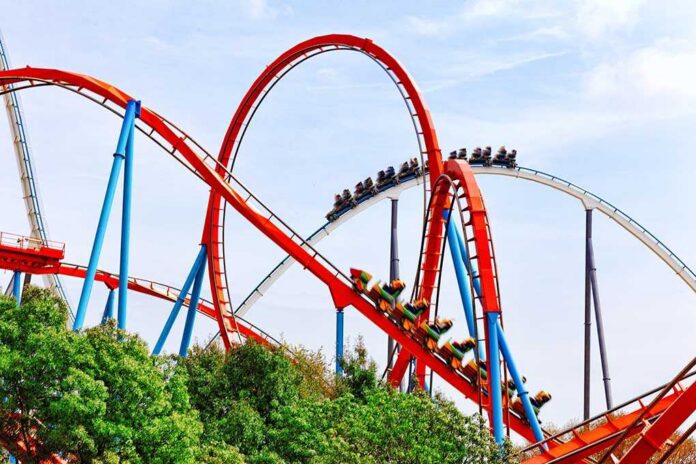
The image is the kind that spreads itself: passengers strapped into a coaster car, inverted, dangling above a boardwalk crowd while the ride sits frozen mid-cycle. What matters more than the shock of that footage is what almost never makes it into the caption — that amusement rides are engineered specifically to fail this way, stopped and held rather than allowed to run uncontrolled, and that the gap between a terrifying freeze-frame and a documented mechanical failure is usually wider than the video suggests.
Key Points
- Modern amusement rides are built with fail-safe braking and lock-in-place systems designed to stop a ride mid-cycle rather than let it continue moving after a fault — inversion during a stoppage is often the system working as intended, not a structural collapse.
- Playland’s Castaway Cove in Ocean City, New Jersey — the park associated with this viral clip’s backstory of prior incidents — has a documented history of ride stoppages, including a 2018 power outage and a 2019 incident in which water-filled test dummies were ejected from the GaleForce coaster.
- In each prior case, park management publicly attributed the event to a specific, correctable cause and reported no injuries, a pattern regulators and reporters have been able to verify only partially through independent findings.
- No incident-specific inspection report, fire-marshal log, or regulatory finding for the exact upside-down stoppage described in the video appears in the public record reviewed here, which means the precise duration and mechanism remain the park’s account until an independent document surfaces.
- The recurring risk in these stories isn’t necessarily mechanical — it’s informational: video travels faster than verification, and by the time an inspection report exists, the clip has already set the narrative.
How a Ride Actually Fails — and Why “Stuck” Isn’t “Broken”
Every modern roller coaster and thrill ride operates under a programmable logic controller wired to a battery of sensors — position encoders, proximity switches, brake-pressure gauges — that continuously check whether the ride is behaving within tolerance. The moment a reading falls outside spec, whether from a power dip, a sensor glitch, or an actual mechanical anomaly, the controller’s default response is to halt the train and engage redundant braking, not to let it keep moving. That’s precisely the pattern Ocean City has seen before: in one 2018 incident at Castaway Cove, a brief power outage caused several rides to stop mid-cycle, stranding riders until crews could manually work them free, with no injuries reported.
Inversion during a stoppage, then, is frequently a byproduct of where a train happens to sit on the track when the safety system trips — not evidence that a restraint failed or that the ride nearly crashed. Riders held upside down for minutes feel every second of it, and that fear is real and worth taking seriously. But the engineering purpose of that pause is to prevent the worse outcome: an out-of-control train continuing to move with a fault present. Distinguishing a controlled safety stop from a genuine structural failure requires exactly what most viral clips don’t include — the maintenance log, the fault code, and the time-stamped sequence of what the controller actually registered.
Castaway Cove’s Track Record: A Park With a Pattern Worth Understanding
Playland’s Castaway Cove is not a park with a spotless history, and that context matters for reading any new incident there fairly. In April 2019, two water-filled test dummies on the GaleForce coaster were thrown from a train and landed on a nearby hotel roof during what the park described as a routine safety check; NBC Philadelphia reported the park’s explanation that the dummies had developed undetected leaks, lost shape, and were ejected — and that the ride “remains in operation” afterward, with no injuries reported. Vice President Brian Hartley told reporters at the time that “nothing failed on the ride at all,” attributing the failure entirely to the dummies rather than the coaster’s mechanism.
That same coaster had already drawn scrutiny for a bumpy track that the park replaced after riders and staff complained, with Hartley insisting at the time that “there was never a safety issue to the customer.” Two years later, a four-alarm fire tore through the park’s arcade and Dairy Queen building; city officials eventually determined, after a multi-agency investigation, that the blaze was accidental, stemming from an undetermined electrical source, and the park reopened with its ride roster intact. Taken together, this is a park that has weathered outages, mechanical embarrassments, and a serious fire, and has consistently returned to the public with the same message: the specific cause has been identified, it’s been corrected, and no one was hurt.
The Case for Taking the Park’s Explanations Seriously — and Where That Case Runs Thin
There’s a reasonable argument that Castaway Cove’s public messaging deserves a measure of trust precisely because it has been consistent and, where checkable, borne out. The dummy ejection was independently corroborated by multiple outlets describing the same leak-and-shrink mechanism, and no injury claims emerged from that event or the 2018 outage to contradict the park’s account. A park that repeatedly says “no one was hurt” and turns out to be right builds a credibility record, however informal. Regulatory bodies for amusement rides — state inspectors, insurance auditors — also tend to keep parks that have serious unresolved safety defects from reopening rides quickly, and GaleForce’s swift return to service after 2019 is at least consistent with an inspector having cleared it.
The case runs thin, though, at the exact point where most viral incidents live: the specific event itself. Nothing in the public record — not a fire-marshal log, not a ride-controller fault printout, not a named eyewitness affidavit — documents the precise duration or mechanism of a rider-inversion stoppage beyond the park’s own framing. That’s not evidence the park is wrong; it’s simply evidence that verification hasn’t caught up to circulation. The 2021 fire investigation offers a useful analogy: NJ1015 reported that as of the day after the blaze, “no possible cause had been determined… as the investigation was active and underway,” and only weeks later did a multi-agency conclusion arrive. The lesson isn’t distrust — it’s patience, paired with a healthy skepticism toward any account, official or viral, that outruns its own documentation.
What This Pattern Means for Riders, Parents, and Anyone Watching the Next Clip
The durable lesson from Castaway Cove’s incident history isn’t about one park’s safety culture; it’s about the mismatch between how fast a phone camera travels and how slow a real inspection moves. A ride stoppage — even one that leaves passengers dangling — is engineered to be recoverable, and the overwhelming majority of these events end exactly the way Ocean City’s have ended before: no injuries, a specific mechanical or procedural cause identified, and the ride back in service within days. That track record earns the park a presumption of competence, not a blank check. Readers encountering the next terrifying thirty-second clip should ask the same three questions every time: what does the operator’s own fault log say, has an independent inspector weighed in, and how long did it actually take to resolve — because those three answers, far more than the freeze-frame, determine whether an incident was frightening or dangerous.
Sources:
facebook.com, en.wikipedia.org, nbcphiladelphia.com, inquirer.com, youtube.com