

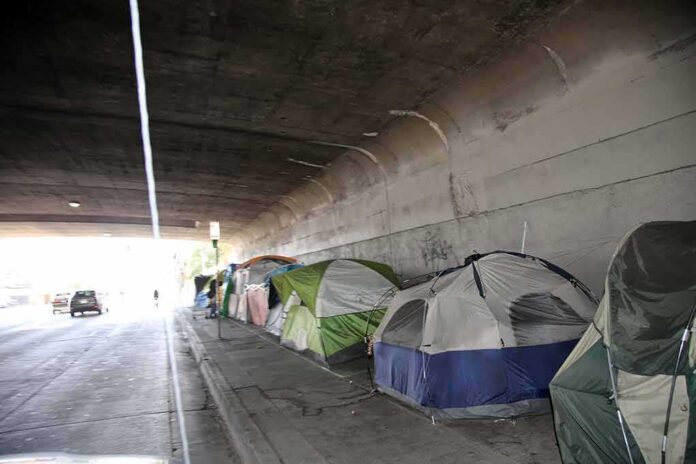
When cities clear large encampments, they are no longer just moving tents; they are executing coordinated public-safety operations that braid policing, sanitation, transportation access, and, increasingly, animal-welfare enforcement—raising hard questions about what counts as protection versus displacement, and for whom.
At a Glance
- Los Angeles authorities cleared a sprawling Sun Valley–Arleta freeway encampment, reporting more than two dozen arrests and the rescue of multiple animals, including dogs, cats, and poultry.
- Officials framed the action as necessary to enforce the law and address public-safety and animal-welfare violations; advocates argue conditions demanded intervention earlier and that some abuse allegations remain unverified.
- The operation reflects a statewide shift after the 2024 Supreme Court ruling in Grants Pass, with California’s SAFE Task Force and local Inside Safe–style efforts enabling faster, coordinated removals linked to services.
- Encampment policy now hinges on execution details: lawful process, meaningful placements, pet accommodation, and measurable outcomes that reduce harm rather than merely relocate it.
What Authorities Did—and Why It Matters
Los Angeles officials moved on the Sun Valley–Arleta encampment beneath a freeway with a multi-agency team that included LAPD and Animal Services. A city councilmember publicly reported that more than 25 people were arrested during the operation, and that animals on site included dogs, cats, and chickens; TV coverage documented animal rescues consistent with those claims. The stated rationale blended three imperatives: enforce laws against illegal activity within the encampment footprint, restore safe access to transportation infrastructure, and address alleged animal abuse and unlawful breeding. Framed that way, the clearance fits a template that has become common across California: public-safety action paired—at least on paper—with outreach, services, and cleanup.
Advocates, for their part, had pressured the city to intervene, citing unsanitary conditions and reports of puppy breeding and sales at the site in the days before the sweep. Some of these allegations remained publicly unverified even as advocates insisted the situation was inhumane and deteriorating. Their critique was as much about timing and follow-through as it was about cause: they argue the city came late and initially under-resourced the animal-welfare piece, which allowed problems to harden into crisis.
How Encampment Clearances Work Now: From Ad Hoc to Orchestrated
To understand this operation, set it against the post–Grants Pass landscape. The Supreme Court’s 2024 decision in City of Grants Pass v. Johnson allowed governments to enforce anti-camping rules even when shelter is unavailable, removing a federal constitutional barrier that had constrained Western cities for years. In California, that ruling catalyzed a more assertive approach: the state launched the SAFE Task Force to coordinate removals on state and local land while pledging to connect people to interim shelter, behavioral health care, and housing navigation. Los Angeles County has, in parallel, built programs under its encampment “resolution” architecture—Pathway Home and Inside Safe–adjacent efforts—that script outreach, offer placements, and time sanitation and enforcement for when beds exist or pathways can be offered.
Coordination matters because freeways and their underpasses are multi-jurisdictional spaces. Caltrans controls the right-of-way; cities handle policing, sanitation, and, often, outreach; counties fund services and healthcare. Without an integrated playbook, cleanups give way to whack-a-mole. With it, agencies can sequence steps—notice, outreach, storage of belongings, animal services interventions, then closure. Done well, this lowers risk during the operation and reduces quick returns. Done poorly, it simply pushes human and animal suffering to the next block.
Animal Welfare at Encampments: Real Risk, Real Nuance
Animal-welfare allegations inject urgency—and complexity. Advocates flagged puppies, parvovirus risk, and unsterilized breeding; media coverage treated puppy-sales allegations and disease reports as unverified but plausible, given the conditions. In real-world practice, animal control officers face two competing truths. First, neglect and opportunistic breeding can flourish where sanitation, money, and veterinary access are thin. Second, a robust evidence base shows that many unhoused owners provide attentive care and strong bonds that benefit both the person and animal; studies have found dogs with homeless caretakers can be physically healthy, with behavioral profiles comparable to housed peers, aside from separation-related stress.
Policy that ignores either truth fails. A credible encampment response equips the field team with veterinary triage, vaccination and deworming supplies, low-barrier spay/neuter offers, and temporary foster pathways for animals whose owners accept hospital care or interim housing that cannot yet accommodate pets. It also treats unverified sales allegations carefully: investigate, cite or charge where warranted, and avoid conflating all pet ownership in encampments with abuse. The reported Sun Valley–Arleta rescues, including poultry, underscore why animal services must be at the table from day one, not as an afterthought.
Where the Disagreements Actually Are
There is little dispute that arrests occurred and animals were removed; those are the concrete outcomes city officials and television crews described. The serious contention lies elsewhere. Advocates argue municipal response lagged even after warnings, and that the first on-scene animal-services contacts were too credulous or underpowered to curb suspected breeding and sales. They also stress that unsanitary conditions did not equate to universal abuse by individual pet owners, and that some of the most explosive claims—organized puppy sales, parvo-related deaths—had not been independently verified in the public record at the time they spoke.
Those positions do not refute the operation’s core facts; they challenge the system’s pacing, thresholds for action, and evidentiary standards used to escalate from outreach to clearance. This is the fulcrum of modern encampment policy: the move from voluntary engagement to coercive resolution, and whether the latter is triggered too late (allowing harm to grow) or too early (sweeping in people who could have stabilized with less disruptive help).
"A sprawling homeless encampment beneath a Los Angeles freeway became the target of a major crackdown this week, with more than 25 people arrested and dogs, cats and chickens rescued after furious animal advocates exposed the troubled area."https://t.co/UwmABFhrOa
— bluoz (@auweia1) October 30, 2026
Execution Determines Outcomes: Beds, Belongings, and Pets
Clearance quality is not judged by arrest counts; it is judged by what happens to people and animals 30, 60, and 180 days later. Three operational details drive that arc. First, placements: jurisdictions that pair closures with real bed inventory and treatment access see better retention; Los Angeles’ emergency shelter standards and county programs are designed to widen that inventory, albeit unevenly. Second, property handling: lawful notice, storage, and retrieval procedures reduce legal exposure and trauma. Third, pet accommodation: contrary to old assumptions, a substantial share of shelters do allow pets or service animals, and expanding that capacity is one of the simplest ways to prevent refusals of otherwise acceptable placements.
Finally, safety metrics should be tracked with honesty. Some analyses warn that clearances can raise short-term risk by scattering communities and disrupting informal safety networks, even as they remove specific hazards. Evidence here is mixed and context-dependent; it is precisely why jurisdictions should publish post-operation dashboards that include returns to area, service uptake, health and mortality indicators, and animal outcomes (reunifications, adoptions, euthanasia). The point is not to avoid action; it is to choose actions that measurably reduce harm.
What Competence Looks Like Going Forward
The Sun Valley–Arleta operation illustrates the new normal: multi-agency encampment resolutions that assert safety and animal-welfare aims and deliver visible enforcement results. To make that normal legitimate, cities and states should set and meet higher bars. Investigations into alleged animal abuse or sales should be documented and targeted, with charges where evidence clears. Field protocols must include standing partnerships with veterinary nonprofits to vaccinate, sterilize, and shelter animals during and after operations. Housing offers must be real, proximate, and pet-accommodating. And the public should see post-clearance reporting that connects the dots from arrest to adjudication, from rescue to placement, from tent to lease.
That is how an encampment clearance becomes more than a cleanup—and how a necessary intervention avoids becoming a revolving door.
Sources:
nypost.com, cbsnews.com, foxla.com, laist.com, homeless.lacounty.gov, impact.bham.ac.uk, gov.ca.gov, avmajournals.avma.org, planning.lacity.gov, dot.ca.gov