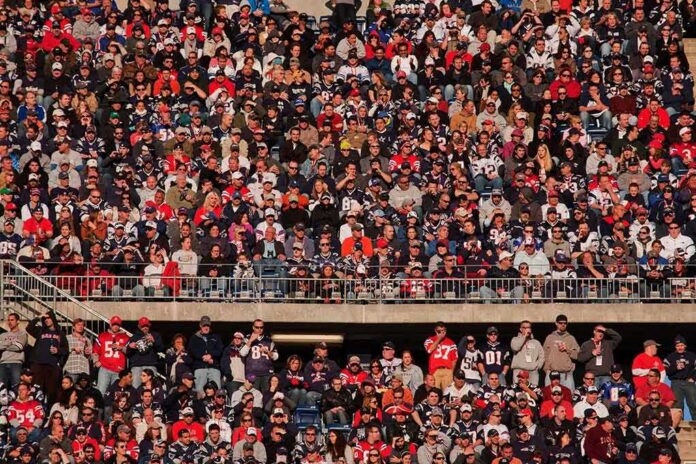
When a short, heated exchange in the stands goes viral, employment decisions for public-facing officials can move faster than facts; that is precisely what happened after Britt McHenry was filmed tossing a drink toward another spectator at the Washington Wizards’ home opener and resigned from her State Department post within days.
At a Glance
- Video from the Wizards–Bucks game shows Britt McHenry throwing a drink toward another fan at Capital One Arena.
- McHenry resigned from her U.S. State Department press-adviser role shortly after the clips circulated widely.
- Additional footage indicates a drink was thrown toward McHenry before she threw one back, though the full lead-up is not captured.
- Reports attribute the confrontation’s spark to remarks about Bucks forward Kyle Kuzma and his fiancée, Winnie Harlow.
What happened at the arena
The core facts are straightforward. During the Washington Wizards’ home opener against the Milwaukee Bucks at Capital One Arena, video captured Britt McHenry, then a U.S. State Department press adviser, hurling a drink toward a nearby spectator. Multiple outlets published the clips; ABC News summarized the incident and the immediate fallout, which included her resignation from government service later that week. Separate footage published by TMZ from a different angle shows that as McHenry and her companion moved away amid crowd jeers, a beverage appeared to be thrown in her direction first; McHenry then bent down, picked up a cup, and tossed its contents back toward the same section.
Context matters for understanding how an otherwise minor in-venue altercation turned into a reputational event. Reports attribute the initial verbal friction to comments made by spectators about Bucks forward Kyle Kuzma—formerly with the Wizards—and his fiancée, model Winnie Harlow. That explanation of the spark surfaced across several mainstream outlets that compiled what the available video showed and what witnesses and sources relayed in the moment’s aftermath. The circulating clips, however, do not include clean audio of the exchange or the earliest moments of the dispute, so they cannot independently reconstruct the full verbal back-and-forth that preceded the thrown beverages. One claim, many cameras, partial chronology.
The resignation and why it came so quickly
McHenry resigned from her State Department role within roughly two days of the game, as reported by ABC News; Front Office Sports also received her confirmation that she had signed the resignation letter, relayed through subsequent aggregation. That timeline—and the lack of a granular, on-the-record agency narrative—aligns with how modern personnel crises play out when compact, emotionally legible video circulates at scale. The institutional calculation is not subtle: a newly appointed communications aide becomes the subject of viral footage depicting a breach of decorum in a public venue, and the cost of letting the controversy breathe often appears higher than a rapid separation. People magazine’s coverage framed the development in similar terms, centering the video, the public reaction, and the swift exit from government service.
It is important to separate two questions that often get conflated. First, did the incident occur as described in widely shared video? On the available evidence, yes: the clips show McHenry tossing a drink toward a fan amid a heated exchange. Second, what formal basis, if any, underpinned the employment decision? Here, reporting makes clear she resigned and confirmed signing a letter, but does not produce a detailed State Department record or official rationale for the departure; several outlets repeated a “forced to resign” characterization attributed to entertainment media sourcing rather than to a named agency official or document. For readers focused on institutional process, that distinction matters, even if it rarely changes the practical outcome in a case driven by optics.
What the video shows—and what it never can
Short-form clips are powerful because they compress a narrative into a single, vivid act. In this case, the act is a visible drink toss from a government communications professional onto a member of the public in a crowded section at an NBA game. Additional angles sharpen some details—the apparent incoming splash toward McHenry, the ensuing jeers, the escort from the area—but they do not rewind the tape to the first antagonistic words. That evidentiary asymmetry is common in stadium disputes and has repeatedly shaped adjudication and public judgment. In a civil case involving former Knicks forward Charles Oakley’s ejection at Madison Square Garden, for instance, synchronized broadcast and cellphone footage played a decisive role in reconstructing escalation and supported summary judgment for arena security. The common thread is not equivalence of facts, but the centrality—and the limits—of what the camera captured.
Research on public shaming dynamics helps explain why the reputational arc often outruns granular verification. Social scientists have mapped how viral video that appears to depict a norm violation triggers moral emotions—anger, disgust, outrage—that accelerate condemnation and mobilization online. As repetition grows, the punishment can become decoupled from measured fact-finding, with consequences that can be swift and severe for the person at the clip’s center. That pattern does not negate accountability for visible conduct; it clarifies why organizations respond on platform time rather than process time.
WEEK LATER: Britt McHenry finally speaks out on the NBA drink-toss that ended her State Dept role — she says she was defending Winnie Harlow, was doused with drinks first, and the main agitator got ejected. Full record: https://t.co/OGvJtpRPdg
— CancelPeople.com (@cancelpeoplenow) October 29, 2026
Sports venues, codes of conduct, and the line between heckling and harassment
NBA arenas are not speech-free zones; heckling comes with the ticket. But all major venues maintain fan codes of conduct that restrict abusive, harassing, or threatening behavior, and teams have increasingly enforced them in the smartphone era. After a high-profile confrontation between Russell Westbrook and a Jazz fan in 2019, for example, the team investigated, cited code-of-conduct violations, and issued a lifetime ban—an action later discussed in appellate litigation over defamation claims stemming from the team’s statements about that incident. The McHenry altercation sits at a different point on that spectrum: there is no indication police were involved or that the arena issued discipline to specific fans. Still, the logic is the same: when incivility crosses into conduct that creates risk for patrons and staff, venues act fast. Public officials in the bowl are not exempt from that risk calculus; they are, if anything, more exposed to it.
What this means for public-facing professionals
Communications roles in government, campaigns, and corporate leadership ask for a reserve tank of discipline in chaotic public settings. That is not about saintly restraint; it is about understanding how a single frame—rightly or wrongly—can define a tenure. The McHenry episode, as captured on video and reported across mainstream outlets, will be taught for precisely that reason: a brief lapse that, when magnified by the crowd and the camera, became incompatible with the demands of a high-visibility post. The lesson is not new, but the half-life from incident to consequence keeps shrinking. Anyone in a role where optics are part of the job should plan accordingly: choose the aisle, exit early, ignore the bait, let security work. The phone is always rolling.
Sources:
abcnews.com, tmz.com, people.com, thenewstribune.com, latimes.com, gsb.stanford.edu