
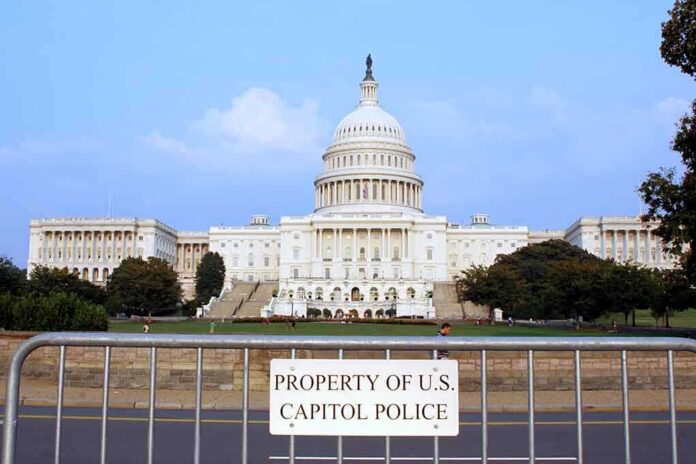
Calls to investigate a president and his orbit are only as legitimate as their focus: the narrower the questions and the clearer the legislative purpose, the stronger the oversight; the broader and vaguer the mandate, the likelier it is to read as politics by other means.
At a Glance
- Hillary Clinton urged a Democratic Congress to investigate President Trump, “his administration, his family, his supporters and allies,” an expansive formulation that is on-record and unusually broad.
- There is established legal basis for scrutiny of Trump himself, including a 2024 New York jury conviction on 34 felony counts and adverse civil findings on business practices.
- Congress’s power to investigate is real and constitutionally grounded, but it is constrained by scope, jurisdiction, and legislative purpose; the President is treated differently under separation-of-powers principles.
- The phrase “supporters” is undefined and risks collapsing legitimate oversight into partisan targeting absent specific predicates for inquiry.
- Counter-claims of “lawfare” are largely rhetorical absent specific refutations of the on-record statement or the court outcomes cited; the real test is whether any inquiry articulates concrete conduct to examine.
What Clinton Said—and What That Actually Authorizes
In a podcast appearance, Hillary Clinton argued that a Democratic Congress should “rein [Trump] in, hold him accountable, and investigate him, his administration, his family, his supporters and allies.” Multiple outlets reported the quotation, treating it as a forward-leaning blueprint for oversight if her party holds power. On its face, the statement puts four distinct categories on the table—presidential conduct, executive-branch action, family members’ dealings, and a very open-ended bucket of “supporters and allies.” The first two are conventional subjects of oversight. The last two are not per se improper, but they require a traceable nexus to governmental action or potential legislative remedies; otherwise they drift toward general-purpose opposition research. The record provides no further granularity—no named committees, no investigative predicates, no legislative aims—beyond the quote.
That absence matters. Congress’s oversight power is implied by its legislative function; it is not a free-standing policing authority. Effective—and defensible—congressional inquiries state the question, identify the authority to ask it, and link findings to potential legislation. As the Library of Congress’ constitutional annotations and House history pages make clear, that’s the through-line from the earliest investigations to modern practice.
Oversight Is Constitutional—And Bounded
Congress has investigated presidents, campaigns, agencies, and private actors whose conduct directly bears on federal programs or lawmaking since the earliest days of the republic. The legitimacy of those efforts flows from the body’s need for information to legislate. Landmark inquiries—from 18th- and 19th-century probes to Watergate and the Church Committee—fit that mold: defined topics, identifiable jurisdiction, and a contemplated legislative response. The same Constitution Annotated also underscores a separation-of-powers wrinkle: when the target is the sitting president, distinct accommodations apply; Congress must tailor subpoenas and inquiries to respect executive function while still pursuing legitimate information needs. Clinton’s call gestures at oversight but, as reported, does not translate those constitutional guardrails into a plan. The language is therefore advocacy, not yet an oversight program.
That distinction is not academic. Broad language invites equally broad rebuttals. Critics can plausibly call the phrase “supporters” a blank check: it could mean donors, appointees, Hill allies, or even voters. Without narrowing criteria or a suspected-offense theory, it is difficult to defend on legal process grounds—and easy to caricature as collective punishment.
Where Substantive Predicates Exist—and Where They Don’t
Two bodies of adjudicated fact underwrite continued examination of Trump himself. First, a New York jury found Trump guilty on 34 felony counts in May 2024 in the so-called hush-money case; while the precise legislative implications for Congress may be limited, the conviction is a durable factual predicate for accountability discussions. Second, Trump and his businesses have lost significant civil litigation in New York over fraudulent asset valuations, following a multiyear investigation by the state attorney general; those findings speak to business practices that, where they intersect with federal programs, banking regulation, or tax administration, could justify fact-finding hearings. These are not speculative claims; they are the kinds of adjudications oversight committees often treat as jumping-off points for policy review.
Other threads are thinner. Reporting referenced a past FBI preliminary look at Russia-related dealings that did not mature into a full investigation at the time; by definition, a preliminary inquiry that found “no evidence” sufficient to proceed offers little affirmative basis for new, wide-scope subpoenas on that topic unless new facts emerge. And none of the cited material transforms “supporters and allies” into an investigable class. Individual allies implicated in discrete conduct tied to federal functions may be fair subjects; undifferentiated categories are not.
Politics, Rhetoric, and the Charge of “Lawfare”
Trump and his supporters have long characterized investigations as politically motivated, framing prosecutions and probes as attempts to block his political future. Rhetorically, that claim lands with audiences already skeptical of institutions. Legally, it is not a refutation of either Clinton’s on-record statement or adjudicated outcomes; it is an argument about motive. The most credible answer to the “lawfare” charge is not a counter-slogan but disciplined process. Congressional inquiries that start with a clear legislative purpose, name the factual questions to be answered, and avoid diffuse categories are resilient against such critiques; sprawling mandates and hazy targets are not.
This is the oversight paradox: investigations genuinely can illuminate abuses and tighten law, and they also can—and often do—serve partisan aims that erode trust. Political scientists have shown that high-visibility oversight can depress a president’s approval ratings even when no legislation follows, which helps explain why both parties reach for the tool; it is not inherently disqualifying, but it heightens the premium on craftsmanship and restraint in scope.
What Responsible Oversight Would Look Like Here
If Clinton’s call is to mature into a legitimate congressional program, several elements are non-negotiable. First, specificity: identify discrete policy domains where adjudicated facts or credible evidence implicate federal interests—e.g., business valuations intersecting with federally insured lending or tax administration—and task the relevant committees accordingly. Second, articulated legislative purpose: what statute, appropriation safeguard, enforcement tool, or transparency regime might plausibly change in light of the facts the committee seeks? Third, individualized nexus: abandon generic “supporters” language and tether any non-government target to a clear connection with federal programs or presidential decision-making. Fourth, process integrity: use standard subpoena practice, respect privileges where valid, and avoid selective leak campaigns that substitute innuendo for evidence.
Congress has done this well before. When it hasn’t, courts have pushed back. The Supreme Court’s modern separation-of-powers cases signal that even when Congress investigates a president or private parties connected to him, it must demonstrate a legislative objective and tailor demands proportionally; a capacious, undifferentiated dragnet fares poorly against that standard.
Bottom Line
Clinton’s statement is both grounded and overbroad: grounded, in that adjudicated outcomes involving Trump himself justify rigorous fact-finding and potential policy reform; overbroad, in that “supporters” sweeps far past any principled predicate and invites the very “lawfare” narrative her critics prefer. The legitimacy test is not who asks for oversight but how it is done. Congress’s power to investigate is robust, earned across centuries of practice; it works best—both constitutionally and politically—when it is precise, disciplined, and tied to lawmaking rather than to labels.
Sources:
townhall.com, therothmanreport.com, thedailystar.net, 1stheadlines.com, news.whatfinger.com, ibtimes.co.uk, protectdemocracy.org, washingtonpost.com, theatlantic.com