

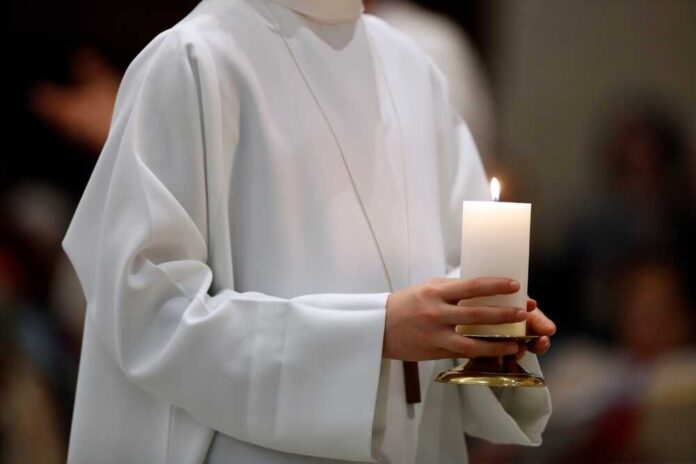
A new warning from Bishop Schneider challenges modern liturgical practices, sparking debates about tradition and feminism.
Story Highlights
- Bishop Schneider argues against women serving as altar servers.
- He connects this practice to broader liturgical feminism.
- Schneider criticizes past papal decisions enabling these roles.
- Debate highlights ongoing liturgical polarization in the Catholic Church.
Bishop Schneider’s Stand Against Female Altar Servers
In a January 2026 interview, Bishop Athanasius Schneider asserted that women should not serve as altar servers during Mass, citing St. Paul’s directive that women remain silent in church. Schneider believes this practice represents a male-ordered sanctuary, and allowing women in these roles could lead to broader liturgical feminism, including female ordination. He criticizes Popes John Paul II and Francis for their roles in enabling these changes, which he sees as a slippery slope toward a more feminist-influenced liturgy.
Schneider’s position has ignited a renewed debate within the Catholic Church, particularly among traditionalists who view these changes as a departure from doctrinal purity. This debate is not new; it traces back to the post-Vatican II era, when reforms began to allow lay involvement in the liturgy. However, female altar servers remained rare until Pope John Paul II permitted their involvement in 1983, a decision Schneider openly criticizes as a foundational error.
Historical and Liturgical Context
Historically, Catholic liturgy reserved sanctuary roles for males, reflecting Christ’s male priesthood and apostolic tradition. The introduction of female altar servers is seen by Schneider and his supporters as a significant departure from this tradition. They argue that post-Vatican II reforms, particularly those under Popes John Paul II and Francis, have eroded Christ-centered worship. These reforms culminated in Pope Francis’s expansion of roles for women within the church, including instituted acolytes and lectors, which Schneider views as problematic.
The issue is compounded by broader liturgical polarization, where traditionalists face restrictions, such as the suppression of the Traditional Latin Mass, while progressive innovations continue unchecked. This ongoing tension is highlighted by recent controversies, including the 2025 LGBTQ+ Jubilee pilgrimage, which Schneider denounced as a “desecration.”
Impact and Future Implications
The implications of Schneider’s statements are both immediate and long-term. In the short term, his critique may bolster traditionalist movements and further divide progressive and conservative factions within the church. Long-term effects could lead to a reevaluation of female roles in the liturgy, potentially reversing policies that allow women in the sanctuary. Schneider warns that failure to address these issues could lead the Catholic Church down a path similar to the Anglican tradition, which he believes has compromised its doctrinal integrity.
Why Bishop Schneider Says Women Should NOT Serve at Mass
Bishop Athanasius Schneider offers a clear and uncompromising defense of apostolic tradition, arguing that women and girls should not serve as lectors or altar servers during Holy Mass.
Watch the full show here:… pic.twitter.com/UHioe5xDVm
— LifeSiteNews (@LifeSite) January 15, 2026
While the Vatican has yet to respond to Schneider’s latest interview, the debate it sparks is likely to continue as traditionalists and progressives grapple with the future direction of Catholic liturgy and the role of women within it.
Sources:
Bishop Schneider’s Warning: Women Should Not Serve at Mass – A Rejection of Feminism in the Liturgy
Spiritual Criminals and Murderers
The Strengths and Flaws of Bishop Schneider’s Credo: A Traditionalist Perspective