President Trump’s new vaccine order matters because it does not merely tinker at the edges of pediatric guidance; it reclassifies the federal childhood schedule into a smaller core set, separates the MMR vaccine into individual shots, and reframes vaccine policy around parental choice and “peer-developed” country comparisons.
Key Points
- The executive order reduces the routine childhood schedule to 11 diseases and moves several other immunizations into high-risk or shared-decision categories.
- It directs federal agencies to pursue separate MMR dosing and to recommend vaccines at separate medical visits when feasible.
- The administration says the new schedule is aligned with best practices from other developed countries and will preserve access to covered vaccines.
- The supplied record shows a policy shift, not proof that the new schedule is safer, or that splitting MMR improves outcomes.
What the Order Actually Changes
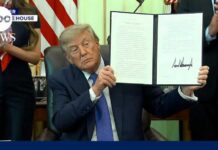
Trump signed an executive order on August 10 that revamps the federal government’s recommended childhood vaccine schedule, reducing the list of immunizations recommended for all children and dividing the schedule into three categories. Under the new framework, vaccines for 11 diseases remain in the routine category, while others are shifted into recommendations for high-risk groups or shared clinical decision-making. That is the practical heart of the move: it narrows what the federal government presents as universal, and it pushes more of the decision-making back toward individual families and clinicians.
The order also takes aim at combination dosing, especially the measles, mumps, and rubella vaccine. The White House says the combined MMR shot should be split into three separate shots once those products are available, and it directs HHS to draft recommendations on how to administer core childhood vaccines as single vaccines rather than combination products, starting with MMR. The administration further says vaccines should be given during separate medical visits when feasible, giving parents more flexibility over timing and sequencing. In policy terms, that is a real redesign of the schedule’s architecture, not merely a rhetorical flourish.
The Administration’s Theory of the Case
The White House has anchored the order in a comparison with peer-developed countries, arguing that U.S. practice should be realigned with what it calls better or more flexible approaches abroad. The earlier presidential action directed CDC and ACIP to review a scientific assessment and take appropriate steps to update the schedule, while preserving access to vaccines already available in the United States. That sequence matters: the administration is presenting the change as a managed reorganization of recommendations, not a wholesale withdrawal of childhood immunization.
That framing is reinforced by the coverage provisions. According to the American Hospital Association’s summary, the order says the immunizations it recommends should continue to be covered without cost sharing by private insurers, Medicaid, CHIP, and the Vaccines for Children program. The CDC’s January 2026 memorandum likewise said the schedule would continue to be organized into three distinct categories, all of which require insurers to cover them without cost sharing. So while the policy narrows the universal list, it is still designed to remain embedded in the insurance and public-program structure that makes childhood vaccination routine in the first place.
Why This Was Not Just a Symbolic Announcement
The administration’s own documents show the policy is already more than a talking point. CDC’s January 2026 memorandum said it accepted recommendations from a comprehensive scientific assessment after Trump directed HHS and CDC to examine peer-country practices and update the schedule if superior approaches existed abroad. The order also directs the Justice Department to maximize parental choice by challenging state laws that conflict with parental authority, religious freedom, disability accommodations, and equal protection. It encourages states to review their own vaccine regulations to align with the updated schedule.
That said, the immediate operational effect is still limited by the structure of U.S. vaccine governance. Reuters and other outlets reported that the order relies on HHS’s assessment as a guide, but implementation still runs through CDC and ACIP, and the order itself calls for further agency action. The supplied record also notes that several of the vaccines moved out of the universal category are not being eliminated outright; they are being recast as high-risk or shared-decision recommendations. In other words, this is a federal reclassification exercise with legal and administrative consequences, not a simple “fewer shots tomorrow” switch.
IT’S OFFICIAL.
President Trump has signed a new Executive Order directing changes to America’s childhood vaccine recommendations, including greater flexibility in the timing and sequencing of childhood vaccines.
This is a step in the right direction.
For too long, parents who… pic.twitter.com/10zN72sbA3
— Vic Mellor For Congress RI (@VicMellorForRI) August 12, 2026
Where the Evidence Stops, and the Politics Begin
The strongest thing the record shows is that Trump has changed the schedule. It does not show that the new schedule is medically superior. The White House materials assert alignment with “scientific evidence” and “best practices,” but the package provided here does not include comparative trial data, population studies, or ACIP evidence demonstrating that the reduced schedule lowers harm or improves outcomes. Nor does it supply clinical data showing that separating MMR into three injections is safer or more effective than the combined product. That is an evidentiary gap, and it is a meaningful one.
The autism angle sits in the same category. Trump and Robert F. Kennedy Jr. have continued to press the idea that vaccine timing or combination dosing may relate to autism, and media summaries of the announcement say that claim remains central to the politics of the order. But the primary documents in the research package do not establish that link as a scientific finding. What the materials do establish is that the administration has launched or expanded research efforts on vaccine safety, timing, adjuvants, and autism, including work involving CDC, FDA, NIH, ARPA-H, and the National Toxicology Program. That creates a research pathway. It does not, by itself, validate the premise that produced it.
How the Change Is Likely to Be Read
Public reaction is predictable because the policy lands in one of the most durable fault lines in American health politics: parental autonomy versus public-health standardization. Supporters will read the order as a return to informed consent, less coercive scheduling, and greater room for individualized medical judgment. Critics will read it as a politically driven rewrite of pediatric guidance that may increase confusion, complicate implementation, and weaken confidence in immunization. Both reactions are consistent with the shape of the order itself. It broadens discretion while narrowing the routine federal list, which is exactly why it is so contentious.
The most important practical question is not the rhetoric but the downstream effect on uptake. If separating doses increases missed appointments or delays completion, the policy could alter real-world protection even if the official insurance architecture remains intact. If, on the other hand, the change merely rearranges recommendations without changing coverage or access, its effect may be more gradual and uneven, especially because states and local systems do not all move in lockstep. The supplied reporting already points to that patchwork reality, and to the fact that legal and administrative constraints may slow the order’s reach.
What to Watch Next
The next meaningful developments will come from the implementation layer: HHS guidance, CDC and ACIP action, and any state response to the federal signal. The decisive evidence will not be slogans about “gold standard” recommendations; it will be the actual schedules, the insurance guidance, the legal interpretations, and the data that emerge once the new framework is put into practice. Until then, the record supports a clear conclusion: President Trump has ordered a substantial reorientation of childhood vaccine policy, but the claim that the new schedule is scientifically better remains unproven in the materials provided.
Sources:
youtube.com, whitehouse.gov, apnews.com, abc7news.com, nytimes.com, reuters.com, people.com, cdc.gov, washingtonpost.com