A police hot-car rescue is not a viral curiosity; it is a case study in how quickly interior vehicle temperatures threaten life and how the law expects first responders to act when an animal’s welfare is clearly in danger.
At a Glance
- Newport Beach officers rescued five dogs from a parked car after finding them distressed, with windows only slightly cracked.
- Body-camera footage shows officers breaking a window to reach the animals; the incident occurred May 18 on Holly Lane.
- California law prohibits confining animals in conditions that endanger their health and authorizes rescue under defined steps.
- The pattern fits a national trend: more states codify “hot car” protections as agencies lean on fast, decisive intervention.
What Happened: A swift, justified intervention
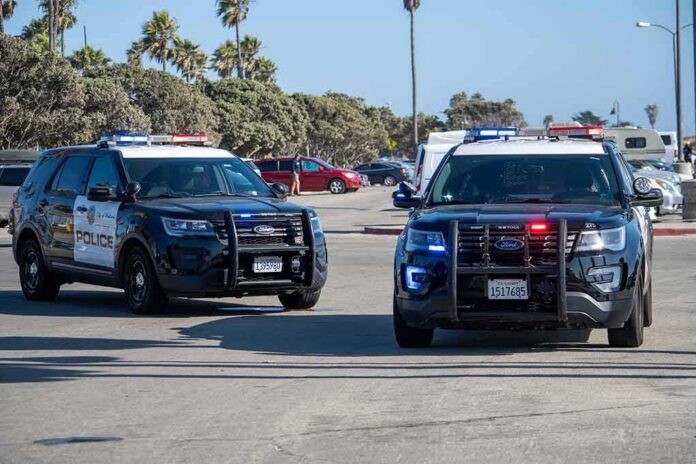
On May 18 in Newport Beach’s 2400 block of Holly Lane, police and animal control officers responded to a report of multiple dogs confined inside a parked car. According to the department’s account and body-camera video published afterward, the animals were in distress, most of them caged, and the vehicle’s windows were only slightly cracked—insufficient to provide safe ventilation in warm conditions. Officers broke a window, extracted five dogs, and transferred them to care. The department released the footage as a community reminder of heat risk and the rationale for immediate entry when an animal’s condition appears jeopardized.
That sequence—public report, rapid assessment, forced entry, triage—is not unusual. First responders operate on a simple calculus: if clinical signs of heat stress are present and the vehicle environment is unsafe, the window is glass, but the dog is a life. California’s statutory framework supports that posture when certain procedural steps are met.
Why the interior of a “cracked-window” car becomes lethal fast
Vehicle cabins heat by the greenhouse effect: solar radiation passes through glass, warms interior surfaces, and the trapped infrared energy elevates ambient temperature. Within minutes, cabin temperatures can exceed outdoor air by 20–40 degrees Fahrenheit, accelerating as the sun continues to load the interior. “Cracked” windows provide negligible convective relief once the cabin is superheated. Dogs, with limited eccrine sweat capacity and heavy reliance on panting, decompensate rapidly; core temperatures rise, mucous membranes redden, salivation increases, and mentation dulls. At that point, you are racing multi-organ failure. The video evidence of distress, paired with the environmental setup described, matches the clinical picture that compels immediate intervention.
Cages compound risk by restricting posture and airflow, preventing a dog from finding the least hot microclimate in the vehicle or moving off heat-retaining surfaces. Even a shaded parking spot can shift to direct sun; asphalt reradiates heat; and any delay waiting for an owner to return turns minutes into the margin between recovery and irreversible heatstroke.
The legal framework that guides rescues in California
California explicitly prohibits leaving or confining an animal in an unattended vehicle under conditions that endanger the animal’s health or well-being—due to heat, cold, lack of ventilation, food, or water, or other circumstances reasonably expected to cause suffering. The law also outlines who may enter a vehicle and under what conditions, providing a safe harbor for first responders performing a rescue when they reasonably believe the animal is in imminent danger and they follow specified steps such as contacting law enforcement and using no more force than necessary.
In practice, that framework aligns with how the Newport Beach case unfolded. An animal control response, observation of distress, and a controlled breach to remove animals comport with both the spirit and letter of the statute. The post-incident release of body-camera footage functions as both documentation and public education: it shows the threshold conditions that prompt entry and the measured way officers execute it.
How this case fits a broader national pattern
Across the United States, “hot car” protections have broadened and matured. More than half of states now have some form of law addressing animals left in vehicles—either prohibiting dangerous confinement outright or authorizing specified rescuers (and in some jurisdictions, Good Samaritans) to enter vehicles under certain conditions. While eligibility and liability protections differ by state, the trend line is clear: codified expectations, clearer immunity when protocols are followed, and a bias toward action when an animal’s life is at risk.
Those frameworks emerged because the physiology and the data are unforgiving; preventable animal deaths in vehicles, especially in the summer months, galvanized public and legislative attention. States continue to refine who may act and how—for example, adjusting civil liability rules or specifying required notifications—so that well-intentioned rescues are channeled into safe, accountable practice.
The operational decision: assessment, threshold, action
From a responder’s standpoint, the threshold to breach is not abstract; it rests on observable indicators. Key cues include ambient conditions (sun exposure, heat advisories), animal presentation (excessive panting, drooling, ataxia, lethargy, vomiting), car configuration (windows nearly closed, no airflow), and constraints (caging, multiple animals). In Newport Beach, the combination—slightly cracked windows, visible distress, and confined dogs—hits that threshold. Once crossed, the sequence is standardized: confirm law enforcement presence, document with body-worn camera, select the least destructive point of entry, remove the animals, and begin cooling and veterinary evaluation.
This disciplined approach serves three masters at once: the animal’s immediate welfare, the public’s property interests through minimal-force entry, and the legal process through thorough documentation. The subsequent release of video—which some departments now treat as a preventive communication tool—also clarifies community expectations: leaving animals in a hot vehicle will trigger intervention.
Consequences and deterrence
California law contemplates criminal exposure for owners who endanger animals in vehicles; prosecutors evaluate each case on its facts, including environmental conditions, duration, animal condition, and owner intent or negligence. The visible, well-documented nature of hot-car rescues supports both specific deterrence (educating the immediate owner) and general deterrence (signaling to the public that enforcement is real). Newport Beach and other Southern California jurisdictions have, in recent years, seen multiple high-profile interventions against dangerous confinement in vehicles; together they function as civic messaging as much as casework.
For pet owners, the practical takeaway is non-negotiable: plan as if you cannot leave an animal in a parked car, even briefly. The difference between “I’ll be right back” and a crisis is measured in minutes, not hours; shade shifts, errands run long, and a dog’s thermal physiology is unforgiving. For bystanders, the correct first step is to call 911, stay with the vehicle, and be ready to guide responders; in California, civilians may have a path to intervene under AB 797’s “Right to Rescue” framework, but only after contacting authorities and adhering strictly to the statute’s conditions.
HOW DID WE NOT RUN THIS??
Five dogs were trapped inside a scorching hot car in Newport Beach, most of them locked in cages and already showing signs of distress.
A police officer realized they were in immediate danger, smashed the window and pulled all five to safety.
A… https://t.co/bqucSatOkv pic.twitter.com/6iRWQvTlwn
— Frank (@Frank_67x) August 23, 2026
The real lesson: clarity saves lives
The Newport Beach rescue is not remarkable because glass shattered; it matters because policy, physiology, and training aligned to save five animals that could have been lost to a preventable scenario. The clarity of that alignment—recognize distress, know the law, act decisively—turns what might have been another grim statistic into a blueprint. Communities that internalize it, from owners to officers, will bury fewer pets and break fewer windows. That is the trade any serious jurisdiction will accept.
Sources:
nypost.com, patch.com, tmz.com, nbpd.org, countryliving.com, aldf.org, facebook.com, peta.org