Caravans are a recurring, organized way for hundreds of people to move through southern Mexico toward the United States, not a one-off spectacle; the latest instances out of Tapachula fit that well-worn pattern in size, route, and stated intent, even as headlines fixate on U.S. election season and political sound bites.
At a Glance
- Hundreds of migrants departed Tapachula in October in organized groups, with stated plans to head north through Mexico and, for many, ultimately to the United States.
- Counts varied by date and outlet, but reports consistently described a substantial contingent—several hundred people, including families and older adults—moving in stages.
- The route and chronology align with prior caravans: staging in Tapachula, consolidation at parks and plazas, and stepwise progress northward.
- Participants consistently cited economic opportunity, safety, and family reunification as motivations; some commentary tied the march to U.S. politics, a claim only partially documented.
What Happened: A Large, Organized Departure From Tapachula
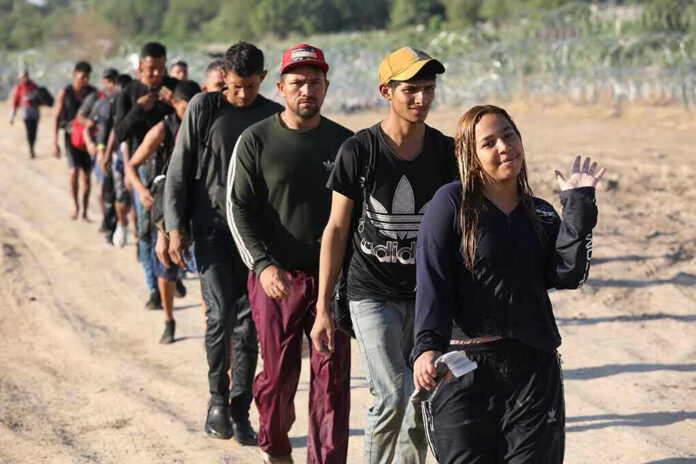
In mid-to-late October, local reporting from Chiapas documented several hundred migrants setting out from Tapachula—Mexico’s primary reception city near the Guatemala border—in an organized formation commonly described as a caravan. One outlet reported roughly 500 people departing on October 20, including men, women, children, and older adults; others, across adjacent days, cited groups of approximately 300 to more than 600 as people joined and regrouped. The stated plan was to move north in stages, first toward central Mexico and, for many, onward in the direction of the U.S. border.
These were not isolated walkers. The caravan model deliberately aggregates people for visibility and mutual protection. Tapachula’s public spaces—especially Bicentennial Park—again served as the logistical hinge: a place to rest, gather, and receive staples like water, food, basic medical care, and hygiene supplies before moving. That provisioning, described by a Chiapas daily, reflects the local humanitarian posture that has developed over years of repeated movements through the city’s corridors.
Route, Names, and Numbers: Why the Details Don’t Line Up Perfectly
Different banners, same road. Reports referenced caravans labeled Fe y Esperanza and Sin Fronteras (and close variants). In practice, labels often reflect an originating organizer, a social-media call, or a rallying phrase rather than a legally constituted entity. Groups merge, splinter, and rebrand as they cross the Suchiate River or Rodolfo Robles Bridge and filter into Tapachula’s grid. That fluidity explains the headcount spread—300, 400, 500, even 600-plus—without implying fabrication; they may be snapshots of the same flow at different moments, or adjacent contingents tracked by different reporters standing a mile—and a day—apart.
The chronology lined up with the standard southern arc. One contingent left San Pedro Sula in late September, crossed into Mexico within days, and moved toward Tapachula, which functions as both a bureaucratic bottleneck and a staging ground. From there, the march proceeds north by legs along Mexico’s highways and rail-adjacent corridors. For seasoned observers, those waypoints are familiar; they have been mapped and remapped by researchers cataloging at least 30 caravan iterations since 2017.
Motivations on the Move: Family, Safety, and Economic Calculation
When migrants explain why they join a caravan, the answers fall into a consistent triad: economic survival, safety, and family ties. The Tapachula reporting echoed that: people seeking better work and living conditions, reunification with relatives already in the United States, and a way out of precarious local circumstances. A caravan is a tactic as much as a trek—trading speed for numbers and visibility to reduce costs, resist predation, and navigate checkpoints with less individualized risk. That logic is well-documented in academic and policy analyses of the caravan phenomenon over the past decade.
Scholars add another layer: caravans arise when enforcement hardens and smuggling grows costlier and more dangerous. The larger the group, the lower the per-person risk from criminal gangs and corrupt intermediaries; the public character of the march also draws media and civil-society attention, creating a measure of deterrence against abuse. This is not theory in search of facts; it is an account built from repeated observation of the southern Mexican corridor.
Politics at the Edge: Election Talk Exists, But the March Runs on Older Fuel
Some commentary framed the Tapachula departure as intertwined with U.S. electoral politics, emphasizing interviews in which migrants reportedly said they hoped Democrats would win the midterms. That sentiment exists in the record, but it appears as episodic claims rather than a structured platform, and it sits alongside the far more common motivations of work, safety, and family reunification documented by local outlets on the ground. This distinction—between discrete political remarks and the underlying socioeconomic drivers—is consistent with broader research showing caravans as complex mobilizations shaped by policy signals and opportunity structures, not single-issue campaigns.
In other words, electoral cycles can color the discourse, but they rarely invent the movement. Caravans surged well before any given midterm season and recurred under vastly different administrations. Analysts who have followed them across years find a patterned response to changing enforcement and risk, rather than a parade conjured by a news cycle.
Why Tapachula Again: Geography, Bureaucracy, and Civil Society
Tapachula’s role is structural. Geography funnels northbound travelers through a limited set of crossings; Mexican immigration processing and shelter capacity concentrate in and around the city; and a mature ecosystem of civil-society groups, faith networks, and local authorities now manages the recurring humanitarian demands caravans create. The result is a stop-and-go tempo: groups pause to rest and formalize documents where possible, splinter into smaller parties, then reconverge to move when conditions—weather, transport access, enforcement posture—favor another push. The recent October march conformed to that cadence, including regrouping announcements and supply distribution in public parks.
What It Means Going Forward: Expect Cycles, Not One-Offs
The immediate stakes are practical. For Mexican municipalities in Chiapas and Oaxaca, each caravan is a logistics event—food, water, waste management, medical care, and local security—that strains budgets already committed elsewhere. For migrants, the calculation remains hard-edged: caravans reduce some risks but do not eliminate the perils of extortion, exhaustion, and interception. For U.S. and Mexican authorities, the march is a moving policy stress test, illuminating how changes in asylum processing, transit permits, and enforcement posture alter flows and tactics. The Tapachula groups show those dynamics in miniature.
The longer view is clearer than the headlines. Caravans will recur so long as the push factors—economic precarity, violence, weak local labor markets—and the pull factors—family networks, wage differentials, perceived policy windows—remain misaligned across borders. Counting precise heads in any given week misses the larger truth: the model persists because it works just well enough, for enough people, to try again. October’s march out of Tapachula was another turn of that wheel.
Sources:
thegatewaypundit.com, chiapas.quadratin.com.mx, diariodechiapas.com, elorbe.com, elcongresista.mx, yournews.com