

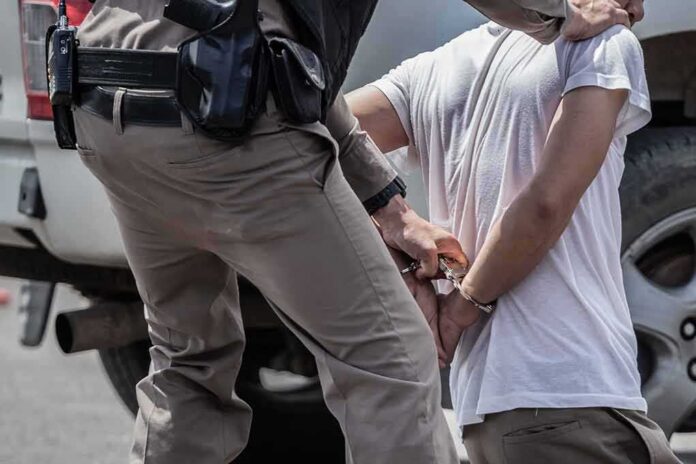
When force meets enforcement in the narrow space of a vehicle stop, tiny decisions compound in seconds; that is why prosecutors treat a swung hammer against federal officers as not just a scuffle but a felony assault with a dangerous weapon.
At a Glance
- Federal prosecutors charged a Honduran national, identified as Licona Amador, with assaulting two ICE officers using a hammer during an operation in Gibbsboro, New Jersey.
- The complaint, as described by the U.S. Attorney’s Office, alleges he retrieved a hammer from his truck, ignored commands, climbed onto the passenger door, and swung multiple times before officers subdued him.
- Independent local and national outlets reported materially consistent details and the same charge: assault on federal officers with a deadly or dangerous weapon.
- This case sits within a broader debate over the prevalence of assaults on ICE personnel and how those incidents translate into prosecutions and outcomes.
What Prosecutors Allege Happened in Gibbsboro
The U.S. Attorney’s Office for the District of New Jersey states that during an October 4 enforcement operation in Gibbsboro, two immigration officers encountered Licona Amador at a truck, where he allegedly retrieved a hammer from a container inside the vehicle. According to the government, he refused repeated commands, climbed onto the truck’s passenger door, and swung the hammer multiple times toward both officers. They deployed OC spray, wrestled him to the ground, and arrested him. He was charged by complaint with assaulting federal officers with a dangerous weapon and appeared before a U.S. magistrate judge in Camden federal court.
Local and national coverage tracked closely with the prosecutor’s account: reports describe the Gibbsboro location, the hammer, the command refusals, the elevated position on the truck door, and the multiple swings before officers gained control. Several stories also note the arrest concluded without reported injuries and that, if convicted, the charge can carry a significant prison term and fine.
Why a Hammer Can Be Charged as a “Dangerous Weapon”
Federal assault statutes treat “dangerous weapon” functionally rather than by a fixed catalog: an object becomes dangerous when used in a manner capable of causing death or serious bodily injury. Hammers, which concentrate force on a small striking surface, readily qualify when swung at close range. Prosecutors, and ultimately juries, examine context—distance, swing trajectory, officer positioning, and whether the implement was wielded in a way likely to inflict grave harm. That is why complaint narratives in cases like this dwell on physical detail: the climb onto the passenger door, the repeated swings, the officers’ immediate resort to OC spray and control techniques—facts used to satisfy statutory elements and to convey imminent risk.
In this posture, injury is not a prerequisite for the charge. The core question is whether the conduct constituted an assault while using a dangerous weapon against federal officers engaged in their duties. Evidence that often carries weight includes body-worn camera video, consistent officer accounts, and physical exhibits, such as the recovered tool. Media summaries indicate prosecutors referenced video in describing the encounter.
How These Encounters Escalate: Mechanism and Tactics
Vehicle-side arrests compress risk into arms-length distances. Officers train to control hands, manage angles, and keep visual contact with any container that could hold a weapon. The moment a subject introduces a tool—hammer, screwdriver, pry bar—officer options narrow: create distance, disrupt vision or grip with spray, or close quickly to control the limb and disarm. The government’s account here reflects that progression: verbal commands; the subject’s elevation onto a door (which adds reach and leverage); repeated swings; then OC spray to degrade visual acuity and motor performance; followed by a takedown while the tool arm is controlled. OC spray is a common intermediate step intended to shorten the window of dangerous movement without resorting to higher-force options.
From an evidentiary perspective, spatial reconstruction matters. Where were the officers relative to the cab? How far did the hammer travel per swing? Were there obstructions or deflections? Prosecutors often pair narrative affidavits with stills from body-camera footage and photographs of the implement to map those answers clearly for a judge or jury.
What the Charge Signals About Consequences
Assault on federal officers with a dangerous weapon is charged to reflect both the threatened harm and the federal interest in safeguarding on-duty personnel. The government typically emphasizes not only the object and motion but also the officers’ official function at the time—here, an immigration enforcement operation. In practical terms, the charge elevates potential penalties, affects detention and release decisions, and signals to other would-be assailants that improvised weapons at close quarters will be treated as grave offenses. Outlets covering the case report the government’s framing along those lines, as well as the appearance before a federal magistrate.
One caveat belongs in any criminal-process explainer: a complaint is an allegation, not a conviction. The defense will have opportunities to test the government’s account through discovery and, if necessary, at trial. That process frequently hinges on video clarity, corroborating physical evidence, and internal consistency across officer statements.
The Broader Pattern: Reported Assaults on ICE and the Data Gap
This incident sits inside a contested statistical landscape. Federal officials in recent years have highlighted sharp increases in reported assaults against ICE personnel; independent analyses of court filings, however, tend to show far smaller growth in actual assault charges and a meaningful share of those cases ending short of conviction. That divergence reflects the difference between internal incident tracking and the narrower set of cases that prosecutors file and that courts adjudicate to completion.
Two things follow for readers evaluating any single case. First, the particulars matter more than the rhetoric: contemporaneous video, a coherent timeline, and physical exhibits will decide outcomes. Second, internal agency statistics and courtroom statistics answer different questions—one about operational risk reporting, the other about provable criminal conduct beyond a reasonable doubt. Understanding that distinction keeps a single hammer swing in Gibbsboro anchored to its facts rather than swept into overbroad claims about national trends.
Hammer attack on ICE officers during a traffic stop! 📷 Was this an act of desperation or a deliberate assault? 📷#TrafficStop #ICE #NewJersey
— ピクセル侍 (@KdSaini93) October 21, 2026
What to Watch as the Case Moves
In cases charged on close-quarters use of a tool as a weapon, three evidentiary pillars typically determine the trajectory: authenticated video that captures angles and motion; the implement itself, documented and tested as appropriate; and consistent, detailed accounts from the officers involved. Media reports indicate those elements are in play here—especially body-worn camera video described by local outlets—but those materials will do their real work in court, not in headlines.
Sources:
foxnews.com, justice.gov, newjersey.news12.com, nj1015.com, noticias.foxnews.com