

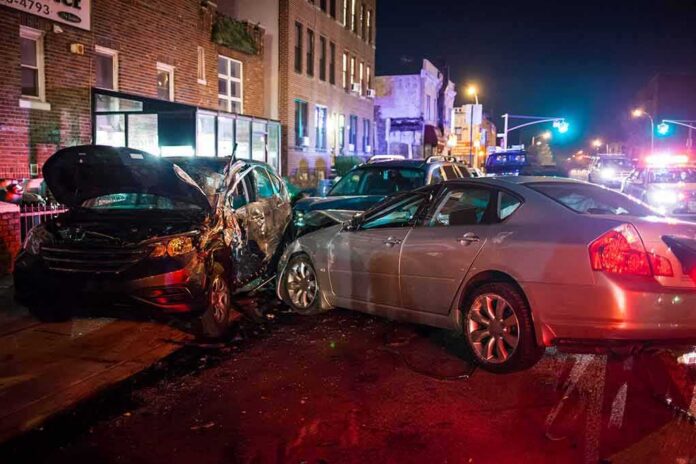
When prosecutors file murder charges in a suspected DUI case, they are signaling more than outrage—they are asserting the evidence will show implied malice under California’s Watson doctrine. The North Hollywood crash that killed three street vendors is such a case: a defendant identified by police at the scene, an official allegation of extreme intoxication, and a charging decision that frames the driving as life-endangering conduct done with conscious disregard for human life.
At a Glance
- Los Angeles County prosecutors charged Ihor Demianenko with three counts of murder plus DUI-related felonies in the North Hollywood crash that killed three women and seriously injured others.
- The District Attorney’s Office alleges Demianenko’s blood alcohol level was more than three times California’s legal limit of 0.08%.
- LAPD’s account: a white Toyota Sienna traveling at an unsafe speed veered off Lankershim Boulevard onto the sidewalk near the Metro station, striking vendors and pedestrians.
- The murder counts reflect California’s implied-malice (Watson) theory, applied when evidence supports a conscious disregard for life—not intoxication alone.
What prosecutors say happened on Lankershim and why it matters
The Los Angeles County District Attorney’s Office charged 61-year-old Ihor Demianenko with three felony counts of murder, along with DUI causing injury and driving with a 0.08% or higher blood-alcohol concentration causing injury, after a crash outside the North Hollywood Metro station killed three women and seriously injured two others. The case—filed as 26VWCF02111—centers on the state’s allegation that Demianenko drove onto a sidewalk lined with vendors and pedestrians, causing catastrophic harm. LAPD’s initial account places his white Toyota Sienna southbound on Lankershim Boulevard near Chandler Boulevard “at an unsafe speed,” veering off the roadway and striking a light pole before hitting people on the sidewalk.
The charging announcement also puts a number—albeit an approximate one—on the intoxication theory: prosecutors allege his alcohol level was more than three times the legal limit. That detail, if sustained by evidentiary toxicology records, is legally significant because it can support the inference of subjective awareness of danger that California courts require in Watson murder cases.
How California turns a fatal DUI into second-degree murder
California’s second-degree “Watson murder” doctrine traces to People v. Watson (1981), which permits a murder charge when a driver’s conduct amounts to implied malice: a willful act dangerous to human life, performed with conscious disregard for that danger. Intoxication alone does not prove murder; the state must show both the dangerous act and the driver’s subjective awareness of its deadly risk—often through facts like prior DUI advisements, high intoxication, reckless maneuvers, or other aggravating indicators. Appellate decisions have repeatedly upheld implied-malice convictions in fatal DUI cases when those factors coalesce, underscoring that the legal pivot is the driver’s mental state, not the mere presence of alcohol.
In practical terms, prosecutors build that mental-state case by combining crash mechanics with corroborating context. Evidence can include a very high blood-alcohol concentration, speed and steering inputs recovered from a vehicle’s event data recorder, erratic roadway choices (like mounting a curb or plowing into a crowd), training or warnings a driver received in earlier incidents, and post-collision statements or behavior suggesting knowledge of risk. The more of these strands align, the stronger the implied-malice theory becomes under Watson’s framework.
What the official record establishes so far
The state’s filing and parallel public reports lock in several concrete propositions. First, Demianenko is charged—this is not investigative speculation but an executed prosecutorial judgment—on three counts of murder and two DUI-related felonies, tied to a single crash near the North Hollywood Metro station that killed three pedestrians and seriously injured others. Second, the authorities have identified the driver, the vehicle (a white Toyota Sienna), and the crash sequence’s location and direction of travel. LAPD attributes the sidewalk incursion to unsafe speed, an initial rightward veer off Lankershim, and impacts with a tri-light and pedestrians/vendors concentrated near the station. Third, the District Attorney’s Office publicly alleges a blood-alcohol level exceeding three times the legal threshold, an aggravator that, if borne out at trial, strengthens an inference of conscious disregard.
Community reporting has also named victims and illuminated their longstanding presence at the site—context that explains the density of pedestrians there during the evening hour and the scale of harm when a vehicle leaves the roadway. Those human details do not decide legal guilt, but they do clarify why the event produced murder counts rather than manslaughter filings: three deaths, serious injuries to others, and an officially alleged extreme BAC can collectively satisfy prosecutors that a jury could find implied malice under governing law.
Mechanism and evidence: what typically carries weight
In cases like this, the evidentiary center of gravity tends to sit in three places: toxicology, crash reconstruction, and the driver’s knowledge profile. Toxicology answers the quantitative question—how impaired and when—using blood draws, laboratory analysis, and chain-of-custody documentation. Reconstruction translates crushed metal and marks on asphalt into speed estimates, steering paths, timing, and impact forces using event-data recorder downloads, scene measurements, and video. Knowledge is the bridge to implied malice, established through prior DUI education, court advisements, or any proof the driver internalized the lethal risk of impaired driving before choosing to drive anyway.
The prosecution’s public summary sketches two of these pillars already: an allegation of very high BAC and a roadway departure onto a crowded sidewalk. As the case moves, the state will be expected to connect them with technical specificity—when the sample was collected and what it measured; how the vehicle left its lane, whether the throttle was open, whether braking occurred; and what the driver knew or had been warned about impaired driving’s risks. That is how a Watson charge matures from headline into trial theory.
Why this case sits squarely in California’s mainstream approach
Los Angeles prosecutors are not testing novel law here. Post-Watson, appellate courts have repeatedly affirmed murder convictions where fatal impaired driving coincided with circumstances supporting conscious disregard—high speeds in pedestrian zones, egregious BAC levels, near-misses or collisions that preceded the fatal impact, or prior court admonitions. The doctrine has been reaffirmed in recent years, and prosecutors across the state routinely evaluate fatal DUI cases through this lens when deaths occur and the aggravating facts align. The North Hollywood crash, involving three deaths on a sidewalk near a busy station and an alleged BAC more than triple the legal limit, fits that rubric as charged.
The road ahead: what will likely decide the case
Two sets of facts typically decide Watson prosecutions. First, the quantified, time-anchored impairment evidence—numerical BAC results tied reliably to the driving window—because jurors treat precise toxicology as a proxy for both capability and foreseeability. Second, the objective dynamics of the crash—speed, steering input, pathway onto the sidewalk, and any lack of evasive action—because those physical facts ground the “dangerous to human life” prong. If the state also introduces credible evidence of the driver’s prior awareness of DUI risks (for example, court advisements or documented education), the implied-malice chain is complete under California law.
One cautionary sentence belongs here and no more: as with any criminal case at arraignment stage, charges are allegations; the defendant is presumed innocent unless and until proven guilty in court. The legal posture, however, is unmistakable. By filing murder counts with an allegation of extreme intoxication and a sidewalk strike that killed three people, Los Angeles prosecutors have placed this tragedy firmly within the state’s established implied-malice framework. What remains is the evidentiary work: translating allegation into admissible proof, and physics and chemistry into a jury’s moral judgment.
Sources:
nypost.com, lacounty.gov, cnn.com, nbclosangeles.com, people.com, abc7.com