

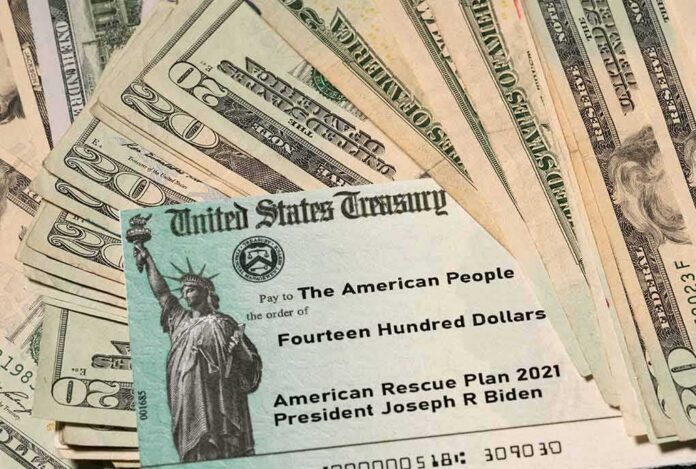
When elected officials propose direct checks to households, they are not just floating a headline number; they are choosing a financing mechanism, an eligibility rule, and an implementation pathway that determine whether relief lands quickly, fairly, and lawfully—or stalls as an aspiration. Representative Ro Khanna’s push for “Iran war refund” payments crystallizes all three.
At a Glance
- Rep. Ro Khanna advocated $1,700 payments as relief for higher household costs he attributes to the Iran war’s oil-route disruptions, tying the idea to an introduced bill, the Illegal War Refund Act.
- The bill’s concept: use unobligated defense funds—excluding key military and health accounts—to finance equal payments to eligible taxpayers and dependents via Treasury/IRS channels.
- Public messaging emphasized a flat $1,700, but reporting indicates the introduced text did not hard-code that amount, pointing instead to a formulaic mechanism.
- The measure was referred to committee and had not advanced, leaving the idea legislatively untested and uns cored; Khanna urged action early in the next Congress.
What Khanna Proposed—And Why It Matters
Khanna framed the case bluntly: American families are paying more for gasoline, food, and electricity because conflict-linked disruptions in oil transport raised energy costs, which cascade through freight, groceries, and utility inputs. His prescription is a one-time “refund” check—described in public remarks as $1,700—to make households whole for those war-driven costs. He tied the proposal to an existing legislative vehicle, the Illegal War Refund Act, rather than keeping it as a talking point, and he laid down a timetable: pass it in the opening week of a Democratic congressional majority and send it to the president.
Two design choices are doing the work here. First, the checks are universal within eligibility bounds, rather than targeted by income or geography; that breadth aims for speed and political salience. Second, Khanna’s team identified a funding source that avoids raising taxes or expanding deficits outright: unobligated defense dollars, with carve-outs to protect military pay, construction, and the Defense Health Program. Those carve-outs are practical politics and appropriations hygiene—core readiness and health accounts are typically fenced even in aggressive reallocation proposals.
The Legislative Mechanism: From Unobligated Dollars to Mailed Checks
The introduced concept, as described in coverage, would transfer unobligated balances from Department of Defense accounts to Treasury to fund equal payments to eligible taxpayers and dependents. In appropriations law, “unobligated” means legally available budget authority that has not yet been committed by a binding agreement; Congress can, by statute, redirect such funds across accounts. Agencies themselves may shift money within their appropriations only under narrow transfer authorities; moving dollars out of defense to a civilian purpose requires explicit legislative direction. Khanna’s bill, as characterized, provides that direction.
That matters because it turns a political promise into a plausible execution plan. Treasury and the IRS have well-worn machinery for one-time payments to filers and dependents—a distribution model used in 2001 and 2008 rebates and in pandemic-era relief. The key administrative variables are eligibility definition (who counts as a filer, which tax year governs) and timing (how fast the IRS can validate records and disburse). When the law is clear and funding is appropriated, those mechanics are routine, not speculative. The remaining question is quantitative: how much to pay, and to whom, under the statute’s formula.
The $1,700 Figure Versus the Bill’s Apparent Formula
Khanna’s public message centers on $1,700 “per family,” a number that communicates intent and scale. Reporting on the introduced text, however, indicates it does not encode a fixed $1,700; instead, it contemplates an amount calculated under the bill’s mechanism—equal payments to eligible taxpayers and dependents financed by specified transfers. That gap between message and text has practical consequences: a per-family promise differs from a per-filer-and-dependent structure, which increases program reach and cost for any given per-recipient dollar value. Absent a statutory number, the realized check size would emerge from appropriated totals and eligibility counts.
This is not unusual. Lawmakers often test a headline number in public while leaving room in legislative text for committee negotiation, CBO scoring, and amendments that reconcile ambition with budget math. The fact pattern here fits that pattern: a clear political target, paired with a bill architecture that can yield a materially similar outcome once the funding pool and eligibility base are fixed.
Does Broad Relief Work? Evidence From Prior Rebates
Universal-style checks are a familiar tool in U.S. economic policy. The 2001 rebates reached more than 85 million taxpayers; studies and CBO assessments found roughly one-third of those dollars were spent in the first three months and about two-thirds within six months, with the strongest responses among lower-income and credit-constrained households. Those findings establish two points relevant to Khanna’s case: checks can move the needle on near-term household cash flow, and design details—amount, timing, and recipient mix—determine the real-world effect.
The 2008 rebates delivered a similar lesson. CBO estimated that about 40 percent of those payments would be spent within six months, with the remainder going to debt paydown or saving—still economically meaningful for household balance sheets, if less stimulative than a permanent tax-rate change. If Khanna’s objective is partial compensation for an oil-shock pass-through to consumer budgets rather than macro stimulus per se, the historical evidence suggests that one-time payments can cushion that blow—especially for households already juggling high fuel and grocery costs.
Linking Relief to War-Driven Energy Costs
Khanna’s argument hinges on a straightforward mechanism: conflict in a chokepoint like the Strait of Hormuz constrains crude and product flows, lifting global benchmark prices; higher oil prices feed directly into gasoline and diesel, and indirectly into food and electricity via transport and input costs. That chain is well-understood in energy economics and was visible in recent shocks; experts routinely attribute gasoline price spikes to supply disruptions and risk premia associated with geopolitical crises. The point of a “refund” frame is to translate that diffuse, involuntary cost into a visible offset.
The policy judgment is whether a broad check is the right instrument versus a narrower, energy-linked credit or a targeted supplement for low- and middle-income households. Broad checks are fast and legible; targeted relief stretches dollars further to those facing the steepest budget stress. Khanna’s design leans toward speed and universality—consistent with his timetable for early congressional action—financed in a way he argues avoids new burdens on taxpayers.
🇺🇸 A $1,700 IRAN WAR REFUND? THE BILL IS REAL. THE CHECK AMOUNT ISN’T IN IT. AND AMERICANS DESERVE TO KNOW WHERE THE MONEY WOULD COME FROM.
TRUTH MATTERS PERSPECTIVE
TruthMatters News | @truthmatternews
Rep. Ro Khanna wants Congress to approve $1,700 payments to American… pic.twitter.com/D7VnnWoi7f
— TruthMatters Movement 🇺🇸 (@TruthMattersAI) November 17, 2026
Appropriations Law Realities and Practical Hurdles
Using unobligated defense funds requires Congress to legislate the transfer. Agencies cannot on their own move money across appropriations for a new purpose; 31 U.S.C. § 1532 bars such transfers absent explicit authority. GAO decisions and appropriations law manuals reiterate the distinction between reprogramming within an account and transferring between appropriations—only Congress can compel the latter at scale. Khanna’s bill, by design, supplies that authority for specified accounts while exempting military pay, construction, and defense health, aiming to protect readiness and personnel while tapping uncommitted balances. Whether those balances are sufficient for any given per-recipient amount is a scoring question for CBO and the budget committees.
As of the latest reporting, the bill had been referred to committee and had not advanced. That status means no enacted authorization, appropriation, or administrative implementation plan is in place; Khanna has pressed for action early in the next Congress. In legislative terms, the architecture is simple, the legal hook is standard when Congress acts, and the administrative rails exist. The open variables are political: the appetite to redirect defense dollars, the chosen per-recipient amount, and the scope of eligibility.
Sources:
nypost.com, washingtonexaminer.com, thehill.com, theepochtimes.com, ianslive.in, nationpress.com, lokmattimes.com, cbo.gov, gao.gov