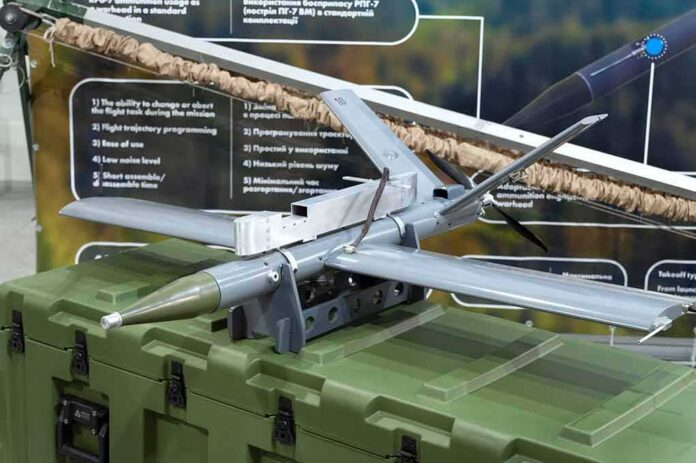
The most revealing thing about Russia’s $2 compass on its Molniya attack drones is not the gadget itself, but the speed and pragmatism with which a front-line force is reengineering cheap plywood airframes to survive in one of the most heavily jammed skies on earth.
At a Glance
- Russian Molniya attack drones are now flying with an ordinary magnetic compass bolted to the fuselage and periodically read by the onboard camera to keep course under heavy satellite jamming.
- This is at least the fourth navigation workaround for the same drone in roughly six months, underscoring a rapid, iterative adaptation cycle rather than a single breakthrough.
- The compass fix sits alongside more complex upgrades—AI-based autonomy, machine vision, mesh radios, fiber-optic links and even improvised Starlink control—turning a low-cost airframe into a flexible weapons platform.
- The episode illustrates a broader pattern in modern warfare: low-cost, “off-the-shelf” improvisations often outpace expensive systems in adapting to electronic warfare and contested electromagnetic environments.
From Plywood Airframe to Iterative Weapon System
The Molniya began its life in the Ukraine war as an unapologetically crude platform: a fixed-wing, suicide or strike drone built largely from plywood and foam, designed to be cheap, expendable and manufacturable at scale with limited industrial capacity. For much of 2024, it functioned as a remote-controlled bomb truck, steered via radio link and basic satellite navigation onto Ukrainian targets—effective, but highly vulnerable to electronic warfare. Ukrainian forces developed jamming and detection tactics that degraded both its control link and its navigation, forcing Russia to choose between a growing attrition rate and a redesign of the drone’s guidance architecture.
That redesign did not arrive as a single “block upgrade” from a defense conglomerate. Instead, observers on both sides of the front began to document a series of field-driven iterations: fiber-optic control wires that made fixed-wing drones effectively immune to RF jamming; early machine-vision tools to help the drone hold a visual lock; and, in 2025–26, experiments with satellite backhaul like Starlink to extend control range beyond line-of-sight. The Molniya thus evolved from a disposable plywood bomb into a testbed, a chassis onto which a succession of navigation and guidance concepts could be bolted, flown, evaluated and either discarded or standardized.
The $2 Compass: How the Fix Actually Works
The compass modification is striking precisely because of its simplicity. According to Ukrainian electronic warfare specialist and defense ministry adviser Serhii “Flash” Beskrestnov, Russian operators have mounted a basic magnetic camping compass on the top of the Molniya’s fuselage and aligned it so that the drone’s existing forward-looking camera can tilt down to bring the compass face into view. During flight, when satellite positioning is unreliable or deliberately jammed, the operator (or an onboard autonomy stack) can momentarily pitch the camera toward the compass, read the heading, and correct course based on the cardinal directions.
Images of downed Molniya drones show the compass quite literally screwed into the plastic or composite skin with ordinary self-tapping bolts, without any attempt to embed it into the avionics bay or integrate it electronically. Military analyst Yan Matveev highlighted the almost comic appearance of this “navigation system”—a scout-grade compass bolted to a combat drone with the camera peeking at it—but the functionality is straightforward. Magnetic compasses provide heading information based on the Earth’s magnetic field; unlike GPS or GLONASS, they are inherently immune to RF jamming and do not depend on external signals or software-defined radios. In a sky saturated with electronic warfare, heading that cannot be spoofed or suppressed is valuable.
Russian and Ukrainian coverage concur on the basic operating concept: the compass is not replacing all navigation, but acting as a low-tech fallback to maintain orientation when terrain features are obscured, satellite fixes are unstable, or the drone must fly a relatively straight course through a corridor of jamming. In practice, this means that a Molniya can continue a mission with degraded positional precision, but with enough directional stability to reach a broad target area, where machine vision or operator steering can complete the engagement.
Why a Compass Matters in a Billion-Dollar Jamming War
The stark contrast in cost—high-end electronic warfare suites and satellite constellations on one side, a $2 compass on the other—captures a core truth of modern conflict: technological advantage is fragile when the underlying mechanisms are exposed to adversaries who can iterate cheaply and quickly. Ukraine, with NATO support, has poured substantial resources into jamming Russian drones, attacking both GNSS signals and radio control links across wide areas. Russia, constrained by sanctions and industrial bottlenecks, has responded by layering low-cost countermeasures onto its existing platforms.
Reports on the Molniya compass note that it is the fourth distinct navigation workaround attached to the same airframe in roughly half a year. Earlier fixes included alternative GNSS receivers, preprogrammed waypoints with inertial backup, machine-vision-assisted guidance, and fiber-optic tethered versions for specific missions. None is perfect; each adds resilience against one slice of the jamming problem. But what matters is the cumulative effect of these incremental changes: each new modification forces Ukraine to refine detection algorithms, extend jamming coverage or adjust air-defense engagement rules, consuming time and resources that far exceed the cost of the Russian patch.
This pattern is not unique to the Molniya or to Russia. A wider body of analysis on “low-cost capabilities” in warfare argues that integrating modular, flexible, off-the-shelf inserts into major systems can dramatically change their cost-performance curve. A compass on a drone is exactly such an insert—simple, robust, and tailored to exploit a specific vulnerability in the adversary’s approach (dependence on satellite denial as a primary counter-drone tool). When the expensive solution can be blunted by a trivial hardware change, the strategic calculus shifts.
Stacking Analogue, Digital and Autonomous Layers
The compass is only one layer of the Molniya’s evolving guidance stack. Ukrainian officials and open-source analysts describe a parallel effort to automate more of the drone’s navigation and targeting using onboard computing. Beskrestnov has detailed how newer Molniya variants fly without a visible control antenna, suggesting they rely on preloaded routes, visual processing and internal decision-making rather than continuous radio steering. Footage and wreckage analysis indicate that machine-vision systems are being used to track roads, vehicles and structural features, allowing the drone to adjust its trajectory even when cut off from an operator.
Other reports describe AI-assisted Molniya drones that were initially difficult to detect and impossible to jam, relying solely on their camera and computer to navigate and select targets, until Ukrainian forces adapted interception tactics and managed to shoot one down over Zaporizhzhia. In parallel, Russian units have experimented with integrating mesh modems—the same category of network gear used on Shahed drones—to extend communication resilience, and with consumer satellite terminals to drive ultra-long-range missions. Each of these layers addresses a different failure mode: loss of satellite fix, loss of radio control, loss of network connectivity, or operator overload.
The compass sits at the analogue end of this stack. Because it is purely mechanical and magnetic, it neither emits nor depends on a signal, making it invisible to most electronic surveillance and immune to the spectrum contest. That simplicity is also its limit: a compass only yields heading, not absolute position. The more advanced layers—AI, machine vision, mesh networking—provide richer situational awareness and weapon effectiveness, but they are vulnerable to software bugs, power failures, and evolving countermeasures. A robust design therefore combines them: an AI drone that can still “look down” at a physical compass for orientation is harder to disorient than one relying entirely on code and satellites.
Effectiveness, Limitations, and Tactical Consequences
Does this $2 fix fundamentally transform the Molniya’s effectiveness? The evidence suggests it solves a narrow but important problem rather than revolutionizing the platform. Ukrainian intelligence has documented numerous cases of Molniya drones becoming disoriented, missing targets or inflicting friendly fire, including strikes on Russian vehicles in rear areas when navigation or target identification failed. A heading reference helps reduce gross orientation errors, but it does not prevent misidentification or compensate for poor mission planning; operators can still steer the drone onto the wrong pickup if they lack reliable target data or visual clarity.
However, from a tactical perspective, the compass increases the probability that a drone launched into a heavily jammed corridor will reach the general vicinity of its intended target. For Ukrainian forces, that translates into a higher baseline of threats penetrating electronic defenses and requiring kinetic interception or hardened infrastructure. Air-defense units cannot assume that GNSS denial alone will cause Molniya sorties to wander harmlessly off course. Combined with autonomy and machine vision, the drone’s navigation is now “good enough” under jamming to remain a serious problem.
The broader implication is that electronic warfare in this conflict is settling into an iterative equilibrium rather than a decisive advantage. Each time Ukraine deploys a new jamming technique, Russian drone units respond with some combination of firmware changes, hardware add-ons and procedural tweaks, then field-test them and propagate successes. The compass is notable mainly as a vivid example of how crude those changes can be while still delivering military value. It is a reminder that a sophisticated EW ecosystem must anticipate and counter not just advanced sensors and radios, but also analog relics and improvised fixes.
“Russian engineers are bolting a magnetic compass onto cheap Molniya drones. An onboard camera periodically tilts down to read the compass, giving the drone a way to hold its bearings even when every satellite signal it depends on has been jammed into static.”
— West Coast Intel (@WestCoastIntel) July 17, 2026
What This Signals for Future Drone Warfare
Looking beyond the immediate Russo-Ukrainian context, the Molniya compass episode points toward a future in which the most consequential innovations in drone warfare may be neither glamorous nor expensive. Highly capable unmanned systems will continue to be developed by major powers, but in contested environments their survivability may hinge on humble modifications—mechanical backups, alternative navigation modes, and modular payloads—that can be added in the field and iterated rapidly.
For planners and industry, this suggests two priorities. First, design drone architectures and counter-drone systems with modularity and redundancy in mind: assume that adversaries will bolt on unanticipated devices and software, and ensure that detection and defense tools can adapt without wholesale replacement. Second, invest in understanding the adversary’s adaptation cycle as much as its current technology. In the Molniya’s case, the “real weapon” is not the compass, the fiber-optic wire or the AI module individually, but the tempo at which Russian units are able to integrate each in turn, learn from failures, and sustain combat-effective volumes of drones.
Seen in that light, a $2 compass on a plywood drone is less a punchline than a warning. When low-cost improvisation is paired with determined iteration, even the simplest hardware can complicate the battlefield for far wealthier, better-equipped opponents. The Molniya is demonstrating that lesson over Ukraine’s front lines; future conflicts are likely to echo it.
Sources:
19fortyfive.com, dialog.ua, www1.ru, linkedin.com, english.nv.ua, nowosci.ai, united24media.com, pravda.com.ua, natsecpulse.com, facebook.com, en.iz.ru, youtube.com, mezha.net, businessinsider.com