

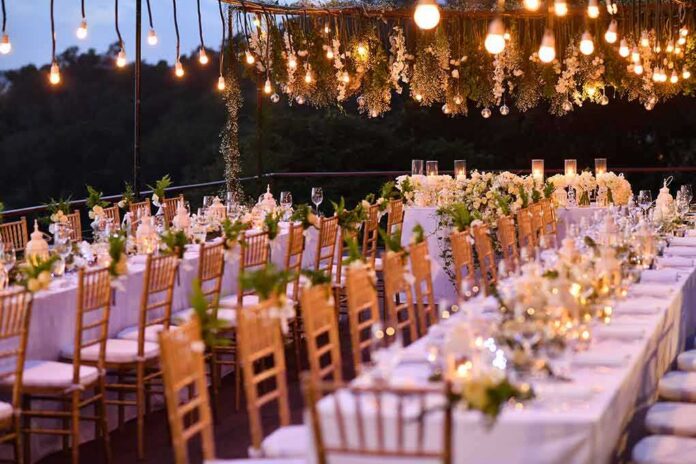
When prominent media figures celebrate at a venue owned by a sitting president, a private milestone becomes a public artifact: the facts are straightforward, but the implications reach into how influence, access, and “fair market value” are understood and scrutinized.
The Short Version
- Sean Hannity and Ainsley Earhardt hosted a Friday pre-wedding gathering at Mar-a-Lago ahead of their Saturday ceremony, with family, friends, Fox News colleagues, and prominent political figures in attendance.
- Hannity stated the couple paid “fair market value” for use of the venue.
- Coverage identified President Trump and other senior figures among the guests, underscoring the event’s public salience beyond a typical rehearsal dinner.
- The invocation of “fair market value” echoes a familiar framework for transactions at properties linked to political leaders.
What Happened: A high-profile pre-wedding celebration at Mar-a-Lago
On the Friday evening before their wedding, Fox News hosts Sean Hannity and Ainsley Earhardt hosted a pre-wedding celebration at Mar-a-Lago in Palm Beach, Florida. Reporting identified a guest list that blended family, Fox News colleagues and executives, and political figures, including President Trump and members of his family, as well as senators and administration officials. Hannity publicly stated that the couple chose Mar-a-Lago and paid fair market value for the venue. The Friday event functioned as a rehearsal dinner-style gathering ahead of their Saturday wedding, and was plainly branded as such by the participants and outlets that covered it.
Two elements are central and uncontested in the reporting: the location—Mar-a-Lago—and Hannity’s explicit claim that the venue was paid for at a market rate. Descriptions of the evening emphasized it as a private celebration with longtime colleagues and friends, framed by the couple and by Fox News as a family-oriented milestone, albeit at a uniquely symbolic property with a uniquely visible roster of attendees.
Why the venue matters: private celebrations at political properties
Mar-a-Lago is not simply an upscale event site; it is a business owned by a sitting president with extensive political, media, and donor traffic. When any high-profile event is hosted there and paid for by private individuals, questions routinely arise—not about whether a bill was paid, but about the nature of “fair market value” in such settings and what, if anything, such transactions signal about access or influence. The federal campaign-finance framework illustrates the logic: when political committees transact with a candidate’s businesses, the rule of thumb is market value—no more and no less—to prevent disguised gifts or in-kind contributions. That standard has become the lingua franca in public debates over payments to properties connected to political leaders.
Although Hannity’s event was a private celebration, not a campaign expense, the vocabulary is similar because the underlying concern is similar: in a venue entwined with political power, the price paid operates as a proxy for independence. That is why public conversation reliably gravitates to the number; whether or not it is disclosed, “fair market value” is meant to signal an arm’s-length deal consistent with what any comparable client would pay for the same service.
What “fair market value” actually entails in hospitality
In hospitality, market value is rarely a single line item; it is a bundle. A typical event agreement specifies the room or space, date and time blocks, food and beverage minimums, staffing, security, setup and breakdown, rentals, service charges, and taxes. Comparable value is established by like-for-like quotes: the same date class (weekday vs. weekend, shoulder vs. peak season), the same space, similar guest counts, and similar service levels. Clubs like Mar-a-Lago also price in exclusivity, access controls, and brand cachet that premium venues routinely monetize. To treat “venue rental” as the whole bill is to ignore how most luxury properties structure revenue: the room fee is often a minority share next to F&B minimums and service charges.
Because those components vary widely by date and configuration, the most credible way to substantiate “fair market value” is through contemporaneous, written quotes for the same package at the same property or close substitutes. That documentation is how professional event planners benchmark cost and how regulators evaluate arm’s-length pricing when the counterparty has political or institutional ties.
Attendees and optics: why the guest list shaped coverage
Coverage highlighted that the gathering drew a mix of Fox News executives and on-air talent alongside political figures and members of the First Family. In the ordinary course, a rehearsal dinner is a private matter—here, the presence of President Trump and senior figures transformed it into a public-facing event with clear news value. Media organizations fairly reported who attended and where it occurred because those details explain the event’s civic salience; they are not incidental color but the reason a private social occasion enters the public record.
For journalists and ethics practitioners, this is familiar terrain: close personal ties between media figures and political leaders increase the importance of transparent boundaries. Ethics codes emphasize both actual conflicts and the appearance of conflicts, because audience trust depends on confidence that professional judgments are not swayed by personal or financial relationships. A plainly stated, arms-length transaction helps, even when the venue is symbolically loaded.
The historical backdrop: transactions at Trump-branded properties
Since 2015, political and media attention has tracked payments to Trump-branded venues by campaigns, committees, and private parties connected to politics. Analyses have tallied millions in political spending at Trump properties, sharpening public sensitivity to who pays, for what, and at what rate. The recurring refrain in this tapestry of transactions is compliance with market value—used both as a defense against claims of self-dealing and as a yardstick for assessing them.
Mar-a-Lago has carried additional symbolic weight due to litigation and public disputes over how the property should be valued for other legal purposes, which has little to do with event pricing but keeps the club’s “value” in the headlines. Those courtroom fights turn on appraisal methods and deed restrictions; hospitality pricing turns on date, demand, and service bundles. Conflating the two obscures more than it reveals.
Fox Hosts Celebrate at Mar-a-Lago Ahead of Saturday Wedding
Fox News hosts Ainsley Earhardt and Sean Hannity held a pre-wedding gathering at Mar-a-Lago in Palm Beach, Florida, on Friday, according to Fox News. The outlet said family, close friends and longtime colleagu pic.twitter.com/ewEKB1PoL6
— John Alayi (@realjohnalayi) October 24, 2026
What to watch in similar situations
The Hannity–Earhardt celebration at Mar-a-Lago is straightforward on facts: it occurred Friday ahead of their Saturday wedding, with a high-profile guest list, and Hannity says they paid fair market value. In future events of this type—private but politically salient—two elements will continue to anchor credible reporting and public understanding. First, clear characterization of the event’s purpose and attendees: who was there, and in what capacity. Second, if pricing claims become part of the public narrative, the most decisive evidence is always the same: contemporaneous quotes and invoices that specify the whole service bundle. Those documents translate the term-of-art “fair market value” into something verifiable in the hospitality marketplace.
Sources:
mediaite.com, newsbreak.com, freep.com, fec.gov, bbc.com, politico.com, cnn.com