

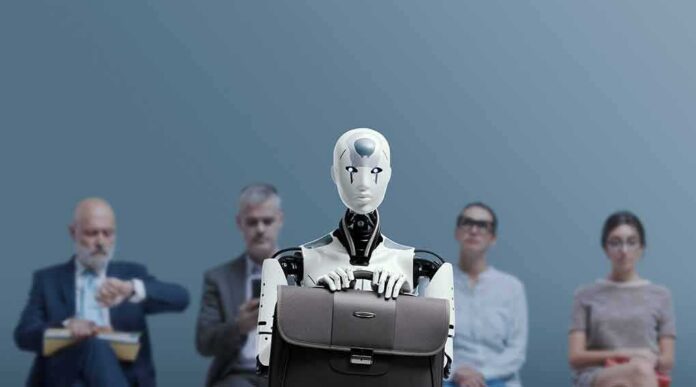
Public robot trials that look like playful street theater are in fact controlled experiments in social learning — and when the subject is child-facing care, the stakes are less about wow-factor and more about whether today’s demo culture can responsibly bridge the gap between a teleoperated stunt and a trustworthy caregiver.
At a Glance
- A life-sized $89,000 humanoid robot mingled with families at Brooklyn Bridge Park, part of an effort to learn social interaction skills from real-world encounters.
- Developers framed future roles in caregiving — babysitting, teaching, companionship — once the system’s social capabilities mature.
- Humanoid demos often blend autonomy with remote control; what delights in a park does not yet equal unsupervised reliability in a home.
- Child-facing robots raise distinct privacy, safety, and ethical issues that demand safeguards beyond generic AI policies.
What Happened at the Park — And Why It Matters
At Brooklyn Bridge Park, a life-sized, AI-powered humanoid robot walked, danced, and sang with visitors as its handler guided the outing; reporting identified the system as an $89,000 platform developed by Faraday Future and chaperoned by the company’s chief technology officer, who described the goal as learning how to “interact” and “nurture” with an eye toward eventual roles like babysitter, teacher, or companion. The spectacle was calibrated to be disarming: a human-shaped machine meeting people where they are, collecting interaction data in a naturally complex environment. As a product strategy, this is sensible — social fluency is hard to simulate in a lab. As a caregiving proposition, it is only the opening move.
Two truths can coexist. First, public trials are legitimate methods to expose an AI system to the messy edge cases of human behavior. Second, the ease with which bystanders anthropomorphize a capable form factor can blur the line between a teleoperated performance and a robust autonomous skill, especially when the prospective use case involves children. That distinction is not pedantry; it is the difference between entertainment and duty of care.
How Social Robots Learn: From Choreography to Competence
Social robots acquire “presence” — the felt sense of interacting with a someone rather than a something — through a stack of capabilities: perception (who is where, doing what), intent inference (what a person likely wants), dialogue and timing (when to speak or wait), and action selection (what to do next). In the wild, those layers tangle: a wind gust masks speech, a toddler darts behind the machine, a caregiver asks a question mid-gesture. Developers therefore blend autonomy with guardrails, including remote operation, scripted behaviors, and constrained tasks, to collect data while keeping interactions on track. Across the humanoid sector, this scaffolding is common; “autonomous” public demos frequently rely on teleoperation or narrow-script control to ensure a smooth display.
The park interaction follows that pattern. A remote operator can intervene to steer, stall, or redirect; meanwhile, onboard models log sensory and social cues to refine future behavior. This is a rational engineering compromise at the learning stage. It is not a proxy for readiness to handle the unscripted demands of childcare, where reliability under stress and principled non-disclosure of sensitive information are table stakes, not stretch goals.
Child-Facing Care Is Different: The Safeguarding Bar
Child-directed robotics brings a specific bundle of risks that adult-facing assistants do not. Children tend to over-trust and self-disclose to robots; studies show young users will confide in social machines as confidantes, which magnifies the stakes of how data is captured, stored, and used. Researchers and ethicists have repeatedly cautioned that current social humanoids lack “reflective abilities” — the capacity to assess the correctness and consequences of their own actions — a gap that undermines unsupervised use in kindergartens and homes.
Safeguarding research converges on a conservative rule: any autonomous behavior around children should be supplemental and assistive, not substitutive for adult judgment — and only after advances in affect recognition and robust perception reduce the risk of harmful misinterpretations. Privacy concerns compound this: to “learn nurturing,” a robot must sense, remember, and generalize from intimate moments. That data has gravity. Meta-analyses and rights-based frameworks warn that connected social robots expand the attack surface for misuse, from hacking to secondary data repurposing, while eroding a child’s private space simply by moving, listening, and watching within it.
From Demo Hype to Duty of Care: What Evidence Must Come Next
The park trial demonstrated that a humanoid form factor, under a handler’s supervision, can engage families and gather interaction data in an unstructured setting — useful for training social policies and calibrating motion. But a caregiving claim lives or dies on different evidence. Before a “robot babysitter” crosses from concept to credible product, three proofs are non-negotiable.
First, operational transparency: a clear accounting of what is autonomous versus teleoperated, backed by logs that can be audited independently. This guards against the well-documented “autonomy gap” in humanoid demos, where stagecraft can mask dependencies on human control. Second, safety cases tailored to children: formal hazard analyses; fail-safe behaviors when perception degrades; and red-line constraints (for example, never physically blocking an exit, never transporting a child, and defaulting to summon a human on any ambiguity). Third, privacy architecture by design: on-device processing whenever possible, data minimization with deletion schedules, unambiguous parental consent flows, and a hard ban on secondary use of child data for unrelated model training — particularly in commercial contexts where incentives to monetize “engagement” are strong.
Future of Childcare? Robot Babysitter Unleashed In NYC Park!
An $89,000 AI robot is now observing human behavior in a New York City park.#AIRobot #FutureTech #NYCInnovation pic.twitter.com/XKPqi59mk9
— OleeAI (@Olee_AI) October 26, 2026
What This Means for Families, Developers, and Regulators
For families, the immediate takeaway is simple: treat public robot encounters as performances and learning exercises, not product trials for unattended care. Enjoy the interaction; assume an adult is in the loop; and decline close-range engagement if you do not wish to be recorded. For developers, the road from park charm to parental trust runs through verifiable autonomy claims, child-specific safety engineering, and privacy commitments that survive contact with business reality. Evidence, not vibes, will decide market permission.
For regulators and standards bodies, child-facing robots warrant a bespoke compliance lane. Borrow from medical-device risk classification and aviation-style safety cases: require pre-market documentation of failure modes, post-market surveillance for harms, and plain-language disclosures to guardians. Social learning in public spaces can accelerate technical progress; coupling that progress to child protection principles ensures it accrues to the right ends.
Sources:
nypost.com, ny.com, scazlab.yale.edu, jaredwatkins.com, news.linxi.com.au, link.springer.com, research.vu.nl, robots.law.miami.edu, frontiersin.org