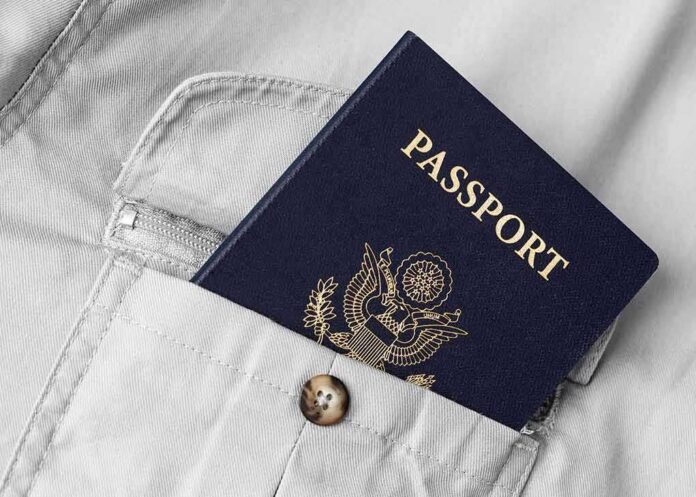
The significance of the new “Patriot Passport” is not the novelty of the document itself; it is the State Department’s decision to turn a routine federal credential into a limited commemorative object and then widen access after demand outstripped the first run.
Key Points
- The State Department is adding 250,000 more commemorative “Patriot Passport” copies because demand has been stronger than the initial supply.
- The passport is a commemorative version of the standard U.S. passport, issued under the same core rules and fees, not a separate travel privilege.
- Access began as a tightly controlled rollout at the Washington Passport Agency, with expansion now extending availability beyond that first bottleneck.
- The story is as much about symbolism and access as it is about paperwork: the passport is a state object, but it is also a political image.
What the State Department Changed
The State Department said it will make an additional 250,000 special commemorative passports available in response to overwhelming demand, extending the reach of the “Patriot Passport” beyond the initial limited release. That is the concrete development: a government agency that had already launched a commemorative passport tied to America’s 250th anniversary is now increasing supply rather than leaving the first allocation to run dry.
The department’s own commemorative passport page establishes the basic framework. The special passport is issued at the Washington Passport Agency in Washington, D.C., starting July 6, 2026, while supplies last. That language matters because it tells you what kind of product this is: not a new class of travel document, but a limited-edition design layered onto the ordinary passport system. The rollout has been deliberately constrained from the start, and the new 250,000-copy expansion is the clearest signal yet that the department underestimated public interest.
How the Commemorative Passport Works
For applicants, the practical point is simple. The commemorative edition does not replace the standard U.S. passport; it is a variant of it, issued under the same passport regime and charged at the same fees. Reporting based on State Department guidance indicates that people who apply online, by mail, or through other routine channels receive the standard booklet, while the commemorative version is tied to in-person access at the Washington agency and special acceptance events.
That structure is classic scarcity design. The federal government keeps the operational passport system intact while attaching a symbolic premium to a small subset of issued documents. In other words, the passport remains functionally ordinary even as it becomes visually and politically extraordinary. That distinction explains why the public reaction has been so intense: the useful part is unchanged, but the image carried inside the document is the point.
The State Department has also framed the commemorative issuance as part of a broader modernization story. At a reception for the passport launch, Secretary of State Marco Rubio described the passport as a “lifeline” and a source of pride, and he said the department was pairing the commemorative rollout with future customer-service changes in the application process. That broader message is not incidental; it is the administration’s attempt to present the project as both patriotic theater and administrative renewal.
Why the Expansion Matters More Than the First Release
The first release created the basic controversy; the expansion tells you where public demand actually landed. A limited federal object can remain obscure when it is merely announced, but once the agency says it is adding another quarter-million copies, the project becomes a mass-circulation symbolic artifact rather than a curiosity for a handful of early applicants. That shift also tells us the State Department is not treating the initial run as a hard cap. It is responding to uptake, which suggests either that the document has a strong collector appeal or that the commemorative framing has proven more resonant than officials expected.
This is why the distribution mechanics are central to the story. The Department began with a bottleneck at a single agency in Washington, then signaled broader access through additional passport offices nationwide. The expansion does not erase scarcity; it softens it. That distinction is crucial. A commemorative federal object derives much of its value from being limited, but if the limit is too tight, it becomes a logistical nuisance rather than a national symbol. The additional 250,000 copies are the department’s answer to that problem.
"PATRIOT PASSPORT" | The State Department announced it is making an additional 250,000 copies of the “Patriot Passport” available “in response to overwhelming demand” from the public. https://t.co/eARlFPP6b7 pic.twitter.com/i5N98GPDJC
— WFLA NEWS (@WFLA) July 31, 2026
The Symbolism Is the Real Product
Passports are among the most formal identity documents a government issues, which is precisely why they are so potent as symbolic objects. They carry authority, border control, and citizenship in one compact format; when a government alters the design for a national anniversary, it is doing more than decorating stationery. It is deciding how the state wants to be seen at a particular historical moment.
That is also why the imagery matters so much. The commemorative edition is tied to America’s 250th anniversary and is being presented as part of a larger celebration of national founding and continuity. In practical terms, the passport still functions like any other passport. In political terms, it becomes an emblem of how the current administration wants the semiquincentennial remembered: not as a neutral bureaucratic milestone, but as a branded national moment with a strongly curated visual identity.
The disagreement around the passport has never been about whether the document exists. It has been about what it represents. Supporters see a patriotic collectible attached to a historic anniversary and supported by a real surge in demand. Critics see a state-issued object pulled toward personal branding. Both reactions flow from the same fact: the passport is official, scarce, and visually loaded. In a government culture where symbols are never just symbols, that combination guarantees attention.
What to Expect From Here
The likely near-term effect of the expansion is straightforward: more applicants will be able to obtain the commemorative edition before the supply runs out, and the passport will move from an unusually scarce launch item to a broader commemorative offering. The longer-term significance is subtler. The rollout shows how a government can use ordinary administrative machinery to produce a durable political artifact—one that is at once functional, collectible, and interpretive.
That is why the “Patriot Passport” is best understood not as a new passport category, but as a test case in how states manage memory through design. It is bureaucratic form made into national narrative. And by increasing the run by 250,000 copies, the State Department has made clear that the narrative has found an audience large enough to justify a much larger printing than the original release implied.
Sources:
facebook.com, youtube.com, washingtonpost.com, travel.state.gov