LA Student Walkout ERUPTS: Property Trashed!
A Los Angeles student walkout that began as an anti-ICE march ended with a police dispersal order, felony vandalism detentions, and a reminder of how fast “protest” can turn into street-level chaos.
Quick Take
- Hundreds of LAUSD middle and high school students walked out on Feb. 4, 2026, marching from campuses to City Hall and toward the ICE Los Angeles Field Office.
- LAPD issued a dispersal order around 3:30 p.m. after protesters blocked traffic, threw items at officers, and vandalized property.
- Police reported at least four suspects detained on felony vandalism allegations, though it remained unclear whether the suspects were students.
- LAUSD leadership publicly emphasized that school is the “safest place,” while acknowledging students’ right to protest.
- Additional walkouts and rallies were being planned, keeping pressure on local schools, downtown businesses, and public safety resources.
What happened in downtown LA and why police ordered the crowd to disperse
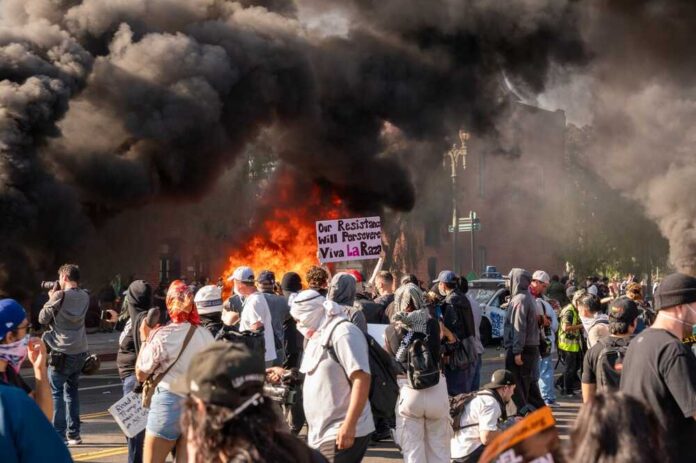
Los Angeles police said a student-led demonstration escalated Wednesday afternoon after crowds moved through downtown near City Hall and the ICE Los Angeles Field Office. Reports described protesters stopping traffic, throwing items at officers, and surrounding police during an arrest. LAPD’s Central Division issued a dispersal order at about 3:30 p.m. near East Temple Street and North Alameda Street, warning that anyone remaining could be arrested.
Early accounts described a large turnout of teenagers—some still carrying backpacks and wearing school attire—who left class earlier in the day and converged downtown. Student messaging promoted the action as peaceful and “student-led,” centered on fear in immigrant communities and anger about raids. By later afternoon, authorities said the situation had shifted from speeches and marching into disorder, forcing police to restore basic public safety and reopen streets.
HAPPENING NOW 🚨: Hundreds of middle school and high school students have walked out of their schools today and met at LA City Hall, and are currently marching toward the immigration detention center to protest ICE deportations and the Trump admin.
Los Angeles, CA 📍 pic.twitter.com/ShCLifI8Q6
— Anthony (@anthonycabassa) February 4, 2026
How the walkout formed: schools, routes, and the message behind the march
Local reporting described students walking out around late morning from multiple campuses, including Mendez High and Woodrow Wilson High, and gathering with signs critical of ICE activity in neighborhoods and near schools. Demonstrators carried Mexican flags and chanted as they moved toward City Hall, where students delivered speeches about family separations and anxiety tied to enforcement. Police later cordoned streets near the Metropolitan Detention Center as the crowd shifted locations downtown.
In 2026, the politics of immigration enforcement land differently than they did during the Biden years. Federal enforcement is no longer treated as optional in many areas, even when local leaders prefer “sanctuary” messaging. That policy collision helps explain why a student protest can draw so many participants so quickly in Los Angeles: the city’s schools serve immigrant-heavy neighborhoods, and student organizers say they are responding to raids affecting parents, relatives, and friends.
Arrests and unresolved questions: who was detained, and what is confirmed
Police reported at least four suspects detained for felony vandalism as the crowd thinned after the dispersal order. Public reports were cautious on a key point: it was not clearly established whether those detained were students, outside agitators, or a mix. That uncertainty matters because it shapes public accountability—families want answers, and the public deserves clarity before anyone paints all students as criminals or, conversely, dismisses the violence as irrelevant.
Video and on-the-ground reporting aligned on the core sequence—walkout, march, congestion downtown, escalation, and a dispersal order—while finer details remained fluid because the situation was still developing. That is typical when police actions, crowds, and multiple locations collide in real time. What is not in dispute is the civic tradeoff: once objects are thrown, property is damaged, and officers are swarmed, law enforcement is obligated to reassert order.
Why this matters: school disruption, public safety, and the constitutional line
LAUSD Superintendent Alberto Carvalho urged families to keep students in school, calling campuses the safest place even while acknowledging protest rights. Attendance impacts were already visible in earlier actions tied to the broader wave of walkouts, with one report citing a notable drop compared with typical daily rates. That disruption is not just political theater; it affects learning, parental work schedules, and the ability of districts to keep normal operations running.
Americans have a constitutional right to speak and assemble, but cities also have a duty to keep roads open, protect businesses, and prevent violence. For a conservative audience, the bigger warning is cultural and institutional: when minors are mobilized into street actions that repeatedly devolve into vandalism, the public is left paying the price—while the same political class that tolerated years of lax enforcement lectures everyone about “community safety.” The facts here show both rights and limits.
Sources:
Massive student immigration protest turns violent in downtown LA, dispersal order issued: police
Massive student immigration protest turns violent in downtown LA, dispersal order issued: police
LAUSD students walk out over ICE raids
Los Angeles school students walk out over ICE immigration protests