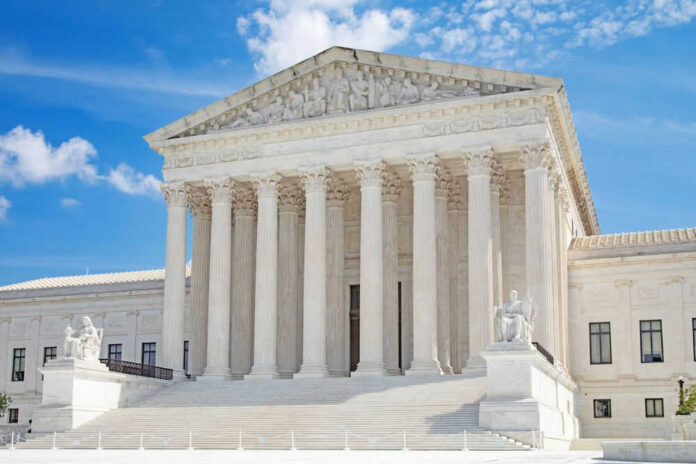
A 9–0 Supreme Court ruling just told the federal government it cannot turn millions of peaceful marijuana users into lifelong prohibited gun owners for simply admitting they smoke.
Story Snapshot
- The Supreme Court unanimously ruled that using marijuana a few times a week is not enough, by itself, to strip an American of gun rights under federal law.
- The justices held the government’s prosecution of Texas resident Ali Hemani under 18 U.S.C. § 922(g)(3) violated the Second Amendment as applied to him.[2]
- The Court rejected the government’s claim that all unlawful drug users can be disarmed based on “status,” while leaving room to disarm true addicts or people who are actually intoxicated and dangerous.[3]
- The decision is another major post‑Bruen win against blanket “class-based” gun bans with no proof of individual violence or impairment.[3]
Supreme Court Rejects Status-Based Gun Ban for Marijuana Users
The case began when federal agents questioned Texas resident Ali Hemani in an unrelated investigation, and he cooperated fully, even handing over a handgun he kept at home for self-defense.[10] During that interview he also admitted he used marijuana about every other day, with no claim that he was violent, intoxicated with a gun, or involved in any drug crime beyond personal use.[2] Federal prosecutors then charged him under 18 U.S.C. § 922(g)(3), which makes it a felony for any “unlawful user” of a controlled substance to possess a firearm, a crime that carries up to 15 years in prison and a lifetime gun ban.[3]
Hemani asked the court to throw out the case, arguing that using marijuana and owning a lawfully kept gun at home for protection falls squarely under the Second Amendment.[2] A federal district judge agreed and dismissed the indictment, and the United States Court of Appeals for the Fifth Circuit affirmed that ruling, holding that applying § 922(g)(3) to a nonviolent, habitual marijuana user like Hemani was unconstitutional.[10] The federal government pushed the Supreme Court to step in and restore its power to prosecute, but the justices instead unanimously sided with Hemani and affirmed the lower courts.[7]
What the Justices Actually Said About Marijuana, Drunkards, and Guns
Justice Neil Gorsuch’s opinion made one core point that matters deeply for gun owners: the government cannot automatically strip a person of the right to keep and bear arms just because that person admits to using marijuana a few times a week.[4] The Court held that the Second Amendment fully covers Hemani’s conduct, since he possessed a firearm in his home for self-defense, and that the government then had the burden, under the Bruen test, to show a historic tradition of similar disarmament laws.[3] Prosecutors tried to lean on old statutes aimed at “habitual drunkards” and people carrying guns while actively drunk, but the Court said those did not match a modern law that permanently disarms anyone who uses a banned substance, even when sober and peaceful.[4]
Crucially, the justices stressed that this was a “narrow” ruling and did not wipe out every part of § 922(g)(3).[3] The Court left open the possibility that Congress may bar true addicts or those who are presently intoxicated and dangerous from possessing guns, so long as those laws resemble historical rules that targeted active impairment and real risk rather than mere status.[3] But in Hemani’s case, there was no evidence of violence, misuse of a firearm, or proof that marijuana use made him a threat, and there was no founding-era tradition of banning all users of an illegal substance from owning guns for life.[3] That failure of proof, not sympathy for marijuana, is what doomed the prosecution and protects millions of ordinary gun owners.
Why This 9–0 Decision Matters for Gun Owners in the Trump Era
This ruling hits directly at the kind of lazy, blanket gun-control policy that has grown in the federal bureaucracy for decades, long before President Trump returned to office.[11] For years, Washington has used § 922(g)(3) to treat any “unlawful user” of a controlled substance—from a medical marijuana patient to a casual recreational smoker—as if that person were the same as a violent criminal, with no hearing, no finding of danger, and no timeline for restoring rights.[5] The Liberty Justice Center, in its brief, warned that this regime effectively brands nearly one-fifth of American adults as “presumptively dangerous criminals” based only on cannabis use, even though many live in states that have legalized marijuana.[5] The Court’s decision pushes back on that mindset and demands real evidence before the government can reach into a citizen’s home and take away a core constitutional right.
Supreme Court backs gun rights for occasional drug users.
📍The Supreme Court ruled unanimously, 9–0, that the government cannot automatically strip citizens of their right to own firearms simply because they occasionally use drugs.
📍The case involved Texas resident Ali Danial… pic.twitter.com/h8qUVBZyer
— The Jewish Voice (@TJVNEWS) June 19, 2026
For conservatives who believe in limited government, this case is about much more than marijuana; it is about whether federal officials can keep inventing new “classes” of disfavored people and then erase their Second Amendment rights without any proof of wrongdoing.[4] After Bruen, and now Hemani, the message from the Supreme Court is clear: if the government wants to disarm someone, it must tie that restriction to our nation’s history and to genuine dangerousness, not to modern moral panics or shifting drug schedules.[4] That standard will matter in future fights over other status-based bans, from nonviolent felons to people caught up in vague restraining orders, and it gives the Trump administration a firm constitutional line when cleaning out decades of overreach from the gun-control bureaucracy.
Sources:
[2] Web – US v. Hemani | American Civil Liberties Union
[3] Web – UNITED STATES v. HEMANI | Supreme Court – Cornell Law School
[4] Web – [PDF] 24-1234 United States v. Hemani (06/18/2026) – Supreme Court
[5] Web – Breaking Down the Hemani Arguments
[7] Web – US Supreme Court unanimously rules in US v. Hemani … – Facebook
[10] Web – United States v. Hemani – Ballotpedia
[11] Web – Supreme Court Decides United States v. Hemani – Faegre Drinker