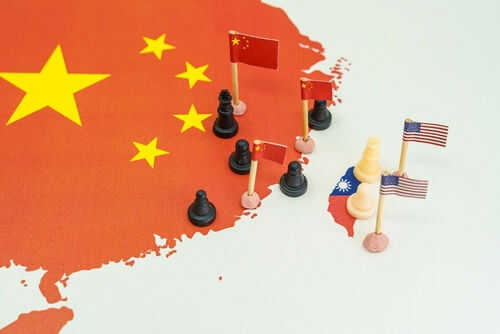
As China tightens the screws on Taiwan, a $14 billion U.S. arms deal has become the latest test of whether Washington will stand firm against communist bullying or blink under pressure.[5][23]
Story Snapshot
- Taiwan’s president is openly pressing the United States to approve a $14 billion arms package “as soon as possible.”[3]
- The Trump administration says the deal is still “under review,” citing the Iran war and U.S. munitions needs.[5][23]
- China strongly opposes the sale, while Taiwan vows it will never accept rule by the Chinese Communist Party.[5][18]
- The fight over timing exposes years of U.S. delays and red tape that leave allies waiting while Beijing builds up.
Taiwan Pushes Washington To Move Faster
Taiwan’s President Lai Ching-te is turning up the public pressure on Washington, saying he has “high hopes” the United States will approve a proposed $14 billion arms sale and stressing he wants it done “as soon as possible.”[3] Speaking to reporters and foreign correspondents in Taipei, Lai tied the package directly to Taiwan’s right to self-defense and repeated that the island “rejects unification” with communist China, which has never ruled Taiwan but claims it as its own.[3][5]
Lai framed the weapons deal as part of a broader push to harden Taiwan against a possible attack, not as a provocation.[5][18] His government plans to raise defense spending to more than three percent of gross domestic product this year, with about NT$1.25 trillion, roughly $40 billion, set aside for weapons purchases, including U.S.-made systems and Taiwan-built drones.[3][4] Lai argued that a democratic people strengthening their own defenses and refusing Chinese Communist Party rule “should not be seen as a provocation” by Beijing.[18]
Why The $14 Billion Package Matters Now
The $14 billion package would be the largest single U.S. arms sale to Taiwan and builds on an $11 billion bundle of rockets, artillery, and drones approved in late 2025.[5][6] Taiwan’s Defense Ministry said that earlier package covered High Mobility Artillery Rocket Systems, howitzers, Javelin anti-tank missiles, and loitering munition drones meant to make any Chinese landing costly and uncertain.[6] Together, these sales fit a long-term effort to give Taiwan more mobile, “porcupine” defenses instead of big, vulnerable platforms.[21][22]
For many U.S. conservatives, helping Taiwan arm up is about more than one island. It is about stopping the Chinese Communist Party from swallowing a free society and controlling a key link in global technology and shipping. Taiwan’s leaders say they rely heavily on U.S. support to counter growing Chinese military pressure, including near-daily air and naval activity around the island.[4] If Beijing can intimidate Washington into backing down here, allies across Asia will take note, and so will Moscow and Tehran.[19]
Trump’s Review, The Iran War, And China’s Shadow
Officials in the Trump administration say the $14 billion deal is “under review” and have tied the pace of approval to U.S. munitions needs for ongoing operations against Iran.[5][23] Acting Navy Secretary Hung Cao told senators there was a “pause” on certain foreign military sales, including Taiwan, “to make sure we have the munitions we need” for a joint operation in Iran, adding that deliveries would resume “when the administration deems necessary.”[23] That language makes clear this is a presidential-level policy choice, not just routine paperwork.[1][23]
At the same time, reporting shows Beijing is lobbying hard behind the scenes to delay or shrink the package as part of a broader push to ease pressure on China.[2][19] Chinese officials have protested the sale and warned Washington not to “interfere” in what they claim is an internal issue.[1][5] In recent years, the United States has sometimes treated arms sales to Taiwan as a bargaining chip with Beijing, even as the Taiwan Relations Act says America will provide the island with weapons of a defensive character.[2][9] That tension between law and diplomacy is now front and center again.
Years Of Backlogs And Delays Leave Taiwan Waiting
This fight is not happening in a vacuum. Taiwan already faces a huge backlog of approved but undelivered U.S. weapons, which reached about $32 billion by early 2026, thanks to U.S. production bottlenecks and long timelines.[20] Analysts note that key systems like new fighter jets, advanced torpedoes, and precision missiles have slipped further behind schedule, even as Chinese forces grow stronger each year.[20][22] Taiwan’s own politics have also slowed things down, with repeated fights over special defense budgets at home.[20][21]
🥜 Taiwan hopes US arms sale package can be approved soon, president says
Taiwan's President William Lai Ching-te is advocating for the swift approval of a US arms sale package, emphasizing the need for respectful dialogue with China.
— Squirrel Brain News (@aylookasquirrel) June 18, 2026
For American readers, that backlog raises hard questions about whether Washington’s defense industry and bureaucracy are keeping up with reality. While the United States delays deliveries to allies like Taiwan, Japan, and Eastern European partners, it has rushed billions in “emergency” sales to other countries tied to current wars.[23] The pattern suggests a system that reacts late instead of preparing early, even when the threat from China is plain and growing. That is not how you deter a determined communist regime.
What Is At Stake For U.S. Security And Values
For conservatives who believe in peace through strength, the core issue is simple: either the United States helps Taiwan become a hard target now, or it risks a much larger conflict later. Taiwan’s president has made clear his people will not accept rule by the Chinese Communist Party, and that only the citizens of Taiwan should decide their future.[5][18] That stance lines up with basic American values of self-determination and resistance to authoritarian control.
If Washington hesitates too long, Beijing may read delay as weakness and push harder, betting that U.S. leaders are distracted by wars elsewhere and domestic drama at home.[2][23] Approving and delivering the $14 billion package would send a different message: that America keeps its word, stands with democratic partners, and will not let communist pressure dictate U.S. policy. In a world where globalists, woke elites, and dictators often seem aligned, many on the right see a clear choice here between appeasement and resolve.
Sources:
[1] Web – Taiwan president says hopes for $14 bn US arms sale ‘as soon as …
[2] Web – US pausing $14bn arms sale to Taiwan due to Iran war, navy chief …
[3] Web – Iran war, China thaw complicate U.S. support for Taiwan
[4] Web – US navy chief says $14bn arms sale to Taiwan paused due to Iran war
[5] Web – Taiwan says US hasn’t notified it of any pause in arms sale – AP News
[6] Web – US Arms Sales to Taiwan – Forum on the Arms Trade
[9] YouTube – U.S. Pauses $14 Billion Arms Sales to Taiwan | China in Focus
[18] Web – Taiwan hopes new US arms sale package can be approved soon, president …
[19] Web – Taiwan hopes new US arms sale package can be …
[20] YouTube – Will Trump Approve US$14B Arms Sale? | Taiwan Hits Back at China’s …
[21] Web – Arms Sales Backlog – Taiwan Security Monitor
[22] Web – US arms sales pause would push Taiwan toward asymmetric …
[23] Web – Taiwan Arms Backlog, June 2024: First Arms Sales to the Lai Ching …