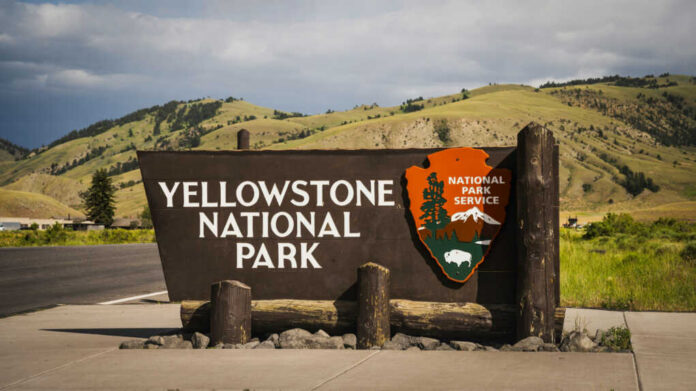
When a 1,500‑pound bull bison turned a quiet Yellowstone campground into a charging arena, it exposed a hard truth about America’s marquee national park: even when visitors follow the rules, rutting bison can turn deadly in seconds.
Key Points
- A 65-year-old grandfather was launched roughly 8 feet into the air by an agitated bull bison at Yellowstone’s Bridge Bay Campground, suffering serious injuries that required hospitalization and surgery.
- Video and eyewitness accounts indicate the bison was already highly agitated, moving through the campground and charging “anything and everything” before targeting the man and his grandson at an estimated 100-yard distance.
- This was Yellowstone’s second human–bison injury in less than two months, part of a long‑documented pattern in which bison injure more visitors than any other animal in the park.
- Research shows most bison injuries occur when people approach too closely for photographs, but this case highlights a more unsettling scenario: a compliant visitor caught in the path of a rut‑crazed bull.
- The incident has reignited debate over how Yellowstone balances visitor access, wildlife behavior, and risk communication, especially in developed areas like campgrounds and boardwalks.
A Violent Charge in a Developed Campground
On a July evening at Yellowstone National Park’s Bridge Bay Campground, a routine walk between campsites turned into a violent, life-altering encounter. A 65-year-old man and his young grandson were on a campground road when a bull bison, already moving through the area in an agitated state, locked onto them and charged. Professional photographer Mike MacLeod, on site to capture the animal’s behavior, recorded the sequence: the bison barrels past tents and vehicles, heads toward the trees where the pair seek cover, then hooks the man with its left horn and sends him flipping through the air.
Witnesses and subsequent reporting describe the man being thrown roughly 8 feet off the ground, flipping midair before crashing onto his side. The impact shattered his leg in multiple places and left him with “pretty significant injuries,” according to his grandson’s account relayed by MacLeod. The bison does not immediately disengage; instead, it stands over the injured man, shaking its head, a posture consistent with lingering agitation and dominance.
What the Video Shows — and What It Doesn’t
MacLeod’s footage and detailed statements are central to understanding this incident. He describes arriving at Bridge Bay and observing a bull bison already “agitated, pissed off, and charging anything and everything” as it moved through the campground. One clip shows the animal running past tents and a white pickup truck, evidence that this was not a single, isolated lunge but part of a broader pattern of aggressive movement in a high-use visitor area.
Accounts converge on a key detail: the man and his grandson were initially about 100 yards from the bison, far beyond the National Park Service’s recommended minimum of 25 yards for bison. They reportedly stopped to take photos from that distance and then attempted to move behind a stand of trees when the bull rose and began to charge. From there, the video shows a grim chase—trees used as shields, the grandson slipping away, the grandfather caught on the wrong side of a trunk as the animal hooks him and launches him into the air.
Injuries, Recovery, and the Quiet Human Cost
The physical consequences of such a toss are predictable and severe. Local and national coverage report that the man sustained a broken leg fractured in several places, requiring hospitalization and surgery. MacLeod’s later conversations with the grandson suggest a prolonged recovery, with the family indicating he was “not out of the woods yet” in the days following the attack.
Unlike some prior Yellowstone bison incidents, where victims walked away with minor injuries, this encounter is firmly in the category of “seriously injured.” The National Park Service confirmed the injury and hospitalization but, as is typical, did not release detailed medical information or the victim’s identity. That privacy leaves the public discussion focused on the spectacle of the toss rather than the months of rehabilitation that almost certainly follow trauma of this magnitude.
Bison Behavior, the Rut, and Why Campgrounds Are Not Sanctuaries
To understand why an apparently distant, non-approaching visitor can end up airborne, you have to look at bison biology and seasonal behavior. Yellowstone’s bison population, which in recent years has ranged from roughly 3,000 to nearly 6,000 animals, includes bulls that can weigh more than 1,500 pounds, run up to 35 miles per hour, and clear obstacles 5 feet high. That combination of mass, speed, and agility turns even a short charge into a high-energy collision.
The Bridge Bay attack occurred during the annual rut — the mating season that typically runs from late June through September, when bull bison compete for dominance and access to females. During rut, bulls are more likely to spar, chase rivals, and demonstrate heightened aggression. MacLeod’s description of a bull “charging anything and everything” in a campground fits that pattern: the animal was not responding to a single provocation but moving through space in a state of elevated arousal.
Critically, this campground attack was not the only serious bison incident in Yellowstone that summer. Less than two weeks earlier, a 12-year-old visitor near the Mud Volcano area was injured when a bison charged after the family reportedly approached within the recommended distance, prompting an official NPS safety release. The cluster—two serious injuries in developed visitor areas within two months—reinforces that rut-season bison behavior can intersect dangerously with human presence even outside the classic “tourist walks up for a selfie” scenario.
The Established Risk Pattern: When People Close the Gap
Over the long term, bison injuries in Yellowstone have been studied in detail. A 2018 analysis of bison–human encounters from 2000 to 2015 found 25 documented injuries, with bison accounting for more visitor injuries than any other animal in the park. In that dataset, 80 percent of injured people actively approached bison before the incident and another 20 percent failed to retreat when the animals approached them. Nearly half of the cases involved photography, and the typical distance at the moment of injury was around 11 feet—less than half a car length.
Those numbers underpin the National Park Service’s clear guidance: stay at least 25 yards (23 meters) from bison and far more from predators; never approach, feed, or attempt to touch wildlife, even if an animal appears calm. NPS safety releases and interpretive materials emphasize visitor responsibility—“Visitors are responsible for staying at least 25 yards away”—and point out that bison may appear docile but can pivot from stillness to a full-speed charge almost instantly.
Most widely-publicized attacks conform to that pattern. In 2022, for example, Yellowstone bison injured two visitors, including one woman who reportedly approached within 10 feet to take a photo and was gored in the hip. Media coverage and park messaging framed those incidents as cautionary tales about ignoring distance rules and underestimating wildlife.
When the Rules Are Followed but the Bull Still Charges
The Bridge Bay incident sits uncomfortably alongside that dominant narrative. Here, the best available accounts — the professional photographer, social media descriptions, and follow‑up reporting — all converge on a starting distance near 100 yards. That is four times the minimum recommended distance. The grandfather and grandson stopped briefly to take photos, then attempted to move behind trees when the animal’s body language shifted toward a charge.
There is some ambiguity: an Instagram reel describing the attack insists the man “did nothing wrong” and was at a “safe distance,” while ABC’s coverage notes they “stop to take photos of the bison,” language some readers interpret as contributory behavior. But the critical distinction here is not whether a photo was taken; it is whether the pair closed the gap below 25 yards. The weight of the reporting suggests they did not.
That matters because it exposes the limits of a rule-based safety message. When a rut‑crazed bull is already moving through a campground road, charging trucks and trees, a compliant visitor can still be swept into the line of fire. The decision to use trees as cover was rational in the moment; the problem was that the animal simply chose to go where the people were hiding.
Media Framing, Public Reaction, and Blame
Mainstream coverage of the attack has often folded it into a familiar storyline: tourists and wildlife do not mix, keep your distance, don’t be foolish around large animals. News segments routinely juxtapose the Bridge Bay footage with other clips of visitors crowding bison or being tossed after approaching too closely. The effect is to suggest continuity—that this grandfather’s trauma is another example of avoidable risk-taking, even though the specifics here are more complex.
On social platforms, the response has sometimes been harsh and dismissive, with commenters cracking jokes about “average Americans” and celebrating the toss as a kind of deserved consequence for human intrusion. That reflex to blame the victim serves as a psychological buffer for viewers—it preserves the belief that “I’d never be that stupid, so this won’t happen to me”—but it obscures the reality that in a dynamic environment, risk is not always a direct function of personal judgment.
MacLeod himself has been explicit: he does not blame the victim or his grandson and characterizes the bull as the clear instigator, already charging through the campground before targeting the pair. That perspective, from the person closest to both the lens and the scene, aligns more closely with the factual record than the meme‑driven commentary that followed.
Yellowstone’s Structural Challenge: Wild Animals in Human Spaces
This case also highlights a deeper tension in park management. Bridge Bay is a developed campground, not a remote backcountry meadow. People sleep, cook, and walk between sites along paved or gravel roads. Bison, however, do not recognize those boundaries. They move freely through campgrounds, parking lots, and boardwalks, drawn by forage, terrain, or simple chance.
Research and NPS incident reports make clear that most dangerous encounters happen in these shared spaces—developed areas where visitors feel “safe” and where social crowding, cameras, and vehicles compress both people and animals into narrow corridors. The park’s current strategy is to maintain distance rules, post warnings, and occasionally close areas when wildlife behavior becomes predictably hazardous. Yet episodes like Bridge Bay demonstrate that unpredictably aggressive individuals can still traverse high-density areas without warning.
For visitors, the practical takeaway is threefold. First, the 25-yard rule is a floor, not a guarantee; when bulls are in rut or any bison appears agitated—pawing, snorting, tail raised—greater distances and physical barriers are prudent. Second, “developed area” does not mean “low risk”; a bison on a campground road is still a wild, highly capable animal. Third, situational awareness matters as much as obedience to posted rules: if an animal’s behavior changes abruptly, moving away early and decisively is safer than assuming it will respect invisible lines.
An agitated bull bison barrels through a Yellowstone campground and sends a visitor flipping through the air in a terrifying attack caught on camera.
Witnesses say the man and his grandson were keeping their distance when the animal suddenly targeted them after charging a group…
— Erinest™ (@Elinestbwanakw1) July 13, 2026
Sources:
facebook.com, cowboystatedaily.com, nps.gov, instagram.com, youtube.com, thehill.com, npshistory.com, pmc.ncbi.nlm.nih.gov, greateryellowstone.org, krem.com