The most revealing detail in Nicholas Kristof’s latest poverty dispatch is not the thousand miles he drove, but the six pennies in a piggy bank that now stand in for a hollowed-out safety net.
Key Points
- Kristof’s 1,000‑mile road trip across the United States culminates in the profile of Trinity Goodman, an Oklahoma City woman living on a few dollars in the bank and six cents in cash.
- He frames Goodman’s situation as emblematic of how recent cuts to food stamps, health care, and other social programs have intensified hardship for millions of low‑income Americans.
- Goodman survives by selling blood plasma and relying on SNAP benefits that cannot be used for essentials like toilet paper or menstrual products, forcing her toward church pantries for basic needs.
- Kristof’s column sits within a long career of using deeply reported individual stories to illuminate large‑scale policy changes, especially reductions in aid and food assistance.
A Thousand Miles to Six Pennies: What Kristof Actually Found
Kristof’s column, “Meet the Americans Who Can’t Afford Hair Cuts or Toilet Paper,” is structured around a physical journey — roughly 1,000 miles by road — and an economic descent. He drives through parts of the country that have borne the brunt of industrial decline and fragile service‑sector work, but it is one stop in Oklahoma City that becomes the spine of his argument: the visit with Trinity Goodman.
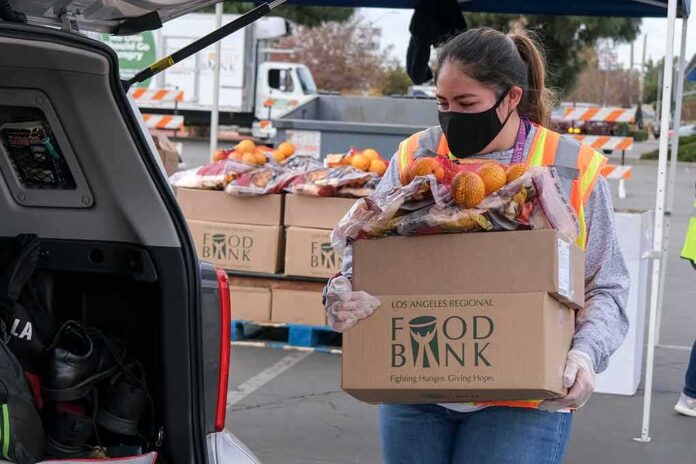
Goodman is 44, upbeat and talkative in his description, but financially stripped to the bone. At the moment he meets her, she has $3.78 in her checking account, one cent in her savings account kept open for form’s sake, and six pennies in cash — the kind of ledger that would be unusual even by the standards of the working poor. To keep herself afloat, she sells blood plasma twice a week, a practice that exposes the body’s literal fluid reserves as the final resource when wages and benefits fail. Her monthly food stamps — $298 — keep her fed, but because SNAP cannot be used for non‑food items, she is left scrambling for toilet paper and feminine hygiene products at church‑run pantries.
From Case Study to Policy Argument: Linking Goodman to Safety‑Net Cuts
Kristof’s road trip is not presented as a neutral travelogue; it is explicitly framed as a search for Americans whose lives have been made more precarious by recent policy decisions in Washington. In the column and accompanying social posts, he argues that “many struggling Americans now find their difficulties compounded by President Trump’s cuts in food stamps and health care.” The Goodman profile is his most vivid embodiment of that claim: a woman whose income and benefits are insufficient for basic dignity, and whose margin for error has narrowed further as assistance programs shrink.
The broader policy context is real and substantial. The One Big Beautiful Bill Act (H.R. 1), enacted in 2025, reduces funding for the Supplemental Nutrition Assistance Program (SNAP) by approximately $186 billion over ten years — described in one peer‑reviewed analysis as the steepest cuts in the program’s history. That same analysis estimates that around 4 million people will either lose SNAP benefits entirely or see meaningful reductions in their monthly support. Separate reporting and economic analysis have found that more than 3.5 million individuals have already lost food stamp access as the cuts and new requirements take effect. In parallel, commentary from Kristof and other observers points to reductions in Medicaid, reproductive‑health funding, and mental‑health programs for children, all presented as part of a unified retrenchment of the safety net.
The Mechanics of Hardship: How Policy Changes Show Up in a Household Budget
What makes the Goodman episode compelling, and useful as a teaching case, is that it allows us to watch policy changes cascade down into the granular choices of a single household. SNAP is designed to supplement food budgets, but Goodman’s $298 monthly benefit cannot be used for non‑food essentials. That means items like toilet paper, shampoo, laundry detergent, and menstrual products must be purchased with cash she does not have. When benefits are cut or eligibility tightened, households like hers face an immediate trade‑off: eat less, skip rent or utilities, or search for charitable stopgaps such as church pantries.
Clinical and public‑health reporting has long documented that when food assistance shrinks, people improvise in ways that carry long‑term costs: stretching meals by skipping protein, prioritizing groceries over medications, or relying more heavily on cheap, calorie‑dense food that deepens chronic disease. One psychiatrist writing during a previous SNAP cut described patients choosing meals over co‑pays for crucial mental‑health medications, a pattern that maps neatly onto the pressures Kristof highlights. The Federal Reserve Bank of New York has recently noted a “notable surge in food insecurity” as people absorb higher prices alongside reduced assistance, an aggregate signal that the stresses Kristof encounters are not isolated.
Kristof’s Story‑First Method: Why He Drives, and Whom He Chooses
Kristof has built a career on the belief that individual stories are the most effective way to convey complex injustices, whether the subject is global health or domestic poverty. In a talk on communicating about hardship, he argues that audiences lose focus as numbers climb — “the moment our minds begin to wander… is when n equals 2” — and that empathy is most reliably engaged by a single, identifiable person. The thousand‑mile trip is therefore not just a reporting flourish; it is a method for finding a protagonist whose lived experience can stand in for dry budget tables and acronyms.
His prior work shows the same pattern. Through his “Win a Trip” contests, he has taken college students to places like eastern Congo and Darfur to witness and document extreme deprivation, mixing data on mortality or funding with portraits of specific families. In his recent memoir and related talks, he describes returning to his hometown in Oregon to trace how economic decline and addiction pulled one working‑class family apart, using that narrative to underline broader trends in American inequality. Goodman’s six pennies fit squarely into that tradition: a small, concrete detail that anchors a wider indictment of policy priorities.
The Scale Behind the Story: SNAP Cuts, Work Requirements, and Health Effects
One legitimate question in any anecdote‑driven reporting is whether the highlighted case is representative. Kristof’s argument rests on the idea that Goodman’s situation, while extreme in its specifics, is part of a much larger pattern created by federal decisions on SNAP and related programs. Here, independent research provides important corroboration.
Health‑policy scholars examining the 2025 SNAP reductions warn of “health effects of reductions in food assistance benefits,” including increased rates of food insecurity, stress‑related illness, and deferred medical care. Their review flags not only the funding cuts but also the expansion of work requirements and administrative hurdles that can cause eligible people to lose benefits. Those requirements, Kristof notes, may sound reasonable in the abstract but have repeatedly proved costly to administer and effective mainly at pushing people out of the program rather than into stable employment.
Economic and journalistic analyses likewise caution against interpreting a shrinking food‑stamp caseload as a sign of reduced need, arguing that participation can fall even as hardship persists or grows when barriers are raised. When 4–4.7 million people lose SNAP assistance or see their monthly benefit reduced, the probability that many of them look like Goodman — juggling low wages, unstable work, and health needs — is high. Kristof’s road trip gives those aggregate numbers a face and a name.
Critiques of Kristof’s Approach: Anecdote, Power, and Representation
Kristof’s style is not without critics, and understanding those critiques is part of taking his reporting seriously. Scholars and commentators have challenged some of his foreign‑aid columns for flattening complex societies into backdrops for Western moral narratives, or for leaning too heavily on savior tropes and shocking stories at the expense of structural analysis. A widely discussed critique from a left‑leaning magazine argues that his work risks implying that poverty can be solved primarily through individual charity and well‑chosen NGOs, underplaying the role of politics and collective action.
These concerns travel, in modified form, to his domestic poverty reporting. An anecdote, no matter how vivid, cannot by itself prove causality between a specific federal cut and a particular household’s misery. What it can do — and what Kristof aims for — is to make the consequences of plausible causal links tangible: cuts to SNAP and Medicaid reduce disposable resources; reduced resources force painful trade‑offs; those trade‑offs show up as skipped haircuts, unpaid utility bills, and, in Goodman’s case, a reliance on blood plasma sales. The critique therefore pushes readers to ask what structural changes would reduce the need for such stories, rather than simply increase private generosity in response to them.
Why Stories Like Goodman’s Matter in the Policy Arena
From a policy perspective, the Goodman profile operates as a case study in the politics of attention. Budget bills and regulatory changes often move through Congress and federal agencies with only cursory public debate, especially when they are wrapped inside large, multi‑issue packages. A single story, reported in detail and amplified by a prominent columnist, can change that by making abstract trade‑offs feel morally immediate.
Kristof himself has argued, in talks and interviews, that journalism’s job is partly to “open a pathway” through emotion, creating enough engagement that people will then pay attention to the data and proposals. Goodman’s six pennies, the bandage on her arm from plasma donation, the haircuts she has never had because they feel like a “luxury” — these elements are crafted to lodge in the reader’s mind, so that when they next hear about SNAP cuts or Medicaid waivers, they recall a concrete person rather than a line item.
For readers, the real test of such reporting is not whether they feel sympathy, but what they do with it: whether it prompts them to examine local food‑pantry needs, query their representatives about safety‑net legislation, or scrutinize claims that benefit reductions simply encourage self‑reliance. Kristof’s thousand‑mile road trip, at its best, functions as a bridge between the lived experience of poverty and the policy debates that determine how common that experience will be.
How This Fits Into the Larger Story of American Poverty
Goodman’s situation is extreme, but it sits on a continuum that decades of research and reporting have charted. Around 47 million Americans have, in recent years, relied on food stamps to combat hunger. Even before the latest cuts, about 5 percent of the population experienced “very low food security,” meaning episodes where food ran out before income arrived; in one‑third of such households, an adult reported not eating for an entire day. These realities intersect with low wages, rising housing and health costs, and uneven access to quality education — the same structural issues Kristof traces in his work on both global and domestic poverty.
What changes in the wake of Trump‑era safety‑net reductions is the thickness of the cushion between a bad break and catastrophe. Goodman’s six pennies dramatize that thinning cushion. For a middle‑class household, a surprise bill can be absorbed with savings or credit. For someone living on the narrow edge of SNAP eligibility and plasma money, the same bill might mean eviction, untreated illness, or a stretch of days without food. Kristof’s thousand‑mile road trip is, in effect, a survey of where that edge now lies — and of how federal policy has pushed it closer to disaster for people who were already balancing on it.
Sources:
twitchy.com, journalism.missouri.edu, youtube.com, crcna.org, dailymotion.com, magazine.blogs.wesleyan.edu, en.wikipedia.org, africasacountry.com, npr.org, nytimes.com, x.com, cgdev.org, pbs.org, ipl.org, cnbc.com, pmc.ncbi.nlm.nih.gov