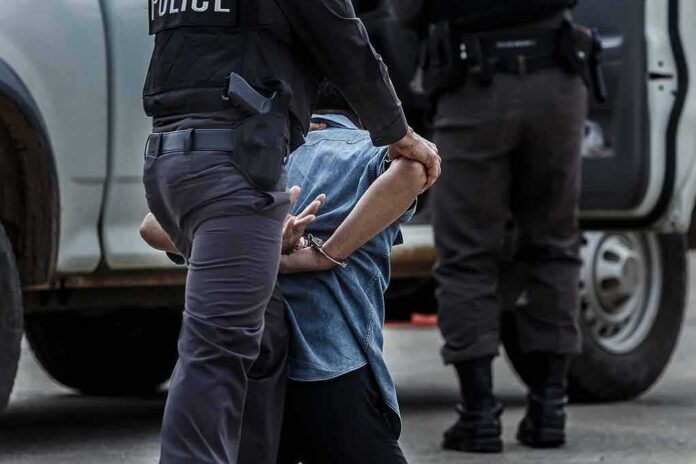
In the uneasy space between routine security planning and feared political violence, the arrest of Marine veteran Jeanine John Taele at President Trump’s Los Angeles golf club shows how suspicious conduct, firearms, and a high-profile protectee can rapidly escalate into a complex federal case even before any intent to attack is proven.
At a Glance
- A 38-year-old Marine veteran, Jeanine John Taele, was arrested at Trump National Golf Club Los Angeles after agents reported surveillance-like behavior ahead of President Trump’s visit.
- Authorities say he twice roamed the grounds wearing an earpiece, taking photos and videos of Secret Service and security preparations, and later falsely claimed State Department security affiliation.
- A search of his truck and home yielded a loaded 9mm pistol, hollow‑point ammunition, and an alleged unregistered short‑barreled AR‑style rifle, along with body armor, high‑capacity magazines, and notebooks with “concerning” writings.
- Prosecutors have charged firearms offenses and cited a separate robbery investigation, while officials emphasize that no specific, credible threat to President Trump or the public has been identified.
An Arrest Built Around Conduct, Context, and a Gun
According to federal and local authorities, the case against Jeanine John Taele begins not with a manifesto or an explicit threat but with behavior that looked, to trained eyes, like advance surveillance of a protected site. Over several days, as Secret Service and other federal agents conducted a security assessment at Trump National Golf Club Los Angeles, they observed a man later identified as Taele walking the grounds, wearing a radio earpiece, and taking photos and videos focused on security personnel and their activities rather than the scenery.
That pattern alone does not prove malign intent; people film high‑profile venues every day. What changed the posture from watchful to intervention was the combination of repetition — agents say he returned to the property during active security planning — and his proximity to areas where details of that planning could be observed. In the post‑2024 environment of repeated threats and attempts targeting President Trump, anything resembling reconnaissance draws an immediate and aggressive response.
What Authorities Say They Found
When deputies and federal agents confronted Taele on the Sunday before President Trump’s scheduled fundraiser, they were not meeting a casual passerby. According to a Justice Department complaint and sheriff’s statements summarized across outlets, Taele told federal agents on scene that he was a U.S. State Department employee on a security detail, an assertion authorities say was false. Investigators treat bogus claims of official status as a serious red flag: it suggests pretense designed to move freely in sensitive spaces or gather information without challenge.
A search of his pickup truck in the club’s parking area reportedly produced a loaded 9mm pistol with a round chambered, a 16‑round magazine of hollow‑point ammunition, binoculars, and at least one badge bearing language such as “security protection agent” or “fugitive recovery.” Deputies further stated that he had a round of ammunition on his person. The ammunition type, hollow‑point, is not rare in civilian use but is treated with particular concern when combined with deceptive claims about being part of a security detail.
The more substantial legal exposure emerged the following day, when sheriff’s detectives and FBI agents searched his home in Downey. There, according to the federal complaint and media accounts that have reviewed it, they found an AR‑platform rifle they describe as illegally modified into a short‑barreled configuration, a.45‑caliber pistol, body armor, multiple high‑capacity magazines, bulk pistol ammunition, radio signal devices, and several notebooks containing what officials call “concerning statements.” Those alleged modifications underpin the federal charge: possession of an unregistered short‑barreled rifle can carry up to 10 years in prison.
From Suspicion to Charges: The Legal Theory
This case illustrates a familiar pattern in high‑security arrests: prosecutors build a chargeable theory around clear firearm offenses and concealment, while the more dramatic question — was there an actual plan to attack President Trump? — remains unanswered at the complaint stage. The Justice Department has publicly described only one federal count so far: possession of an unregistered short‑barreled rifle, based on measurements and configuration of the AR‑style weapon recovered from his home.
On the state side, Taele reportedly faces accusations of receiving a large‑capacity magazine, carrying a concealed firearm, possessing a short‑barreled rifle under California law, and involvement in an unrelated robbery investigation in El Segundo. Each of these involves specific statutory elements: the capacity threshold for magazines, the definition of “concealed” in a vehicle context, and the precise barrel and overall length measurements that turn an ordinary rifle into a regulated short‑barreled weapon under both California and federal statutes.
For now, the public record shows that law enforcement had probable cause to investigate and arrest based on observed conduct, the recovered handgun and ammunition, and the allegedly illegal rifle configuration. Probable cause is a relatively low threshold — a reasonable basis to believe a crime has been committed — and it does not require proof beyond a reasonable doubt of any intent to harm President Trump or anyone else.
Veteran Status and Mental Health: Background, Not Defense
One of the most striking features of the coverage is the emphasis on Taele’s military background. Pentagon records cited in multiple reports confirm that he served in the Marine Corps, including deployments to Iraq and Afghanistan. Some television segments describe him as a decorated or disabled Marine veteran who lives with post‑traumatic stress disorder. That framing inevitably shapes public reaction: for some, it evokes concern about untreated combat‑related trauma; for others, it raises the specter of a trained individual turning his skills toward a political figure.
From a legal standpoint, veteran status and PTSD are double‑edged. Defense counsel may later invoke them to explain behavior, mitigate sentencing, or argue for treatment rather than lengthy incarceration. Yet they can also erode credibility in the court of public opinion, especially when prosecutors present firearms, surveillance, and ambiguous writings. NBC’s references to PTSD and mental health issues may predispose some observers to treat any future defense narrative as unstable or self‑serving rather than as a structured rebuttal to the government’s claims.
What Is Known — and What Is Not — About Intent
The center of gravity in this case is the gap between suspicion and proof. Authorities have been explicit on one key point: despite the timing and the venue, they have not identified a specific, credible plot to harm President Trump or the public. The notebooks seized from Taele’s home are described in broad terms as containing “concerning” or even “nonsensical” statements, but no excerpts have been released that tie his writings to a concrete operational plan.
Nor has the public seen the full federal complaint or supporting affidavit, beyond paraphrases in press reports. Those documents would normally lay out the factual basis for each charge, including dates, times, and officer observations that could connect his movements on the golf course to any broader scheme. Until they are published in detail, the case remains, in public view, a combination of advance‑security suspicion, firearms possession, and investigative caution in an environment shaped by prior Trump‑related threats.
It is equally important to note what is not visible: there is, at this stage, no publicly articulated defense theory. The supplied research contains no motion challenging probable cause, no statement from counsel disputing the rifle’s classification, and no alternative explanation for the State Department claim or the content of the notebooks. That asymmetry — many pages of law‑enforcement narrative, zero pages of defense narrative — does not mean the government is infallible; it means the evidentiary conversation is incomplete and still largely one‑sided.
Trump Security Incidents and the Amplification Effect
This arrest did not occur in isolation. Since 2024, there have been multiple high‑profile incidents involving armed individuals near Trump properties and events, including the prosecuted attempt on his life and arrests of men found with rifles near golf courses or venues where he was speaking. Media outlets routinely situate Taele’s case inside that narrative, reinforcing a sense of cumulative peril around the current president.
That broader context matters because it amplifies how ambiguous facts are received. A man with a loaded pistol and an unregistered rifle is serious enough under any circumstances; when that man appears at Trump’s golf course days before a fundraiser, wearing an earpiece and filming agents, the story is almost irresistibly framed as “another possible assassin stopped in time.” Yet, on the evidence currently public, prosecutors have charged firearms crimes, not attempted assassination, and officials are careful to say they lack a verified plot.
For an informed observer, the task is to keep both realities in view. The security services are right to act aggressively when they see what looks like surveillance of a protectee’s site by an armed individual, particularly in a climate of repeated threats. At the same time, the law draws a hard line between suspicious behavior plus illegal weapons, on one hand, and the fully formed intent that defines an assassination attempt, on the other. Where Taele ultimately falls on that spectrum will depend on evidence that has not yet entered public view.
Why This Case Matters Beyond One Golf Club
The Taele case is important not because it proves or disproves a single plot, but because it illustrates how modern protective security, firearms law, and public trust intersect around a controversial president. It shows how a veteran with weapons and ambiguous conduct can be rapidly pulled into a federal case grounded in technical firearm regulations, how narrative gaps — like the absence of a quoted plan — are filled by assumption, and how the same facts can be reported as either vigilance that prevented a tragedy or overreach fueled by political anxiety.
For readers who follow these episodes over time, the discipline is to separate three questions: What did investigators see and seize? What have prosecutors chosen to charge? And what, if anything, ties those facts to an actual plan of violence against President Trump or anyone else? On the first two, the record is already strong. On the third, the jury is still out — not metaphorically, but literally, awaiting the fuller evidence that only a courtroom and unsealed filings can provide.
How Similar Cases Have Evolved
Looking at prior arrests near Trump venues helps calibrate expectations. In some earlier matters, such as the case of Ryan Routh at a Florida golf course, additional evidence — social media posts, stored weapons, ballistic findings — eventually supported charges including attempted assassination. In others, what began as a terrifying headline resolved into a primarily firearms or trespass prosecution, with no proved plan against the president.
The distinguishing factor is almost always documentary and forensic detail: explicit targeting language, maps, timing notes, or digital traces that bridge the gap between being armed in a sensitive place and intending to kill a specific person. At present, the public Taele record mentions “concerning” writings but does not quote them, and references radio devices but does not link them to a tested communication scheme. Until those gaps are filled, his case sits in the zone of serious suspicion plus clear weapons charges, rather than demonstrable plot.
What to Watch as the Case Moves Forward
For those following the matter closely, several developments will be particularly telling. One is the eventual release — or courtroom discussion — of the full federal complaint and any search‑warrant affidavits, which should illuminate exactly how agents interpreted his movements, equipment, and statements. Another is whether defense counsel challenges the classification of the AR‑style rifle as short‑barreled, an issue that often turns on millimeter‑level measurements and specific ATF guidance.
Equally significant will be any expert testimony or filings about his notebooks and mental health. If those writings are merely disjointed or symbolic, the government’s narrative may lean more heavily on the gun charges. If they contain detailed references to President Trump, event timing, or tactical considerations, prosecutors may consider more aggressive counts. Between now and then, the prudent stance is to treat the arrest as a serious but still legally narrow firearms and security case, not as a concluded story about yet another would‑be assassin.
No confirmed information indicates that Jeanine John Taele is former military.16
Reliable news coverage from outlets including the Los Angeles Times, Fox News, CNN, ABC, USA Today, and others identifies him as a 38-year-old Downey, California resident. Reports detail the August…— Domari Nolo 🇺🇸 (@Domari_NoIo) August 5, 2026
Sources:
military.com, nypost.com, abcnews.com, wsj.com, youtube.com, cnn.com, bbc.com, foxnews.com, nbcnews.com, abc11.com, justice.gov, foxbaltimore.com