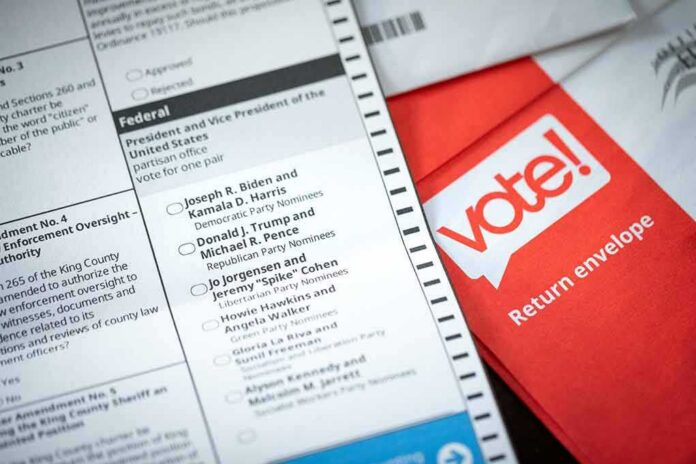
Election law runs on two imperatives that collide in hard cases: vindicating voter intent and preserving orderly, secret-ballot administration. The Alaska “two Sullivans” dispute is a textbook collision, and the court’s rejection of the Justice Department’s proposed fix shows why remedy, not rhetoric, decides these fights.
The Short Version
- Two candidates with materially similar names—incumbent Sen. Dan S. Sullivan and Daniel J. Sullivan—appeared on Alaska’s general-election ballot, creating a plausible risk of voter confusion.
- The Department of Justice sued before certification, arguing that misdirected votes could be outcome-relevant and seeking to segregate and investigate ballots ranking Daniel J. Sullivan.
- U.S. District Judge Sharon Gleason dismissed the request as infeasible and likely to create new voter confusion; DOJ offered no workable, secrecy-preserving method to reconstruct intent from already-cast secret ballots.
- The ruling did not resolve whether anyone engineered a “decoy” candidacy; it turned on remedy, timing, and election-administration constraints.
What the case is really about: remedy under the secret ballot
The Justice Department’s core theory was concrete, not abstract: when two near-identical names appear on the same ballot, some voters may mistakenly select the wrong one, and—under Alaska’s ranked-choice system—the misdirection could alter the cascade of transfers. DOJ sought to prevent certification if the confusion could have changed the winner and asked the court to segregate ballots ranking Daniel J. Sullivan for investigation. That puts voter intent at center stage. But in American elections, ballots are secret by design; once cast, they are commingled and anonymized to protect voters from retaliation or exposure. Any proposed inquiry into “what the voter really meant” must therefore proceed without matching a ballot to a person. The court’s order turned on that operational reality: there was no practicable way to identify, isolate, and reassess a subset of anonymous ballots without breaking secrecy or disrupting the election itself.
Judge Gleason’s opinion squarely faulted the government for proposing no workable plan to segregate ballots and conduct any inquiry consistent with ballot secrecy. She further concluded that announcing such a process midstream would itself likely confuse voters and chill participation—an unacceptable cost for a cure that could not function as promised. In short, the lawsuit’s weakness was not that confusion was impossible; it was that the fix was unadministrable at the moment DOJ asked the court to impose it.
How we got here: Alaska’s ballot design, timing, and the Purcell concern
Alaska election officials placed both Sullivans on the general-election ballot after Daniel J. Sullivan advanced through the top-four primary, where he drew roughly 2.5%—enough to appear in November under state law. The state maintains it “carefully designed the ballot to minimize voter confusion,” a point advanced in litigation to rebut the idea that voters would be systematically misled at scale. DOJ filed on October 22, while voting was already underway, seeking to ensure certification would not lock in an error if misdirected votes proved outcome-determinative.
Late timing is not a mere etiquette issue in election cases; it is jurisprudence. Courts widely apply the Purcell principle—resistance to changing the rules or procedures of an election as voting is ongoing—precisely because last-minute judicial edits risk confusing voters more than they protect them. Judge Gleason applied that logic here, emphasizing that many ballots had already been cast and mixed; any ex post segregation would be infeasible and any new investigative overlay would likely depress turnout or create fresh uncertainty. The ruling thus rested on administrative capacity and institutional restraint, not a thumbs-up or thumbs-down on the underlying suspicion.
What the record shows—and does not
The record contains three relevant strands. First, the objective risk: two similar names sharing a ballot is a known vector for confusion; it is why election administrators typically rely on middle initials, party affiliations, and ballot layout to differentiate candidates. That condition existed in Alaska. Second, the legal posture: DOJ’s theory arrived as a formal federal complaint seeking to halt certification if the confusion proved decisive, not as a press release—a signal that, institutionally, the government believed the risk and timing warranted judicial scrutiny. Third, the remedy gap: neither affidavits from confused voters nor a secrecy-preserving mechanism to reconstruct intent from anonymous ballots appeared in the government’s ask, and the court rejected the relief on that basis.
Two caveats are critical. The dismissal did not adjudicate whether Daniel J. Sullivan was recruited as a spoiler; the judge expressly left that question unresolved. And while Alaska’s Division of Elections previously criticized Daniel J. Sullivan’s filing purpose, that administrative finding does not by itself establish measurable voter confusion or an altered outcome; it speaks to intent in filing, not to the tabulation consequences of votes already cast. Courts need proof they can implement. Here, that proof was either unavailable or incompatible with ballot secrecy and timing.
Comparative perspective: same-name tactics are real, decisive proof is rare
Across jurisdictions, “name twin” gambits surface episodically. They are not folklore; instances from Washington’s 2024 gubernatorial primary to scattered local contests demonstrate the tactic’s allure. But decisive evidence that such schemes flip outcomes is uncommon, for the same structural reason Alaska encountered: once secret ballots are cast, the system contains no forensic key to relink intent to a particular mark without breaching secrecy or imposing speculative reconstructions. That is why election-law commentary treats these cases as serious but rarely outcome-proven; administrators focus on ex ante design to reduce confusion rather than ex post reallocation of votes.
What an appeal can—and cannot—change
An appeal can challenge legal conclusions about standing, feasibility, and the propriety of emergency relief near an election. It cannot conjure a workable, secrecy-preserving ballot-segregation protocol that did not exist when the trial court ruled, nor can it reverse the calendar. Unless DOJ can identify a legally sound alternative remedy—targeted recount protocols anchored in public records, admissible voter testimony offered voluntarily and insulated from ballot exposure, or a clear statutory hook empowering tailored investigations without chilling participation—the fundamental obstacle remains: secret-ballot systems do not permit retroactive reconstruction of ambiguous intent at scale.
What can change on appeal is doctrine around when federal courts may pause certification to investigate a specific, administrable harm in a ranked-choice framework. If appellate judges read Alaska’s timing and process differently—or if DOJ narrows its ask to remedies election officials can execute without segregation—some relief is theoretically possible. But the core insight endures: in election law, a remedy that election administrators cannot run is no remedy at all.
🚨 BREAKING: ALAN DERSHOWITZ JUST SAID THE QUIET PART OUT LOUD 🚨
Harvard Law legend Alan Dershowitz just went nuclear on the Alaska Senate “Dan Sullivan” scheme:
“This CROSSES THE LINE TO A CRIME.”
He says Democrats ran a clear conspiracy to “deny people their civil rights or to… pic.twitter.com/a1AyWfzYPp— CONSTITUTION X 🇺🇸 (@ConstitustionX) November 1, 2026
The durable lesson for election administrators
The Alaska case should reorient effort to the front end, where it is most effective and least disruptive. Three practices deserve priority. First, aggressive ballot differentiation when names are similar—middle names or initials, occupation descriptors permitted by law, clear party labeling, and unambiguous layout—so voters can disambiguate at a glance. Second, voter education and sample-ballot outreach that spotlight same-name races before early voting begins. Third, prompt administrative or judicial screening of potentially frivolous filings that ride on name similarity, completed before ballots are printed. These steps respect secrecy, minimize litigation risk under Purcell, and protect the only thing that ultimately matters: recording voter intent accurately on the first try.
Sources:
foxnews.com, public.courts.alaska.gov, kttc.com, storage.courtlistener.com, cnbc.com, washingtonexaminer.com, courtlistener.com, kyuk.org, us.cnn.com