

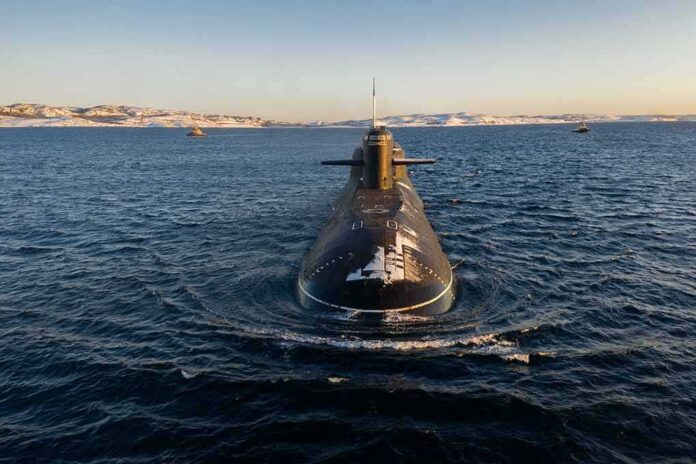
The decisive fact about AUKUS has always been that the submarines come before the sovereignty does — and USS Colorado’s designation as the first American boat to rotate through Western Australia is the clearest proof yet of that sequencing.
Key Points
- USS Colorado (SSN 788), a Virginia-class fast-attack submarine, has been officially named the first U.S. Navy vessel assigned to Submarine Rotational Force-West, based at HMAS Stirling near Perth, beginning in late 2027
- The designation was announced jointly on October 26, 2026 by U.S. Secretary of War Pete Hegseth, Australian Deputy Prime Minister Richard Marles, and UK Defence Secretary Wes Streeting
- Up to five submarines — four American, one British — are expected to rotate through HMAS Stirling once the arrangement reaches full strength
- The rotational presence is explicitly designed as a bridge: it exists to train Australian personnel and build infrastructure ahead of Australia eventually owning and operating its own nuclear-powered fleet
- Independent analysis frames the broader AUKUS submarine program as historically unprecedented, since Australia has neither a civil nuclear industry nor a nuclear arsenal to draw on
What Was Announced, and When
On October 26, 2026, defense chiefs from all three AUKUS nations put their names to a joint statement designating USS Colorado as the lead submarine for Submarine Rotational Force-West, the rotational basing arrangement at HMAS Stirling outside Perth. The announcement was not a surprise in the sense of coming from nowhere; it was the latest milestone in a sequence that began with the original AUKUS Joint Leaders’ Statement of March 2023, which first set “as early as 2027” as the target for forward SSN rotations to Australia. What changed in October 2026 was specificity: a named boat, a named base, a named start window.
USS Colorado arrived at HMAS Stirling for a scheduled, monthlong maintenance period shortly after the announcement, a visit the U.S. Navy described as part of ongoing support activities ahead of the 2027 rotation. Australian officials characterized the arrival as another milestone in a steadily advancing readiness timeline, noting that the submarine will continue on its broader operational deployment before returning to HMAS Stirling in late 2027 to formally commence SRF-West operations. The Pentagon has described the vessel — a 377-foot Virginia-class boat armed with land-attack missiles and advanced torpedoes — as the first U.S. nuclear-powered attack submarine to be based, rather than merely visiting, on Australian soil.
How the Rotational Force Fits Into AUKUS
Submarine Rotational Force-West is the second of three phases in what the three governments call the “Optimal Pathway” to Australian sovereign submarine capability. The first phase has already been underway since 2023, with increasingly frequent U.S. and UK submarine visits to HMAS Stirling — including USS Annapolis’s call in March 2024 — intended to familiarize Australian crews and shore personnel with nuclear-powered submarine operations before any permanent rotation begins. SRF-West is the step up from visits to presence: a standing contingent of American and British boats based, not merely docking, at the Western Australian facility, with Australian sailors embedded in day-to-day operations and maintenance cycles.
The third and most ambitious phase remains years away: Australia’s own acquisition of Virginia-class boats from the United States beginning in the 2030s, followed by construction of a new SSN-AUKUS class, built to a British design, from the 2040s onward. The rotational force exists specifically to compress the distance between those two distant milestones and the present — giving Australian naval personnel, shipyard workers, and regulators years of hands-on exposure to nuclear propulsion before they are asked to own and sustain it themselves. Australian defense officials have been candid that this sequencing, submarines before sovereignty, is deliberate rather than accidental, built into the architecture of the pathway from the outset.
The Scale of What Still Has to Be Built
None of this changes the scale of the undertaking that sits behind the headline. Australia is attempting something no nation has attempted in this particular combination: acquiring nuclear-powered submarines without ever having operated a civil nuclear industry or possessed a nuclear arsenal. Independent assessment from the United States Studies Centre at the University of Sydney notes Australia would be only the seventh country ever to field SSNs, and the first to do so from that starting position. That is not a rhetorical flourish; it is a description of a genuine capability gap that rotational basing is designed to narrow, not eliminate.
The workforce arithmetic alone illustrates the distance between announcement and delivery. Australia’s government estimates the submarine enterprise will require roughly 20,000 direct jobs over three decades, spanning engineers, technicians, and shipyard tradespeople. Separate analysis puts the civilian nuclear workforce needed to operate reactors alone at between 1,400 and 2,500 people, a cohort that largely does not yet exist and must be trained, in many cases, by embedding Australians inside existing U.S. and UK reactor operations. Engineering leaders involved in the program have said plainly that workforce — not money, not technology — is the single greatest risk to the entire enterprise. Infrastructure build-out at HMAS Stirling and the Osborne shipyard in South Australia likewise requires capability Australia has not previously needed to field domestically.
What the Designation Actually Signals
Strip away the geopolitical framing and the USS Colorado announcement signals something fairly specific and fairly modest in isolation: a named vessel has been slotted into a basing plan that was already public, on a timeline that was already set. The substance lies in what it commits each government to in the near term — maintenance infrastructure, crew rotations, regulatory coordination — rather than in any sudden acceleration of Australia’s own capability. Defense officials from all three nations have called the step a “decisive” move toward deterrence in the Pacific, and as a statement of trilateral commitment, it plainly is. As a measure of how close Australia stands to operating its own nuclear-powered fleet, the honest answer is: this gets the training clock running, nothing more, nothing less.
Why This Matters Beyond the Announcement
The durable lesson of AUKUS, and of Submarine Rotational Force-West specifically, is that major defense capability programs are won or lost in the unglamorous middle years — the workforce pipelines, the regulatory frameworks, the shipyard concrete — long after the joint statements and ship-naming ceremonies have faded from the news cycle. USS Colorado’s arrival at HMAS Stirling in late 2027 will be a visible, photographable milestone. Whether Australia is operating its own nuclear-powered submarines in the 2030s and 2040s will depend on thousands of far less visible decisions made in training pipelines and shipyards between now and then.
Sources:
asa.gov.au, minister.defence.gov.au, navy.mil, au.usembassy.gov, gov.uk, news.usni.org, war.gov, ussc.edu.au, atkinsrealis.com, unsw.edu.au, defenceconnect.com.au