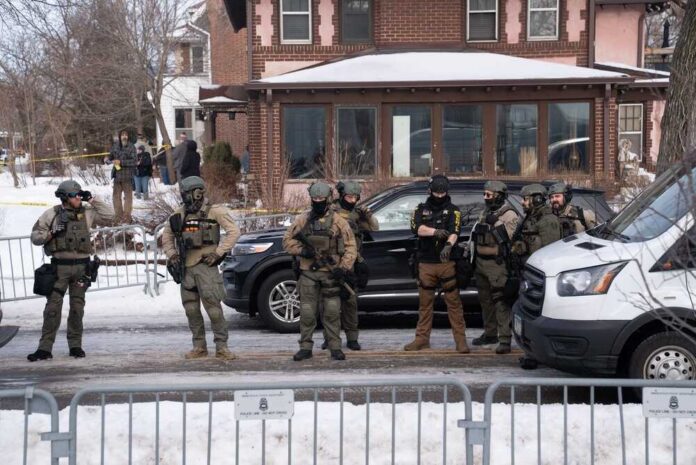
When a deputy U.S. marshal is killed serving a fugitive warrant, as happened in Alexandria, Louisiana, it exposes not only the lethal risks of federal fugitive work but also the opaque way these operations are run and explained to the public.
Key Points
- A deputy U.S. marshal was shot and killed while serving a fugitive arrest warrant in Alexandria; the suspect was injured and taken into custody.
- The FBI has classified the case as an assault on a federal officer and is leading a multi‑agency investigation, but has released few substantive details so far.
- Identities of both the slain marshal and the suspect, along with the underlying warrant, remain undisclosed, limiting independent verification and scrutiny.
- The case fits a broader pattern: fugitive task force operations are structurally high‑risk and often conducted with considerable autonomy and limited external accountability.
The Alexandria Shooting: What Is Firmly Established
According to official statements, a deputy U.S. marshal in the Western District of Louisiana was shot and killed while attempting to serve an arrest warrant on a fugitive in Alexandria. Rapides Parish Sheriff’s Office detectives were working alongside members of the U.S. Marshals Violent Offender Task Force in the Rutland Road area when an officer‑involved shooting occurred at approximately 3 p.m. Federal authorities state that the suspect shot and killed the marshal during this attempt to serve the warrant, and that the suspect subsequently engaged local, state, and federal officers in a standoff.
After what CBS, citing local station KALB, describes as a roughly three‑hour standoff, the suspect—who had sustained injuries—was taken into custody and transported to a local hospital. The U.S. Marshals Service, Louisiana State Police, Rapides Parish Sheriff’s Office, Alexandria Police, and the FBI are all involved; the FBI’s New Orleans office has characterized the shooting as an assault on a federal officer and is leading the investigation. As of the latest reporting, authorities have not released the names of either the slain marshal or the suspect, nor the nature of the warrant being served.
Knowns, Unknowns, and the Limits of the Public Record
The core fact pattern—marshal killed while serving a fugitive warrant, suspect injured and in custody, federal investigation underway—is consistent across all available mainstream sources and has not been publicly contested by any named counter‑position. That is significant: in many controversial shootings, specific alternative narratives or allegations emerge quickly from attorneys, witnesses, or advocacy groups. Here, they have not. Side B, in effect, consists less of competing facts and more of unanswered questions.
Those unanswered questions are substantial. Without the marshal’s name, the public cannot independently verify his service record, prior assignments, or training history. Without the suspect’s name, there is no way to examine his criminal history, the exact fugitive warrant, or any relevant court filings. No body‑worn camera footage or dashboard video has been released, and no ballistic or forensic details—round counts, trajectories, weapons recovered—have been made public. Even basic operational details such as the precise sequence of events and the length of the standoff are reported inconsistently; CBS relays a “roughly three hours” figure, while some local descriptions speak of a shorter duration.
In this vacuum, the entire public narrative rests on agency press statements and brief local interviews with neighbors who heard gunfire. That reliance is not unusual in the first days after a complex shooting, but when combined with continued nondisclosure of identities and warrant information, it constrains the ability of outsiders—journalists, civil liberties organizations, or local residents—to either validate or challenge the official account.
Fugitive Task Forces: How They Operate and Why Risk Is So High
To understand why a marshal would be killed in such an operation, and why the investigative posture looks the way it does, you have to understand fugitive work itself. The U.S. Marshals Service runs Violent Offender and Fugitive Task Forces that combine federal marshals with local and state officers, often under federal authority but in service of both federal and non‑federal warrants. These teams specialize in locating and arresting people wanted on serious charges; by definition, many of the targets have a history of violence or a strong motive to avoid custody.
Operationally, these task forces typically conduct surveillance, verify a fugitive’s presence at a location, and then execute a warrant through approaches that range from quiet apprehensions in parking lots to dynamic entries at residences. The Alexandria operation, according to the sheriff’s office, was a “law enforcement operation…to arrest a wanted fugitive” in a residential area, involving multiple agencies. That multi‑agency configuration is common and carries its own complexity: different training backgrounds, varied equipment, and split chains of command, all converging at a single door.
Risk is not hypothetical. Historically, line‑of‑duty deaths among marshals cluster heavily around warrant service and fugitive apprehension. The Marshals Service’s own Roll Call of Honor traces fatal shootings of marshals back to 1794, when Robert Forsyth was killed attempting to serve civil papers. Contemporary research and memorial projects estimate nearly 300 line‑of‑duty deaths as of 2022, with unofficial counts somewhat higher. Between 2015 and late 2020, data compiled by The Marshall Project show at least five marshals or task force members killed while attempting arrests, including one killed by friendly fire.
Patterns of Violence and Questions of Accountability
The Alexandria shooting also sits inside a documented pattern of high‑risk marshal operations that are often shielded from detailed public scrutiny. Investigations into use‑of‑force incidents by U.S. Marshals task forces have found that these units, while functioning much like local police, tend to operate with “more violence and less accountability” due to Justice Department protections and limited transparency requirements. In some jurisdictions, marshal‑led task forces have higher rates of shootings than local agencies; investigative reporting in Arizona, for example, found 10 marshal‑involved shootings between 2015 and early 2021, resulting in 11 fatalities and one injury.
Those shootings cut both ways. On one side are cases like Deputy U.S. Marshal Josie Lamar Wells, killed in 2015 while serving a warrant on a double‑murder suspect in Baton Rouge; the fugitive was shot and died the following day. In 2018, Deputy Marshal Chase White was shot and killed in Tucson while serving a felony warrant; the suspect surrendered after a standoff and was later prosecuted. On the other side are incidents where marshals shot civilians during warrant service and faced criticism or legal exposure, such as the fatal shooting of Frankie Jennings in Charlotte during the attempt to serve outstanding warrants, which triggered questions about perceived threats and investigative independence.
From the outside, these episodes form a pattern: high‑stakes, high‑velocity operations conducted by mixed teams under federal auspices, often followed by tightly controlled information release. When a marshal is killed, federal authorities tend to classify the case quickly—here, as an “assault on a federal officer”—and centralize the investigation under the FBI. When civilians are shot, investigators and watchdogs have documented a tendency toward limited disclosure and rare discipline. The institutional posture, in both scenarios, leans toward protecting the task force’s operational latitude.
Community Perception and the “Fugitive” Label
In Alexandria, early local accounts reportedly describe the suspect as a “good man,” with neighbors and a local cashier recalling positive interactions and no visible signs of violence in his demeanor. Those recollections do not negate the existence of a warrant, but they do complicate how the term “fugitive” lands in the community. Many residents hear “fugitive” and imagine a dangerous, at‑large offender; in practice, federal task forces sometimes pursue individuals for a mix of violent and non‑violent charges, including cases where failure to appear or probation violations turn a relatively modest underlying offense into a more serious fugitive status.
Without the warrant details, the public has no way to assess whether this suspect fit the archetype of a high‑risk violent fugitive or was wanted for less serious conduct coupled with noncompliance. That distinction matters. If residents know someone primarily as a hardworking neighbor or a “good dude” who was kind at the local store, and they later learn he was targeted by a Violent Offender Task Force, it can fuel skepticism about whether the force’s label truly reflects the person’s history—or whether the “violent” designation is applied broadly to justify aggressive tactics.
What a More Accountable Investigation Would Look Like
Given the stakes—a federal officer dead, a suspect injured, gunfire in a residential neighborhood—an accountable investigation would eventually provide several layers of detail. First, identification: the marshal’s name, age, service record, and assignment history; the suspect’s name, prior convictions, and full warrant documentation, including underlying charges and any risk assessments. Second, evidence: a timeline of the operation, 911 calls, radio traffic, ballistic analysis specifying who fired which rounds from where, and any video from law enforcement cameras or civilian devices.
Third, it would include structured witness testimony. Neighbors who saw movement or heard the first shots, officers on the entry and perimeter teams, and medical personnel who treated both the marshal and the suspect would all anchor the narrative in observed facts rather than general statements. In prior cases where marshals died during warrant service—such as the Wells and White shootings—subsequent federal complaints and court records laid out detailed accounts of the suspects’ alleged actions, the marshals’ approach, and the exchange of fire. The public record around the Alexandria case is, so far, substantially thinner.
Balancing Operational Risk with Public Trust
None of this diminishes the reality that fugitive work is dangerous or the gravity of a marshal’s death. The Roll Call of Honor is long precisely because entering unknown buildings to apprehend determined fugitives is, and always has been, one of the most perilous things law enforcement does. The deputy killed in Alexandria joined a lineage that stretches back more than two centuries.
Yet in a democratic system, the willingness to accept that risk must be matched by an equally serious commitment to transparent accountability when things go wrong. That means resisting the temptation to treat the “assault on a federal officer” label as the final word before an investigation has surfaced proof. It means recognizing that local memories of a “good man” can coexist with a valid fugitive warrant—and that reconciling those pictures requires facts, not silence.
As more information emerges, the Alexandria case will either reinforce or challenge the broader pattern of how U.S. Marshals task forces use force and explain themselves. For now, the core facts of the shooting are uncontested, but almost everything that would give the public confidence in the narrative—names, warrant details, forensics, body‑camera footage—remains behind closed doors. In an era where both law enforcement risk and community skepticism are high, that imbalance is increasingly hard to sustain.
🔴 U.S. Marshal killed serving arrest warrant in Louisiana; suspect in custody
A deputy U.S. Marshal was shot and killed Monday while serving an arrest warrant on a fugitive in Alexandria, Louisiana, approximately 95 miles northwest of Baton Rouge. The shooting occurred at about… pic.twitter.com/d9oPaE2wt0
— NewsTongue (@NewsTongueX) July 14, 2026
Looking Ahead: Questions That Still Need Answers
In the months ahead, several concrete questions will determine how this episode is understood. Was the underlying warrant for a violent offense, and had the suspect previously threatened or harmed others, or was he primarily noncompliant with court processes? Did task force members follow their own policies for planning and executing high‑risk arrests in residential neighborhoods? What does the forensic record show about the first shots fired—direction, distance, and number of rounds—and does that align with agency statements?
Equally important is whether any investigative findings lead to changes. Past marshal shootings have prompted internal reviews but rarely fundamental revisions to task force structures or public reporting practices. If the Alexandria case yields only another brief press release and a name added to the Wall of Honor, it will confirm the existing pattern: high‑risk operations conducted with courage, but explained with minimal detail. If, instead, it becomes a catalyst for fuller disclosure—of both dangers and mistakes—it could modestly shift the balance between operational autonomy and public trust.
Sources:
thegatewaypundit.com, abcnews.com, cbsnews.com, audacy.com, facebook.com, odmp.org, backstoppers.org, wtkr.com, justice.gov, en.wikipedia.org, latimes.com, police1.com, usmarshals.gov