A 75-page manifesto tied to the San Diego mosque shooting is raising as many questions about how our institutions work as it answers about why two teenagers opened fire on a house of worship.
Story Snapshot
- Investigators say they recovered a lengthy hate-filled manifesto after two teens killed three people at the Islamic Center of San Diego.
- Officials describe broad, online-fueled extremism, but have not released the writings or core case documents to the public.
- The heroic actions of a slain security guard are central to the narrative, even as key forensic details remain sealed.
- Conflicting media timelines and heavy spin from all sides risk locking in a story before the hard evidence is visible.
What Officials Say Happened At The Islamic Center
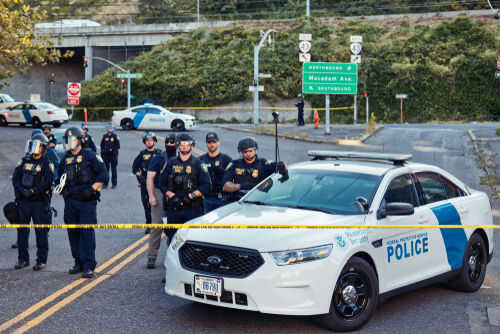
San Diego police and federal officials say two male teenagers, ages 17 and 18, opened fire at the Islamic Center of San Diego around midday, killing three adults before fleeing in a vehicle where they were later found dead from apparent self-inflicted gunshot wounds nearby.[3] Authorities identified the victims as security guard Ameen Abdullah and congregants Mansour Kaziha and Nadir Awad, describing all three as acting to protect others during the chaos inside and around the mosque.[4] Officials are treating the attack as a hate-motivated act of domestic violent extremism.[5]
Police say that earlier that morning they received a call from the mother of a runaway 17-year-old who reported missing weapons, a missing vehicle, and concerns that her son, dressed in camouflage with a companion, was suicidal. Officers used license plate readers to locate the vehicle near a mall and notified a local high school connected to the youth before the mosque call came in, creating a parallel track of concern that only later converged with the shooting. Officials emphasize this chronology to show the system was already mobilizing when shots were reported.
The Alleged Manifesto And A Pattern Of Online Radicalization
Federal Bureau of Investigation (FBI) leaders confirmed that investigators recovered a manifesto associated with the suspects and are dedicating significant resources to analyzing it.[3] A journalist who says he obtained the document describes it as roughly 75 pages of vitriol targeting Muslims, Jews, Black Americans, women, and transgender people, with explicit praise for the Christchurch mosque killer and other prior mass shooters.[4] Authorities say preliminary evidence suggests the teens met online and were radicalized through extremist content, echoing patterns seen in earlier attacks like the Poway synagogue shooting near San Diego in 2019.[3][5]
At the same time, officials have not released the manifesto itself, the digital forensic reports from the suspects’ devices, or the full text of the writings reportedly found in their vehicle.[1][4] Instead, the public has been given high-level summaries and labels such as “broad hatred” and “accelerationist” ideology.[3][4] For citizens across the political spectrum already skeptical of how federal agencies use terms like “extremist,” this gap between sweeping characterization and visible evidence feeds concern that narratives may be hardening before the underlying exhibits are open to scrutiny.[1][4]
Heroism, Children In Danger, And A Narrative That Sets Quickly
Police Chief Scott Wahl and other officials have repeatedly highlighted the actions of security guard Ameen Abdullah, a father of eight who confronted the gunmen in the parking lot.[4] Wahl said Abdullah’s decision to engage the attackers in a gun battle delayed, distracted, and deterred them from reaching classroom areas where roughly 140 children were present, giving time for teachers and staff to secure the kids.[1][4] Two other congregants were described as drawing fire away from the building, with officials crediting the three men’s actions for preventing a far higher death toll.[3][4]
Those details are powerful and consistent across briefings, but they are still being conveyed through press conferences rather than released surveillance footage or a full forensic reconstruction.[1][3][4] That kind of emotional framing—children nearly massacred, a guard dying a hero—understandably resonates with Americans who fear rising violence and breakdowns in basic security. It also risks making later questions about response timing, tactics, or prior warning signs sound like attacks on a martyr rather than reasonable efforts to understand what went wrong systemically.[3][4]
Missing Documents, Conflicting Timelines, And Public Trust
Across multiple outlets and live streams, incident dates and timeline details for the same shooting are mislabeled or contradictory, with references to different 2024 dates attached to what is clearly one event.[1][3] Live coverage carried raw witness accounts about long bursts of gunfire and possible vehicle movements on nearby freeways, but the record set provided here does not include dispatch logs, computer-aided dispatch timestamps, traffic-camera footage, or 911 audio tying every detail together.[1][2] The lack of synchronized, primary records makes it hard for outside observers to independently check exactly when each decision was made.
❌ FALSE
Musk posted: "San Diego police are refusing to name yesterday's mosque shooters"
The claim is not supported by current…
📰 San Diego Police Department / press briefing coverage via YouTube · AP News — Coverage of the San Diego Islamic center shooting#factcheck
— Truth Checker (@truthcheckr) May 19, 2026
For many Americans—conservative and liberal alike—this looks like one more example of a government that demands trust while keeping the most decisive documents out of sight.[1][3][4] Officials say they have executed multiple search warrants, seizing more than 30 firearms, a crossbow, ammunition, tactical gear, and electronics, yet the warrant affidavits and inventory sheets are not public.[1][3][4] Agencies assure the public that the suspects were online-radicalized domestic extremists, but without direct access to the manifesto, posts, or chat logs, people are asked to accept conclusions they cannot verify. That dynamic fuels the sense that “the system” manages narratives first and accountability later—if ever.
Why This Case Touches Bigger Concerns About Power And Safety
The San Diego mosque shooting sits at the intersection of several deep national anxieties: rising political and religious hatred, the ability of teenagers to assemble arsenals, and a digital world that can turn isolated, troubled kids into would-be revolutionaries without anyone in authority catching it in time.[4] Many on the right see yet another failure to protect families and churches or mosques while the government focuses on culture wars; many on the left see a system that still struggles to confront violent bigotry until bodies are on the ground. Both sides see agencies that are quick with labels and slow with hard evidence.
Reasonable people can agree on two things at once: that three worshipers, including a guard who ran toward danger, showed real courage, and that the public deserves full access to the incident reports, warrant records, digital evidence, and autopsy findings once investigative needs are met.[1][3][4] Without that transparency, trust continues to erode, making every future briefing sound like spin, no matter who is speaking. In a country already frayed by partisanship and economic pressure, that erosion of trust may be the most dangerous legacy of this attack.
Sources:
[1] YouTube – WATCH: San Diego officials hold press briefing on deadly …
[2] Web – WATCH LIVE: San Diego police update on deadly mosque …
[3] YouTube – San Diego shooting: victims identified in mosque attack
[4] YouTube – ‘They tried to protect’: Islamic Center Imam identifies victims …
[5] YouTube – San Diego Mayor says mosque shooting suspect …