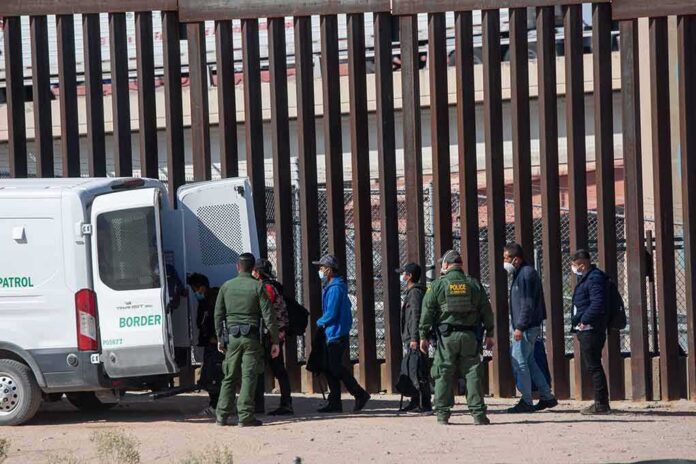
The Ceuta crisis is a vivid example of how a single, dramatic mass crossing can turn Europe’s migration debate into a full-blown argument over borders, sovereignty, and the future of free movement inside the Schengen Area.
At a Glance
- Thousands of mostly young men crossed from Morocco into Spain’s North African enclave of Ceuta in a short span, overwhelming local security forces and reception capacity.
- Spain responded by reinforcing the border with military units and police, treating the episode as a serious security and public-order emergency rather than routine migration management.
- Italian Prime Minister Giorgia Meloni framed the Ceuta influx as evidence of a grave border-security threat and floated “extraordinary measures,” including suspending Schengen free movement with Spain.
- The episode slots into a wider pattern in European politics where visually dramatic migration surges are rapidly recast as sovereignty tests, intensifying pressure for exceptional measures and interstate confrontation.
Ceuta’s Geography and Why Mass Crossings Become Political Flashpoints
Ceuta is a small Spanish enclave on the North African coast, facing Morocco across a short land frontier and a narrow stretch of sea. In map terms it looks marginal; in migration politics, it is anything but. The city of roughly 65,000 residents sits on a six-mile peninsula that functions as part of the European Union’s external border, guarded by fences, breakwaters, and combined Spanish–Moroccan policing. When several thousand people arrive in a matter of hours or days, the impact is immediate and visible: reception centers overflow, local hospitals and shelters strain, and images of crowded beaches and fence breaches ricochet through global media.
This is not the first time Ceuta has been at the center of a migration storm. In 2021, roughly 8,000 people crossed from Morocco into Ceuta over two days, prompting Spain to deploy troops and launch rapid expulsions. The 2026 episode follows a similar script but occurs against a more heated political backdrop: Spain’s left-leaning government has pursued large-scale regularization of undocumented migrants, and several European governments are under sustained domestic pressure to prove they can “control” their borders in the face of irregular arrivals. That context matters, because it shapes how the same set of physical events gets interpreted: as a humanitarian emergency, a policing failure, or an act of hostile pressure by a neighboring state.
What Happened During the 2026 Ceuta Surge
On a single Thursday, thousands of migrants, largely young men from Morocco and possibly other African countries, crossed into Ceuta by swimming around breakwaters, using improvised flotation devices, or scaling fences and pushing past overwhelmed border police. Spanish state agency EFE reported waves of youths jumping the security fence at points where police were simply not present, and local officials described a border that had “totally collapsed.” Over the preceding week, regional authorities estimated at least 1,500 arrivals by sea alone, underscoring that this was not a one-off incident but the climax of a sustained pressure on the enclave’s defenses.
The human cost was immediate: multiple outlets reported deaths during the crossing attempt, with figures around nine to eighteen fatalities as crowds took on rough seas or dangerous coastal terrain. At street level, Ceuta’s local leadership called on Madrid to declare a national emergency on security grounds and requested army support, arguing that the municipality was simply overwhelmed. One union representative for Spain’s Guardia Civil summarized conditions on the ground as “absolute chaos,” stressing that ordinary tools of border management were no longer adequate.
Spain’s Response: Military Reinforcement and Diplomatic Management
Madrid’s central government chose a dual track: reinforce the border and maintain political control over the narrative. On the operational side, Spain deployed military units to Ceuta to back up police and stabilize the frontier, acknowledging that the Civil Guard alone could not manage the influx. Soldiers and special forces were used to secure key stretches of fence and coastal access points, while additional police were brought in to restore basic public order within the city. Reception centers were rapidly overwhelmed, forcing ad hoc arrangements and accelerated procedures for identification and triage.
At the same time, the Sánchez government resisted formally declaring a national emergency solely on migration grounds, a point that frustrated Ceuta’s local authorities but reflects a longstanding reluctance to treat irregular crossings as equivalent to armed conflict or terrorism. Spain moved quickly to coordinate with Morocco on repatriations, with both governments agreeing to facilitate the return “as soon as possible” of people who had entered illegally. In diplomatic terms, Madrid’s stance was clear: the event was serious, but it was to be handled as a border-management and foreign-policy issue, not as a casus belli or justification for dismantling core European freedoms.
Meloni’s Escalation: From Crisis at Ceuta to Schengen Suspension
Where Spain emphasized containment and cooperation, Italy’s leadership seized on Ceuta as proof that Europe’s border regime faces a systemic security threat. Prime Minister Giorgia Meloni publicly described the images from Ceuta as “shocking” and argued that uncontrolled illegal immigration “poses a real threat to the security of Europe’s borders.” She announced that Italy had convened the relevant bodies and was prepared to act “even through extraordinary measures” to defend its frontiers and citizens’ safety, explicitly including the option of suspending Schengen free movement with Spain.
Under Schengen rules, EU states can reintroduce internal border controls in exceptional circumstances, such as serious threats to public policy or internal security. Meloni’s rhetoric pushes that legal lever into political theatre: suspending Schengen vis-à-vis a partner state is far more than a technical check; it is a public declaration that the partner has failed in its duties as guardian of the external border. Reporting from Italian and international outlets indicates that Rome was “considering” such a suspension and studying its feasibility, not that the measure had been legally enacted. Spain responded by summoning the Italian ambassador, framing the proposal as an unwarranted escalation rather than a justified security step.
Is Ceuta a Border-Security Emergency or a Migration-Management Failure?
To understand what is really at stake, it helps to separate three layers of the Ceuta episode: the physical event, the legal framework, and the political narrative. Physically, the situation meets any ordinary definition of a border-security crisis: security forces on both sides were overwhelmed; the fence was breached at scale; deaths occurred; and the army had to be deployed to restore control. No serious observer contests that the city faced extraordinary pressure over those days; the disagreement lies in what that pressure signifies.
Legally, Spain’s response fits the EU’s existing template for managing large-scale, irregular arrivals at external borders: reinforce with military and police, stabilize the situation, and work with the origin or transit state—in this case Morocco—to carry out repatriations and prevent further crossings. There is no publicly available evidence in the record that Spanish territory beyond Ceuta, let alone Italian territory, was under imminent direct threat from those crossings; Ceuta’s unique geography makes onward movement to mainland Europe logistically difficult without state assistance.
Politically, however, Ceuta becomes a canvas onto which different governments project their domestic priorities. Meloni has built her premiership around aggressive messaging on irregular migration, including extending detention periods, expanding deportation centers, limiting NGO rescue work, and championing naval “blockades” in the Mediterranean. Against that backdrop, casting Ceuta as a security emergency that justifies Schengen suspension is consistent with her broader narrative: Europe is under siege, and only extraordinary toughness will suffice. Spain, by contrast, has combined stricter border actions with large-scale regularization of undocumented workers, emphasizing economic integration and legal pathways even as it deploys troops when necessary. Those competing lenses—security-first versus management-and-regularization—shape how Ceuta is described far more than any difference in the raw facts.
Military-Aged Men, “Invasion” Rhetoric, and the Politics of Imagery
The Ceuta episode has been widely framed in commentary and social media as an “invasion” by “military-aged male illegals,” language that merits scrutiny. Reuters and Spanish outlets describe the crossing as involving “thousands of migrants” and “hundreds of youths,” mostly young men, but also note the presence of families, women, and children among arrivals. The demographic skew toward young, fit men is unsurprising: such individuals are more physically able to attempt dangerous crossings and often act as first movers in family migration chains. The leap from this demographic profile to the assertion that Ceuta faced an organized, hostile military incursion is political, not evidentiary.
Commentators like Elon Musk have argued that large numbers of military-aged males crossing a border are definitionally an “invasion.” Yet there is no indication in the cited record of coordinated armed activity, paramilitary organization, or state-directed offensive action in the sense recognized by international law. The drivers reported are familiar: economic hardship in Morocco, lack of employment and social services, and the perception of opportunities in Europe. That does not make the crossings benign—they are illegal, dangerous, and destabilizing—but it does separate the security challenge of irregular migration from the very different challenge of armed incursion. In practice, collapsing the two into the same word “invasion” tends to harden public attitudes, reduce space for cooperative solutions, and justify extreme measures that may be disproportionate to the actual threat.
Schengen Under Strain: What Meloni’s Threat Signifies
The Schengen Area is built on mutual trust: each member agrees to police its segment of the external border in a way that protects all, enabling internal free movement of people. When a high-profile event like the Ceuta surge occurs, that trust is tested. Meloni’s floated suspension of Schengen with Spain is less about immediate operational necessity—Italy’s territory was not directly breached—and more about signaling that, in her view, Spain’s policies and border performance are endangering others.
In legal terms, reintroducing internal border checks is possible but heavily regulated and generally temporary; suspending free movement targeted at a single partner state over a discrete incident would carry serious diplomatic and economic costs. Reporting by European outlets stresses that Meloni’s threat was at the stage of consideration and debate, not a settled or implemented measure. Spain’s decision to summon the Italian ambassador underscores how quickly such rhetoric can shift a shared migration-management challenge into a bilateral sovereignty dispute. The risk for the EU is that, as these confrontations multiply, Schengen’s political foundations erode: states begin to treat free movement as a bargaining chip rather than a core commitment, and every border incident becomes ammunition in a wider contest over national toughness and responsibility.
Broader Lessons: Managing Migration Surges Without Losing Political Compass
The Ceuta crisis distills several patterns that recur across Europe’s southern border. First, visually dramatic mass-arrival events—people swimming en masse, fences being overrun, soldiers deploying on beaches—create high-salience narratives long before detailed incident assessments are available. Politicians under pressure often respond with maximalist language: “extraordinary measures,” “naval blockades,” “invasions.” That language can help win domestic support but tends to crowd out more sober discussion of what actually works: sustained cooperation with origin and transit countries, reliable legal pathways, targeted enforcement, and pragmatic burden-sharing.
Second, the line between migration management and national security is thin in public discourse but thick in law and policy. Ceuta’s experience shows that a city can be overwhelmed and require military reinforcement without the episode necessarily constituting an armed attack or existential threat to the state. Maintaining that distinction is important: if every irregular crossing is cast as war, legal safeguards and proportionality norms erode; if none are treated as serious, local communities are left to absorb shocks without support.
Finally, internal EU disputes like the one between Italy and Spain over Schengen suspension are not side stories; they are central to whether Europe can maintain both secure borders and open internal movement. Ceuta is likely to be followed by other surges along the Mediterranean and Atlantic routes. The degree to which member states can respond in concert, rather than in mutual recrimination, will determine whether the system adapts or fragments. The episode is a warning, not just about the physical vulnerability of a small enclave, but about the political vulnerability of a continent’s shared border regime.
🚨 BREAKING: Ceuta migrant crisis explodes
~49,000 undocumented migrants swam into Spain's Ceuta from Morocco in 24hrs — up to 15 dead en route.
PM Sánchez rushing to the enclave TODAY with military reinforcements.
Italian PM Giorgia Meloni now threatens to cut off arrivals from…— Major Namrata Dhasmana (V) 🇮🇳 (@MajorNDhasmana) July 31, 2026
Ceuta in Perspective: A Continuing Test of Europe’s Migration Order
For citizens watching the footage and reading the headlines, Ceuta may feel like a singular catastrophe—“World War Z” at Europe’s southern gate. In reality, it is a sharp, painful instance of a pattern that has been building for years: persistent socio-economic pressures in North Africa, contested policy choices in European capitals, and a common external border that is both a line on a map and a stage on which larger political dramas play out. Treating Ceuta as a wake-up call is reasonable. Treating it as proof that only ever more extraordinary measures and interstate punishment can keep Europe secure is far less so. The evidence points to a harder, slower task: building a migration order that can absorb shocks without losing its legal and political compass.
Sources:
facebook.com, politico.eu, timesnownews.com, 20min.ch, instagram.com, lafm.com.co, apnews.com, alloranews.com, news.sky.com, theguardian.com, en.ara.cat, blick.ch, dailysabah.com, fr.de, tandfonline.com, npr.org, telegraph.co.uk