
What preserves dignity in a public medical crisis is often not a miracle intervention but a human voice; in the final moments of Rachel Apa’s race, one spectator’s simple assurance — you are not alone, you are loved — is the best-documented thread tying together an otherwise chaotic scene.
At a Glance
- A named bystander, hospital social worker Michaela Nicholas, says she reached Rachel Apa within seconds of her collapse near Mile 24 and stayed at her side.
- Multiple outlets place Nicholas among the first responders at the barricade as runners, spectators, and medical staff initiated CPR and deployed race resources.
- Nicholas’s own words — holding Apa’s hand, praying, and telling her she wasn’t alone — anchor the firsthand account of comfort during resuscitation efforts.
- Officials and family described a rapid emergency response; public reports later focused on a suspected medical cause, but that debate does not undercut the witness account.
A witness, a collapse, and the quiet work of presence
Near 85th Street in Central Park, within sight of the New York City Marathon’s closing miles, spectators were doing what they always do late in a long race: scanning bibs, calling out names, and infusing strangers with energy. Among them was Michaela Nicholas, a hospital social worker. By her account, she had just offered encouragement to 24-year-old runner Rachel Apa when, roughly 15 yards farther on, Apa fell. Nicholas moved quickly toward the barricade, reached Apa, and — while others took up CPR and responders converged — knelt to hold her hand and spoke to her directly. She told Apa she was not alone, that she was loved, and she prayed.
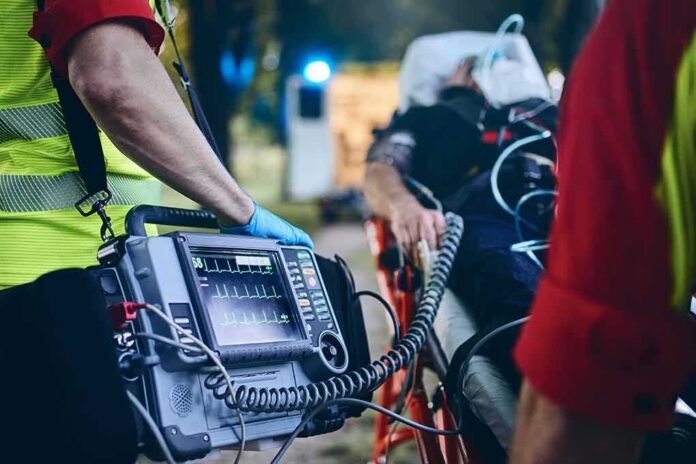
That simple script matters. Emergency scenes splinter attention among compressions, airway, defibrillator pads, traffic control, scene safety; what gets lost is the patient’s subjective experience. Nicholas’s role was not technical care. It was accompaniment — the steadying presence that many emergency clinicians privately wish every patient had. Multiple reports place Nicholas among the first to reach Apa and describe a coordinated response of runners, spectators, and race medical staff performing CPR on scene, followed by transport.
What the reporting establishes — and what it doesn’t need to
In the mosaic of public accounts, the most concrete elements align: location near Mile 24, rapid bystander action, CPR in progress, and Nicholas’s decision to comfort Apa as medical efforts unfolded. Nicholas’s hand-holding and words are drawn from her own named, on-the-record interviews — the strongest kind of attribution for a humane detail no official form is designed to capture. Independent coverage corroborates her presence and the broader response but, predictably, does not parse every utterance amid compressions and commands.
Much subsequent coverage gravitated toward medical causation — a suspected exertional breakdown process and its clinical implications. Those lines of inquiry are important for prevention, yet they do not contradict the narrow, human-scale account at the curb: a witness saw a collapse, rushed in, and spoke to the runner while others worked the algorithm of resuscitation. Put plainly, nothing in the medical discussion alters the reliability of that core sequence.
How such scenes typically unfold at mass-participation races
Marathon emergencies are choreographed by training and repetition more than by chance. When a runner goes down, the first link is almost always a layperson — another runner or a nearby spectator — initiating an assessment and beginning compressions if there is no response and no normal breathing. In modern race medicine, that bystander link is not incidental; it is the fulcrum on which survival turns. Registries of long-distance race cardiac arrests consistently document near-universal bystander CPR and rapid deployment of automated external defibrillators (AEDs) as the response backbone, with survival tightly coupled to how fast those first minutes are filled with competent action.
In Central Park that day, reporting describes a pattern consistent with the evidence base: immediate lay response, rapid escalation as people identifying themselves as physicians stepped in, and then the arrival of race medical staff and police with equipment and transport. The window for defibrillation and advanced life support is counted in minutes; the window for reassurance is identical. It must occur in parallel, or not at all.
Comfort is not cosmetic; it is part of care
Seasoned emergency teams make room for a voice at the patient’s shoulder because they know physiology and psychology are not separable in extremis. A grounded presence can reduce panic in the rare patient who remains intermittently conscious; it can also stabilize the scene by giving family and bystanders a focal point while clinicians work. Nicholas’s reported actions — holding a hand, praying over a bracelet, repeating that Apa was loved — are small interventions that cost nothing and create meaning. They also respect a boundary: she did not attempt procedures beyond her scope; she filled a gap others could not.
This division of labor is not glorified improvisation; it is how resilient systems behave under stress. Technical skills compress the chest; social skills keep the personhood of the patient intact. When the story of a public medical event is retold, the technical sequence often dominates because it leaves artifacts — AED logs, EMS run sheets, hospital timestamps. Comfort leaves none. That absence of paperwork is not a deficit; it is the nature of the act.
NYC marathon spectator told Rachel Apa 'she wasn't alone' as she reveals runner's heartbreaking final moments https://t.co/YHhiZhWilX pic.twitter.com/Pzs5h1G5b2
— New York Post Metro (@nypmetro) November 5, 2026
Where this leaves the larger conversation about race safety
The medical literature on race-associated arrests has grown more sophisticated: incidence estimates have stabilized, risk-stratification has improved modestly, and survival has risen as races saturated their courses with AEDs and trained volunteers. Public attention, however, still oscillates between two poles — the search for a precise etiologic label and the impulse to universalize a singular tragedy into a referendum on race safety. Both impulses can eclipse what is solid and specific about an individual case. In this instance, the durable facts are close to the pavement: a runner went down late in the course; bystanders and professionals acted quickly; amid the tasks and tempo of resuscitation, one person’s focus was presence.
That is not a consolation prize. It is a standard to emulate. Spectators do not need certificates to provide the one intervention that is always in scope: a clear, compassionate voice. Runners who train for months deserve a response ecosystem that does not treat them as a problem to solve but as a person to accompany, regardless of outcome. The technical chain — recognition, 911, CPR, AED, transport — will always be essential. The parallel chain — look them in the eye, say their name, anchor them in relation and care — is just as teachable and just as necessary.
What to take away from Central Park
If you attend a race, learn hands-only CPR; it remains the most powerful lay intervention in sudden collapse. Just as important, be ready to stand or kneel at a stranger’s side. Assign someone to speak calmly and continuously while others do the physical work. Coordinate, don’t crowd. And if you find yourself in Nicholas’s position, do what she did: occupy the space that technology cannot, giving shape to the seconds that matter by reminding a fellow human being that they are seen, accompanied, and loved. The record from that November afternoon is clear about at least this much.
Sources:
nypost.com, cnn.com, post-gazette.com, cbsnews.com