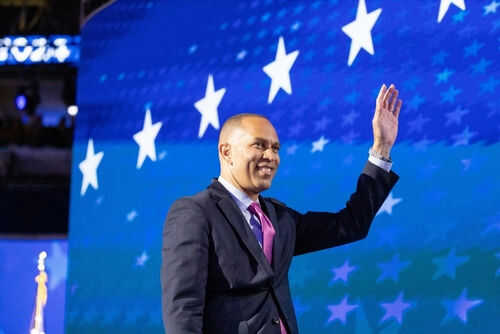
When a child’s blunt question and a two-word soundbite can redefine a party leader overnight, Americans see again how headlines, not hard facts, are steering the national conversation.
Story Snapshot
- Hakeem Jeffries acknowledged voter frustration with both parties and Congress during a Capitol Hill event [1].
- Axios highlighted Jeffries’ “maximum warfare” remark, which Republicans argued could fuel political violence [2].
- Clips show combative rhetoric toward Trump-era figures, but no verified evidence he “lashed out at voters” or “athletes” [1][2][3].
- Partisan framing and short clips risk outrunning primary-source context, leaving voters with narratives instead of facts [1][2].
What Jeffries Actually Said About Voter Frustration
Fox News reported that Hakeem Jeffries told a child questioner that Americans are frustrated with institutions, including Congress and both political parties, because many are living paycheck to paycheck [1]. Fox characterized him as “caught off guard,” but the quoted substance acknowledges broad frustration rather than attacking voters. Jeffries added that Democrats must convince people they are focused on improving daily life, reinforcing that his answer framed concerns about affordability and performance, not contempt for the electorate [1].
Fox also quoted Jeffries linking solutions to affordability and cooperation, including the need to make life more affordable and address border security through bipartisan efforts [1]. That language aligns with a message pitched to moderates who believe Washington neglects basic needs while partisan warfare dominates the airwaves. For readers across the spectrum who see elites failing to deliver results, the core admission—voters are frustrated with institutions—tracks with lived experience more than with the claim that he “unloaded rage” at the public [1].
The “Maximum Warfare” Controversy and Its Limits
Axios reported that Jeffries defended using the phrase “maximum warfare,” while Republicans argued such rhetoric can incite political violence [2]. The article situates the phrase within the partisan messaging battles that define Washington. The report does not tie the remark to an attack on voters or athletes, and it leaves open how the broader context shaped his meaning. The episode illustrates how two words can dominate coverage, even as questions about policy performance and institutional accountability go unanswered [2].
Claims that Jeffries “lashed out at athletes” are not substantiated by the provided materials. The research packet contains no primary-source quote or identifiable event where athletes were targeted [1][2][3]. Assertions that he “lashed out at voters” are also weakly supported; the available on-record comments point to recognition of public anger at institutions, not insults directed at citizens [1]. In a media environment optimized for outrage, those gaps matter because they convert inference and tone into alleged fact without clear evidence.
Combative Rhetoric Toward Officials and What It Does—and Doesn’t—Prove
A widely shared clip summary shows Jeffries calling Kash Patel “deeply unqualified,” criticizing actions he described as a “reckless war of choice,” and labeling Jeffrey Clark a “stone-cold liar” during oversight and national security disputes [3]. Such language is combative and partisan, but it targets officials and policies, not voters. Without corroborating polling, legislative outcomes, or internal documents, these clips alone cannot establish strategic weakness or unusual bitterness; they mainly reflect the sharp-edged discourse common in high-stakes Washington confrontations [3].
WHOA: Top Democrat Hakeem Jeffries "downplayed" his op-ed defending his "infamous" anti-Semitic uncle Leonard Jeffries in an interview with the New Yorker
Reminder: Jeffries literally wrote an op-ed defending his uncle, Louis Farrakhan & their extremely anti-Semitic beliefs pic.twitter.com/LPAilbVR3j
— Ben Petersen (@bennpetersen) May 18, 2026
For citizens who believe the government prioritizes self-preservation over service, these episodes cut both ways. On one hand, brash talk can look like theater that dodges bread-and-butter crises—rising costs, immigration dysfunction, and energy affordability. On the other, acknowledging public frustration and promising cost-of-living relief signals politicians know trust is collapsing. The missing piece is verifiable follow-through. Absent transparent results and primary-source clarity, narratives harden while everyday problems remain unsolved [1][2][3].
Sources:
[1] Web – Hakeem Jeffries caught off guard by child’s question about Democrats
[2] Web – “I don’t give a damn”: Jeffries defends “maximum warfare” remark
[3] Web – Hakeem Jeffries – Wikipedia