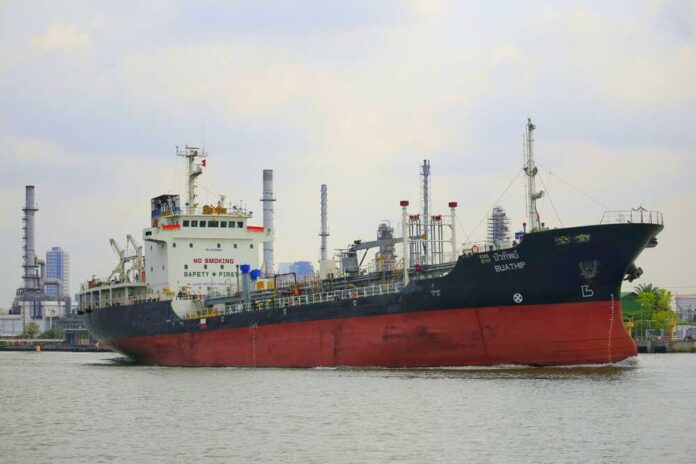
The Strait of Hormuz is not merely a shipping lane; it is a pressure valve for the global oil system, and when a tanker is struck there, the immediate issue is less the damage to one vessel than the signal it sends about who can interrupt commerce, by what means, and with what degree of impunity.
Key Points
- The KIKU was reported hit by an unidentified projectile, but later reporting and official releases shifted the attribution toward a one-way attack drone and Iranian responsibility.
- The strongest evidence in the package supports the core factual claim of a deliberate strike on a commercial tanker, even though the earliest maritime notice stopped short of naming the attacker.
- The disagreement is not whether an attack occurred; it is about how quickly and how confidently the incident was identified as Iranian, and whether the public narrative outran the first evidence.
- The larger significance lies in pattern, not just event: shipping through Hormuz is vulnerable to coercive signaling, and small attacks can trigger outsized military and market responses.
What happened, and why the first reports mattered
The initial maritime picture was cautious. UKMTO described the tanker as having been struck by an “unidentified projectile,” with damage to the bridge and crew reported safe, while other reporting identified the ship as the Panama-flagged KIKU. That distinction matters because maritime notices are designed to report fast-moving risk, not to make forensic judgments. In other words, the first official language told readers that something hit the ship; it did not, by itself, settle who fired, what was fired, or from where.
That uncertainty did not last long. CENTCOM later issued a much more specific account, saying the KIKU was struck by a one-way attack drone at 4:30 a.m. ET while transiting near the Strait of Hormuz, and linking the incident to Iranian action. The package also includes an Iran-linked claim of responsibility in social reporting, which is unusual in maritime incidents because the usual fog of deniability is often the point. Once that later attribution is taken seriously, the central question changes from “what happened?” to “how should the evidence be weighed when the earliest notice was deliberately noncommittal?”
Why the evidence points to a deliberate attack rather than a mystery strike
The strongest reading of the record is that this was not a random maritime mishap but a deliberate strike on a commercial tanker. The bridge damage reported by UKMTO is consistent with a physical impact, and the later CENTCOM account gives the incident a timing, method, and operational context that are much harder to dismiss as ambiguity than the initial “unknown projectile” wording. The fact that crew survived and the vessel remained afloat does not reduce the seriousness of the event; it simply reflects the logic of many tanker attacks, which are calibrated to intimidate, disrupt, and signal, not necessarily to sink a ship.
That logic fits the broader pattern in the research package. The attack came one day after the MV Ever Lovely was struck, which makes the KIKU incident look less like an isolated anomaly and more like a sequence of maritime coercion. The history of the Strait reinforces that reading. During the Tanker War, commercial shipping was targeted not only to inflict damage, but to create uncertainty, raise insurance costs, and force governments to react under time pressure. In that older template, the point of the attack is the reaction it provokes; the vessel is the message carrier.
The real dispute is about timing, attribution, and narrative control
The best counter-argument in the package is not that nothing happened; it is that the first authoritative description did not identify the attacker or weapon. That is a fair evidentiary objection, and it should not be waved away. UKMTO’s initial language was narrower than the later CENTCOM attribution, and the early social posts reflected confusion about mines, drones, and other possible causes. In a fast-breaking maritime incident, those differences matter because they show where certainty begins and where retrospective coherence may be imposed.
Still, the counter-case does not overtake the primary case. It does not produce a forensic rebuttal to CENTCOM’s drone attribution, nor does it disprove the Iran-linked claim of responsibility surfaced in the reporting package. It establishes early uncertainty; it does not establish an alternative explanation. That is a meaningful distinction. Many security incidents begin with incomplete reporting, but incomplete initial reporting is not the same thing as a durable contradiction. The package supports skepticism about the first hour of the story, not skepticism about the eventual classification of the event.
The Strait of Hormuz is shaped by control, not just geography
The deeper issue is the Strait itself. According to the broader context in the package, the waterway carries roughly a quarter of global oil flows and remains contested because control over passage is strategically valuable even when outright closure is difficult. That is why the debate over routes, administration, and safe passage becomes politically loaded. CBS reporting in the package notes that the underlying memorandum governing navigation is vague, with Iran reading its role as “administering” the strait and the United States expecting freer passage than Tehran is prepared to concede. Ambiguity in maritime governance is not a side issue; it is the seam where escalation enters.
This is also why small incidents move markets and militaries at the same time. ABC’s coverage in the package notes oil prices rising above $70 per barrel before easing, while CBS reported a steep fall in tanker traffic after the attacks. Those are not just background indicators; they are the mechanism by which a single strike compounds into a regional event. A tanker attack in Hormuz is never only about one hull and one bridge. It is about premiums, routing decisions, naval posture, and the credibility of every actor claiming to secure the chokepoint.
Moreover, just days ago, the VLCC tanker Kiku was struck by a projectile in the Strait of Hormuz while carrying Qatari oil, inflicting further damage to the Qatari energy blueprint.
— Francesco Sassi (@Frank_Stones) July 6, 2026
What this episode reveals about escalation in maritime chokepoints
The most durable lesson is that attribution and effect are different questions. An incident can be initially unidentified and still later be credibly assigned; a vessel can be damaged without being destroyed; a strike can be tactically limited and strategically large. The Hormuz environment magnifies all three truths at once. Maritime agencies report what they can verify. Militaries publish what they want understood. Governments then act on the version of events that best justifies their next move. By the time the public sees the story, the narrative contest is often already more consequential than the wreckage.
That is why the KIKU matter deserves to be read through the combined lens of maritime security, coercive diplomacy, and energy market vulnerability. The evidence in this package supports a real attack on a commercial tanker, serious bridge damage, and a subsequent attribution to Iranian one-way drone warfare. It also shows the limits of first reports and the ease with which early uncertainty can be translated into competing political stories. In the Strait of Hormuz, those stories are not commentary. They are part of the weapon system.
Sources:
insiderpaper.com, facebook.com, instagram.com, gcaptain.com, thestatesman.com, reddit.com, youtube.com, strausscenter.org