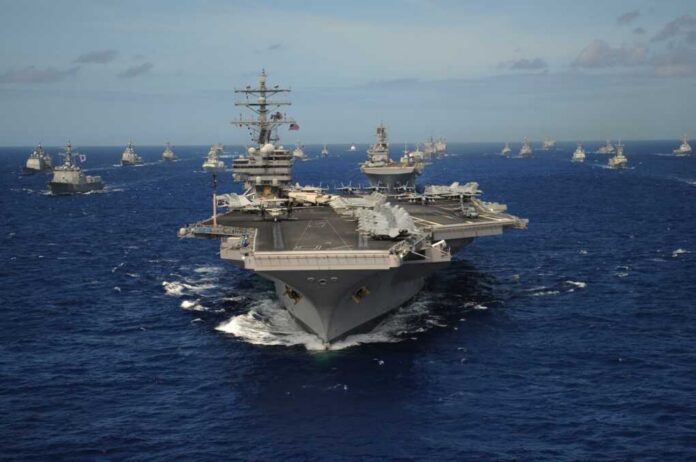
In the summer of 2026, the U.S. campaign of strikes against Iran around the Strait of Hormuz crystallized a long-running reality: when maritime security and great-power credibility collide in that narrow waterway, military force becomes a primary instrument of policy rather than a last resort.
At a Glance
- U.S. Central Command conducted multi-night, large-scale strikes on Iranian military targets, explicitly framed as retaliation for attacks on commercial vessels and a bid to protect shipping.
- Iran insists its actions against the M/V GFS Galaxy were a “warning shot” over an unauthorized route and asserts a right to control and even close the Strait, directly contesting the U.S. narrative of unprovoked aggression.
- The July 2026 strikes hit more than 300 Iranian targets in three nights, aiming to degrade Iran’s ability to threaten civilian mariners—but independent metrics of actual degradation remain sparse.
- This confrontation fits a decades-long pattern: U.S. officials invoke defense of global commerce, Iran invokes sovereignty and toll regimes, and the core factual disputes over specific incidents rarely receive neutral adjudication.
- Domestic and international critics question the strategic coherence of the U.S. approach, Trump’s intelligence base and economic motives, and the risks of sliding into a “forever war” in defense of a chokepoint.
CENTCOM’s Strike Narrative: Retaliation and Maritime Protection
To understand this episode, start with what U.S. Central Command chose to say—and to emphasize—about its own actions. CENTCOM publicly framed the July 11–12, 2026 strikes as direct retaliation for an Iranian attack on the Cyprus-flagged container ship M/V GFS Galaxy transiting the Strait of Hormuz. In multiple statements, the command described the IRGC as the perpetrator, linked the incident to a broader pattern of Iranian aggression against commercial shipping, and explicitly tied President Trump’s authorization to a goal of “holding Iranian forces accountable” and defending civilian mariners.
The scale of the operations was striking by any recent standard. According to CENTCOM and corroborating media reports, U.S. forces hit approximately 140 Iranian military targets on July 11 alone, focusing on missile and drone sites, naval capabilities, ammunition storage, communications networks, and coastal surveillance locations. Over the three nights of strikes that week, the tally exceeded 300 targets across Iran’s coastal and near-coastal military infrastructure, including air-defense systems, radar, and fleets of Islamic Revolutionary Guard Corps small boats. This was not a symbolic warning shot; it was a methodical attempt to disrupt the architecture Iran uses to threaten ships in and near the strait.
CENTCOM cast these strikes as an effort to “degrade Iran’s ability to attack commercial shipping and innocent civilian mariners” and, in separate releases, as “self-defense” measures against Iranian forces attempting to lay mines or launch drones at U.S. assets. The operational logic is straightforward: destroy the sensors, launch platforms, command systems, and small boats that give Iran leverage over vessel movements, and you reduce both the frequency and lethality of attacks on tankers and container ships. At the doctrinal level, this is classic maritime denial—applied not to keep U.S. forces out, but to keep Iran from effectively enforcing its own preferred regime in the Strait.
Iran’s Counter-Story: Warning Shot, Unauthorized Route, Sovereign Control
Iran has not accepted this framing, and its alternative narrative is more than rhetorical. The IRGC Navy has claimed that its action against the M/V GFS Galaxy was a “warning shot” fired because the vessel was using an “unauthorized route,” not a deliberate, hostile strike on a civilian ship. Iranian statements describe the shot as an enforcement measure connected to a toll and routing regime it seeks to impose on foreign shipping, under an Iranian interpretation of its rights in the Strait.
Tehran followed that explanation with an assertion of escalated control: it declared the Strait of Hormuz closed after the incident, framing closure as a consequence of regulatory enforcement rather than unprovoked aggression. In this telling, the central dispute is not over whether Iran attacked a commercial vessel, but whether it was enforcing valid navigational rules and sovereign tolls in the face of U.S.-guided defiance. IRGC officials have gone so far as to accuse the ship of choosing its route “under U.S. guidance,” making the episode less an isolated confrontation and more a proxy contest between Washington and Tehran over who defines lawful transit in the chokepoint.
This counter-story has two structural weaknesses that matter for assessing credibility. First, Iran has not released primary-source navigational data—GPS tracks, charts showing approved corridors, or regulatory texts—to substantiate the “unauthorized route” claim. Second, the physical damage reported aboard the Galaxy, including substantial engine-room damage, fire, and a missing crew member, is difficult to reconcile with the intuitive image of a low-yield warning shot designed merely to signal and deter. Without technical explanation from Iranian authorities, the gap between intent (“warning”) and outcome (severe damage and risk to crew) undermines the plausibility of a purely regulatory action.
What We Know—and Don’t—About the Galaxy Incident
For a reader used to more granular battlefield transparency, the evidentiary picture around the Galaxy incident will feel thin. On the U.S. side, we have named assertions by CENTCOM and the Pentagon that IRGC forces attacked the ship, causing serious damage and prompting the retaliatory strike wave. Media coverage carries interviews, video of fire and damage aboard the vessel, and accounts of crew fleeing in lifeboats, including reports of an Indian crew member missing and ten others rescued. These details make clear something went badly wrong during that transit; they do not, by themselves, prove the chain of command, rules of engagement, or precise weapon used.
On the Iranian side, we have equally named statements describing a warning shot against an off-route vessel, but no radar logs, projectile forensics, or ship-tracking data to show that the Galaxy violated established corridors or that the ammunition employed was calibrated for warning rather than destruction. Neither party has, as of the latest reporting, released an independent incident report from the vessel’s owner or the Cypriot flag state, which would be the obvious neutral source for route compliance, damage assessment, and crew accounts.
This lack of primary, neutral evidence is not unusual in the Strait. Past incidents—drone strikes on cargo ships, mine damage to tankers, attacks on three merchant vessels earlier in July 2026—have likewise generated rapid retaliation, competing narratives, and only partial documentation. In practice, both governments communicate through strategic messaging rather than forensic transparency. The United States foregrounds the pattern of attacks on shipping and its duty to defend global commerce; Iran foregrounds its claim to regulate passage and its resistance to U.S. sanctions and blockades. For outside observers, that means the core factual dispute—was this an unlawful attack or a misjudged enforcement shot?—remains unresolved by evidence in the public record.
Operational Effect: Degrading Capability vs. Changing Behavior
Even if one accepts the U.S. account of the Galaxy incident, an important question remains: did the strikes achieve their strategic purpose? CENTCOM’s metrics are activity-based—number of targets hit, types of systems destroyed—rather than capability-based outcomes such as reduction in attacks, sustained loss of Iranian operational reach, or measurable restoration of shipping confidence.
Independent analysis suggests the answer is mixed. The Institute for the Study of War, tracking the July 7 strikes that destroyed radar, anti-ship missile sites, drone launch facilities, and more than 60 IRGC fast attack craft, judged that similar strikes have shown “no visible effect on Iran’s ability to threaten shipping” and that Iran has proved adept at reconstituting its maritime capabilities during ceasefires. U.S. officials cited by major outlets note that Iran has moved portable radars to replace fixed ones and continues to employ drones and asymmetric tactics to harass vessels.
Meanwhile, ship traffic data show a steep drop in transits through the Strait following the series of retaliatory strikes and attacks on tankers earlier that week. For commercial operators and insurers, the question is less who has the legal right than who can credibly guarantee that a voyage will not end in fire, fines, or seizure. In that sense, both Iranian enforcement actions and U.S. strikes contribute to an environment of risk—even if Washington’s stated intent is defensive.
Strategic Context: Blockades, Toll Regimes, and Narrative Control
The July 2026 confrontation does not exist in isolation; it sits atop an evolving policy architecture built by both sides over years of friction in Hormuz. Trump had already announced, in earlier episodes, that the United States would act as “guardian of the Hormuz Strait,” floated the idea of a 20 percent protection fee on cargo, and reinstated a blockade under which any entity “doing business with Iran” would face restrictions on passage. Iran, for its part, had pursued a memorandum of understanding under which ships would register and pay relatively modest tolls per barrel of oil, then later declared itself no longer bound by that MOU and claimed hundreds of ships had signed up under its regime.[CNN summary]
What looks from Washington like defense of free navigation looks from Tehran like economic coercion and denial of its right to monetize and police a critical waterway. Gulf allies—Saudi Arabia, the UAE, Qatar, Bahrain, Kuwait—often side with the U.S. position, particularly when Iran’s proxies threaten alternative chokepoints like Bab el-Mandeb; but even they must weigh the benefits of American protection against the volatility that comes with U.S.-Iran clashes.[Middle East latest summary]
In this environment, narrative control becomes a strategic asset. Trump emphasizes the destruction of Iranian military assets, the prevention of nuclear advances, and the protection of global energy markets.[USA TODAY summary] Iranian officials emphasize sovereignty, resistance to sanctions, and the illegitimacy of unilateral U.S. tolls or blockades. The Galaxy incident and subsequent strikes matter not only for the damage they cause but for how each side uses them to support its preferred long-term story about who is aggressor and who is guardian in Hormuz.
Pakistan's Ministry of Foreign Affairs has called on the United States and Iran to end hostilities and resume negotiations to resolve their disputes, according to Pakistani media citing Interfax, Report informs.
Tahir Andrabi, a spokesperson for the Pakistani Foreign Ministry,… pic.twitter.com/Z7xQtbXYW1
— Report News Agency (@reportaznews) July 16, 2026
Domestic Debate, Intelligence Questions, and the “Forever War” Risk
Within the United States, this campaign has generated an intense debate that will shape how future episodes are judged. Critics point to Trump’s public threats against Iranian power plants and bridges, arguing that blending protection of shipping with possible attacks on dual-use or civilian infrastructure erodes the moral clarity of the mission and risks significant collateral damage.[CNN summary; 13WHAM/LiveNOW clips] They question the reliance on Israeli intelligence, which some commentators describe as “flawed,” and worry that economic metrics—oil at $78 per barrel, gas above $4 per gallon—are overly driving military choices.[CNN summary]
There is also sustained concern about process. The strikes were directed by the president and reported to Congress, but panelists and analysts highlight a perceived lack of robust congressional oversight and a coherent exit strategy.[CNN summary] A war justified in terms of defending commerce can, if open-ended, begin to look like a structural commitment to police a chokepoint indefinitely, with limited leverage over the behavior of the other coastal state. That is what people mean when they describe a “forever war” in the Strait: not continuous high-intensity combat, but a cycle of incidents, retaliations, and partial reconstructions that absorbs resources and attention without resolving the underlying dispute.
From a strategic perspective, this is the heart of the problem. The evidence strongly supports the claim that Iran, and specifically the IRGC, has repeatedly threatened or attacked commercial vessels in Hormuz. It also supports the claim that U.S. strikes have inflicted substantial damage on Iran’s conventional maritime and air-defense capabilities. What is far less clear is whether those strikes, calibrated around specific incidents like the Galaxy attack, are capable of changing Iran’s long-term calculus about controlling the Strait, imposing tolls, or using harassment as a tool of statecraft. Without a broader diplomatic framework, each retaliatory wave risks becoming another turn of a wheel whose central axis remains untouched.
Sources:
facebook.com, straitstimes.com, usatoday.com, stripes.com, khaleejtimes.com, cbsnews.com, townhall.com, bbs.wenxuecity.com, nytimes.com, foxnews.com, centcom.mil, english.mathrubhumi.com, gmanetwork.com, instagram.com, youtube.com, reuters.com, npr.org, armyrecognition.com, pbs.org, bbc.com, theguardian.com